Gary Rivlin - Broke, USA
Здесь есть возможность читать онлайн «Gary Rivlin - Broke, USA» весь текст электронной книги совершенно бесплатно (целиком полную версию без сокращений). В некоторых случаях можно слушать аудио, скачать через торрент в формате fb2 и присутствует краткое содержание. Город: New York, Год выпуска: 2010, ISBN: 2010, Издательство: HarperCollins Publishers Inc., Жанр: Старинная литература, на английском языке. Описание произведения, (предисловие) а так же отзывы посетителей доступны на портале библиотеки ЛибКат.
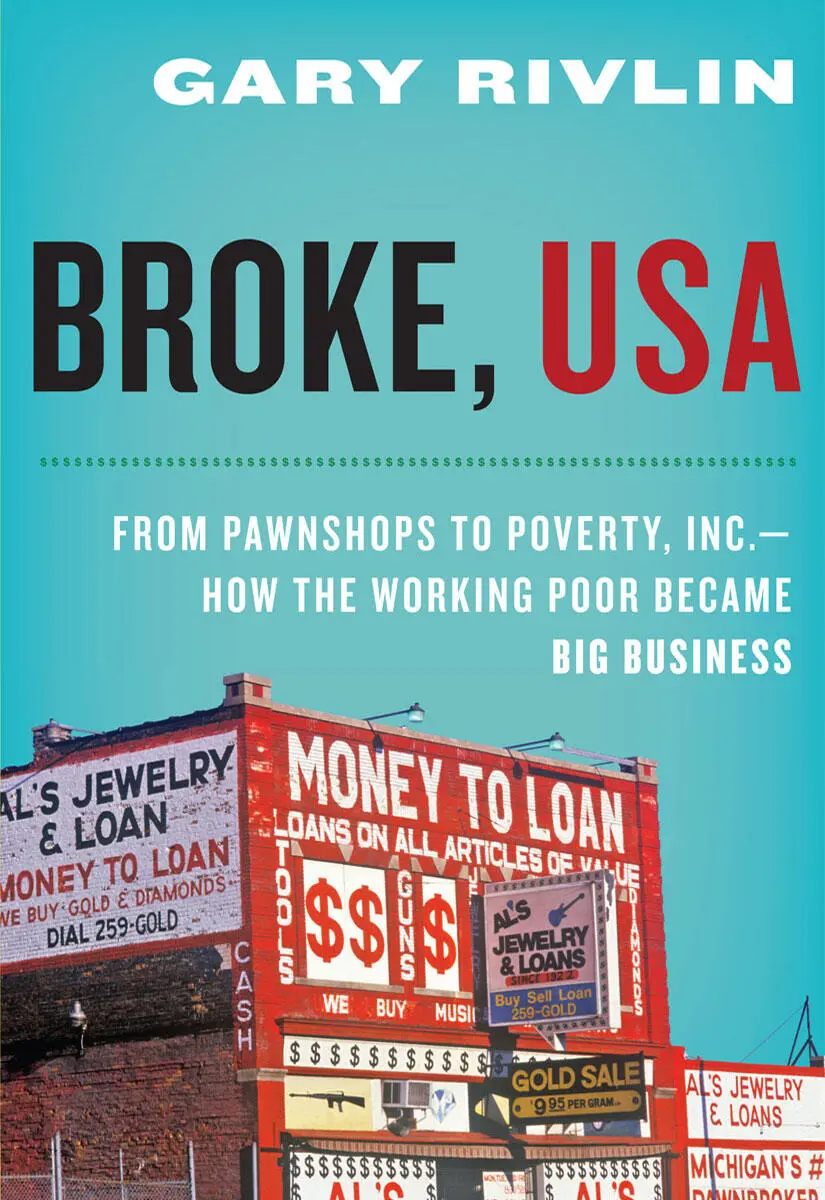
- Название:Broke, USA
- Автор:
- Издательство:HarperCollins Publishers Inc.
- Жанр:
- Год:2010
- Город:New York
- ISBN:978-0-06-199794-5
- Рейтинг книги:3 / 5. Голосов: 1
-
Избранное:Добавить в избранное
- Отзывы:
-
Ваша оценка:
Broke, USA: краткое содержание, описание и аннотация
Предлагаем к чтению аннотацию, описание, краткое содержание или предисловие (зависит от того, что написал сам автор книги «Broke, USA»). Если вы не нашли необходимую информацию о книге — напишите в комментариях, мы постараемся отыскать её.
Broke, USA — читать онлайн бесплатно полную книгу (весь текст) целиком
Ниже представлен текст книги, разбитый по страницам. Система сохранения места последней прочитанной страницы, позволяет с удобством читать онлайн бесплатно книгу «Broke, USA», без необходимости каждый раз заново искать на чём Вы остановились. Поставьте закладку, и сможете в любой момент перейти на страницу, на которой закончили чтение.
Интервал:
Закладка:
Inside Check ’n Go, Browning’s direct supervisors didn’t always appreciate her brassy demeanor. “Chris has a management style that is extremely hard to supervise,” the regional manager assigned her area wrote of her early in her tenure. “She constantly berates her direct superiors and shows little confidence in corporate personnel. Chris has a tendency to feel everyone is against her.” But there was no denying she was very good at what she did. A well-run store in a choice location back then might bring in $150,000 or $170,000 in fees each year; a strong store maybe $200,000. Browning, managing a store in a remote outpost two hours from the nearest big city, generated $247,000 in fees her first full year on the job and $251,000 in her second. “I wish I had eight of Chris,” the same manager wrote, running the eight stores under his control.
“As long as she continues to put up the numbers,” he added, “I will continue to work towards a better understanding between us.”
Browning is a short, stout woman who lives in a small ranch house surrounded by soybean and wheat fields. She and her husband chose a home in so remote a location thirty miles from Mansfield, she said in a scratchy smoker’s voice, because they wanted to insulate the kids from “a town gone to hell in a hand basket.” She was a few months shy of her sixty-second birthday when we met in the fall of 2008. She greeted me at the door wearing a red Ohio State Buckeyes sweatshirt and jeans. She wore her hair in a short gray bob and when she smiled I noticed she was missing a front tooth. Within minutes of my entering her home, she was practically yelling. It was more than a year since she had been pushed out but she was still smarting from the way she had been treated.
“They fired me because eventually their policy became, if a body walks in the door, you loan ’em money, and I wouldn’t do that,” Browning said. That’s no doubt too facile an explanation, but sitting behind her counter every day, staring out a plate-glass window onto a street populated by the Big Lots, Subways, and Wendy’s that litter the edges of any city, Browning had a perfect perch for watching the rapid rise of a new industry and its impact on the people of the community. Increasingly she found she didn’t like what she was seeing. And as her attitude toward payday soured and the competition grew more heated, Check ’n Go decided it had little use for a store manager with the fighting spirit of a longshoreman posting only average numbers.
The Ohio legislature said no the first time they were asked to legalize payday lending within the state’s borders. But then the Ohio House of Representatives switched from Democratic to Republican control in 1994 and the enabling legislation, championed by the state’s check cashers’ association, passed at the end of 1995, without anyone really noticing. “It really flew below the radar,” said Bob Lambert, who was a lobbyist for the state’s pawnbrokers, a group already in the small-denomination loan business. As Lambert remembered it, he was the only person to testify against the measure.
Around one year later Chris Browning spotted the classified ad Check ’n Go ran in the local paper for a branch manager of the new store they would be opening in town. Branch manager: She liked the sound of that title. The starting salary was lousy, only $21,000 a year, and the benefits mediocre (three vacation days that first year), but they also told her she could earn as much as $6,000 more a year in bonuses. She didn’t know what a payday loan might be when she first saw the ad but once it was explained to her it made immediate sense. Her husband had worked as a welder who more than once had been laid off. In time, Browning confessed, they would use a payday loan to help make ends meet.
“There was a need for something like this for working people around here,” Browning said. “The credit unions weren’t licensed to make small, short-term loans. The smaller finance companies were closing up and getting out of Dodge.”
Browning straightened her back proudly and peacocked a bit while talking about her early days with Check ’n Go, when she was something of a star inside the company. A typical store could take six or more months to break even but hers was profitable after just two. She told me about the calls from David Davis to tell her what a good job she was doing and to ask her for ideas. She helped develop some of the early training materials the company used and they were always imposing on her to help them train a new manager for some other store. She kept her bad debt low and her numbers continued to grow; her employee reviews show that her hard work was paying off in a robust bonus every quarter.
She was the dutiful employee in those first years she worked for Check ’n Go. She left flyers for the store at all the local Laundromats and car repair shops and though she hated doing it, she also tried dropping them off at medical offices around town as well. “Doctors were real touchy about brochures,” she said, but at least a few succumbed. “You’d get a new kid on the block,” Browning said. “His receivables are up; he wants his money for treating John Doe’s son”—and soon that doctor’s office starts sending patients and their families to her store. “If somebody couldn’t pay the deductible or the co-pay or whatever, the clerk says, ‘Here’s a brochure, these people might be willing to help you out.’”
More payday outlets opened up in Mansfield. Where there had been five stores in town in 1999, there would be twelve by 2001. The battle was no longer a race to see who could secure a prime location but a war of dueling rewards programs and rival marketing campaigns. By 2000, she was no longer clearing $250,000 in fees per year, but revenue was in the $210,000 to $220,000 range through 2003, and it edged back up to $235,000 in 2004, by which time there were twenty payday loan stores in town. Maybe that was the truly shocking thing about payday and also the tragedy: Rivals could keep opening new stores but revenues at the existing establishments would remain fairly steady.
Ultimately, this modest-sized working class enclave would become home to twenty-seven shops offering payday advances. It fell on people like Browning to keep people coming in the door. And as the pressures increased to collect more revenues from loyal clients and as corporate hounded her and the other managers to find new customers to replace the old ones whom they would invariably lose, so did Browning’s cynicism about the service she was supposedly offering. It didn’t help that whereas once hers had been the only store in her stretch of Mansfield, by 2006 three competitors had opened outlets only steps from her own.
There was something claustrophobic about those hours I spent in a home overstuffed with Beanie Babies and other collectables. There were so many lighthouses scattered about Browning’s home—lighthouses of wood, lighthouses carved out of stone, lighthouse clocks, lighthouse paintings, a lighthouse thermometer—that I couldn’t imagine a safer place to navigate a ship at night. The breakfast nook where we sat was piled high with bills, magazines, and other daily detritus; a shelf stuffed with assorted dolls loomed. But the good news was that this same tendency to save spilled over to her job. She had detailed records showing how her store performed month by month for her entire tenure at Check ’n Go, including a running tally of the proportion of her loans falling into default each month and the number of customers she was serving. She kept copies of her employee reviews and copies of emails and other missives from corporate. I might have suspected hyperbole if she didn’t have a copy of the actual Check ’n Go directive informing store managers that they were to loan “to anyone getting social security who had at least one dime to their name.”
Читать дальшеИнтервал:
Закладка:
Похожие книги на «Broke, USA»
Представляем Вашему вниманию похожие книги на «Broke, USA» списком для выбора. Мы отобрали схожую по названию и смыслу литературу в надежде предоставить читателям больше вариантов отыскать новые, интересные, ещё непрочитанные произведения.









Обсуждение, отзывы о книге «Broke, USA» и просто собственные мнения читателей. Оставьте ваши комментарии, напишите, что Вы думаете о произведении, его смысле или главных героях. Укажите что конкретно понравилось, а что нет, и почему Вы так считаете.