Gary Rivlin - Broke, USA
Здесь есть возможность читать онлайн «Gary Rivlin - Broke, USA» весь текст электронной книги совершенно бесплатно (целиком полную версию без сокращений). В некоторых случаях можно слушать аудио, скачать через торрент в формате fb2 и присутствует краткое содержание. Город: New York, Год выпуска: 2010, ISBN: 2010, Издательство: HarperCollins Publishers Inc., Жанр: Старинная литература, на английском языке. Описание произведения, (предисловие) а так же отзывы посетителей доступны на портале библиотеки ЛибКат.
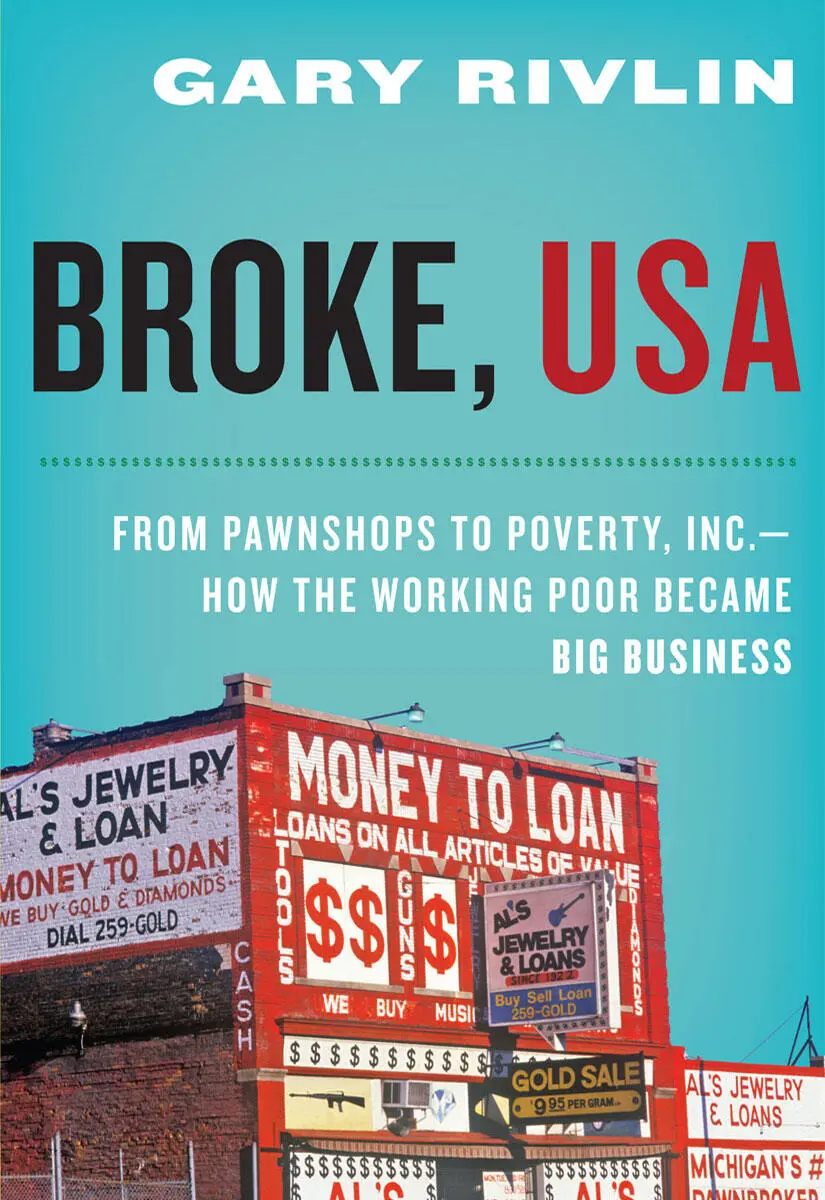
- Название:Broke, USA
- Автор:
- Издательство:HarperCollins Publishers Inc.
- Жанр:
- Год:2010
- Город:New York
- ISBN:978-0-06-199794-5
- Рейтинг книги:3 / 5. Голосов: 1
-
Избранное:Добавить в избранное
- Отзывы:
-
Ваша оценка:
Broke, USA: краткое содержание, описание и аннотация
Предлагаем к чтению аннотацию, описание, краткое содержание или предисловие (зависит от того, что написал сам автор книги «Broke, USA»). Если вы не нашли необходимую информацию о книге — напишите в комментариях, мы постараемся отыскать её.
Broke, USA — читать онлайн бесплатно полную книгу (весь текст) целиком
Ниже представлен текст книги, разбитый по страницам. Система сохранения места последней прочитанной страницы, позволяет с удобством читать онлайн бесплатно книгу «Broke, USA», без необходимости каждый раз заново искать на чём Вы остановились. Поставьте закладку, и сможете в любой момент перейти на страницу, на которой закончили чтение.
Интервал:
Закладка:
Another thing they don’t appreciate, Ogbazion said: He’s more than just an emergency banker to the working poor. As he views it, he’s a positive force for economic development in communities desperate for commerce. Instant Tax provides part-time jobs for six thousand people. He occupies storefronts that would otherwise be dark. “Look at where our stores are,” he said. “There’s no Gap. There’s no Nordstroms. We employ people from the neighborhood. We’re paying rents in those neighborhoods.
“People want to close us down,” he continued, “but that would mean more boarded-up businesses and more boarded-up homes.” When I mentioned that I had peeked into his store across the street, Ogbazion flinched. The place, he said, was in dire need of an overhaul. He tapped on his keyboard and then swiveled around his computer screen. He wanted me to see pictures of stores that had recently had a makeover. There were shops with wood floors and ficus trees and handsome hardwood desks and stylish couches—the sort of environment you’d happily visit again next year if necessary.
“Basically our deal is we tell our customers we know a bank that is willing to loan them money on their refund when no one else will do it,” he said. “And if we can make them feel a little better about the experience, then I think that’s a good thing.” Ogbazion said he hoped to add one hundred new locations during 2009. Hard economic times would make it more difficult for potential franchisees to raise the start-up capital but low-cost storefronts, especially in the hard-pressed communities in which his industry flourishes, would no doubt be plentiful, and people desperate for money only increases the demand for rapid refunds.
Ogbazion initially deflected questions about the interest rates the banks that underwrite his refund anticipation loans charge his customers. “What’s the fair rate to charge?” he asked me. “We don’t really care what that is. We get our tax preparation fees and we get a little more if they want an instant refund.” When pressed, he defended his partners. “They’ve burned the banks,” he said of his customers. “They’ve bounced too many checks. They’ve mismanaged their finances. Their credit is poor.” Still, the rates the banks charged seemed excessive given the risks. People owe money for back taxes or for child support but the banks tell Ogbazion that they default on maybe one in every one hundred customers. Yet Wu and Fox found that banks charge an APR between 83 percent and 194 percent for a RAL. JPMorgan Chase would boast that it had lowered its RAL rate, but, including fees, the APR on a RAL still worked out to more than 60 percent on the average sized return.
Ogbazion didn’t know the names Wu and Fox before I sat down in his office, but he wants to argue with them. “Sometimes when I hear people like that putting the industry down, it really bugs me,” he said. “It’s not like me or any of these franchisees would be the people who would climb through the ladder at a Big Four firm even if we were to become CPAs. You go with the hand that you’re dealt and you make the best of it.” Looking out the window of his fourteenth-floor office, he asked, “What else was I supposed to do?”
Ten
Same Old Faces
An agitated Jared Davis paced the top floor of the prosperous looking offices he and his brother built for themselves a few years back on a glitzy edge of Cincinnati. The 1,300 or so Check ’n Go payday loan stores they operated then, at the end of 2008, may share strip mall space with low-rent cousins such as Rent-A-Center and Jackson Hewitt but the bosses work down the street from a Nordstrom, a Restoration Hardware, and other establishments that suggest that the poverty industry is far away. With slate floors and the sleek modern furniture in the conference room where we met, the Davis brothers seemed to have spared little expense in the building of what rival Allan Jones described as a “fancy monument.”
Jared Davis is a large man standing around six feet, five inches tall with a pear-shaped body and a big lump of flesh under his chin. The day I visited he was wearing a salmon-colored dress shirt open at least one button beyond modesty. His hair was unkempt and his face was covered with stubble. A “big old goofy-looking dude who always needs a shave” is the way Allan Jones described him. Jones then blinked one of his eyes rapidly as if sending a Morse code message. By that time I had met Davis and knew Jones was doing a crass imitation of his competitor. During our time together Davis was a bundle of movement. He pulled on the leaves of a nearby plant; he kept jumping out of his seat as if the point he was making got him so worked up that he physically needed to move. But mainly what one couldn’t help notice was the uncontrollable tic that caused one of his eyes to blink spastically. Davis later referred to it as his Tourette’s. The more voluble he grew, the more vigorously he blinked.
I was in Cincinnati primarily to talk about the early days of payday lending and a specific store that Check ’n Go has operated in Mansfield, Ohio, since 1997. Davis, however, was spoiling for an argument with all those who question the way he and his brother make their money. In the old days, Davis said, the town druggist or Walt over at the general store would let you run a tab when money was tight. “What used to happen, if you needed eggs or milk, the basics, the local grocers let you buy it on credit,” Davis said, pacing back and forth. Try that today at your local Kroger, he said, throwing his hands into the air, “and they’ll throw you out of the store.” That’s where the payday lenders come in. But try explaining this to a media hopelessly biased against you and with frauds like Martin Eakes donning a cape as if Supermen. “Anyone with half a brain,” he said, “can see that the reason Self-Help and Eakes are against us is because they’re our direct competitor.”
Eventually Davis began talking about the early days of payday when the country seemed one giant opportunity to explore and conquer. He lost his share of races, like the time he thought he had found a choice storefront in the center of one modest-sized town in Kentucky and then learned from the real estate agent on the property that Check Into Cash had gotten there a few hours before him. But he lucked out in Mans field, a small city of fifty thousand in an otherwise rural stretch of Ohio that had no doubt been a happier place before its largest employer, Westinghouse, shut its plant, as did Tappan and a depressingly long list of other manufacturers.
“You wanted to be the first or second chain to discover some new town because once those two or three good spaces were taken, the game was over,” Davis told me. Billy Webster had beaten them to Mansfield but the Davis brothers were second and they leased the perfect spot, a storefront just off the main highway into town. There, next to a Mr. Hero sandwich shop, they installed a woman named Chris Browning to open and manage their fifth store in Ohio and around the seventieth overall. Browning, who had spent the previous fourteen years working collections for various car dealers around town, was a minor payday miracle. The turnover rate among store managers at the big chains exceeds 50 percent a year yet Browning lasted for more than ten years before being fired in the middle of 2007.
Chris Browning knows she can be difficult. But what are you going to do when you’re surrounded by idiots and fools? “To me what’s right is right, what’s wrong is wrong, and why mince words?” she told me in a voice just a little too loud. “I’m pretty straightforward, bold, and vocal. I tell it like it is.”
Читать дальшеИнтервал:
Закладка:
Похожие книги на «Broke, USA»
Представляем Вашему вниманию похожие книги на «Broke, USA» списком для выбора. Мы отобрали схожую по названию и смыслу литературу в надежде предоставить читателям больше вариантов отыскать новые, интересные, ещё непрочитанные произведения.








Обсуждение, отзывы о книге «Broke, USA» и просто собственные мнения читателей. Оставьте ваши комментарии, напишите, что Вы думаете о произведении, его смысле или главных героях. Укажите что конкретно понравилось, а что нет, и почему Вы так считаете.