Gary Rivlin - Broke, USA
Здесь есть возможность читать онлайн «Gary Rivlin - Broke, USA» весь текст электронной книги совершенно бесплатно (целиком полную версию без сокращений). В некоторых случаях можно слушать аудио, скачать через торрент в формате fb2 и присутствует краткое содержание. Город: New York, Год выпуска: 2010, ISBN: 2010, Издательство: HarperCollins Publishers Inc., Жанр: Старинная литература, на английском языке. Описание произведения, (предисловие) а так же отзывы посетителей доступны на портале библиотеки ЛибКат.
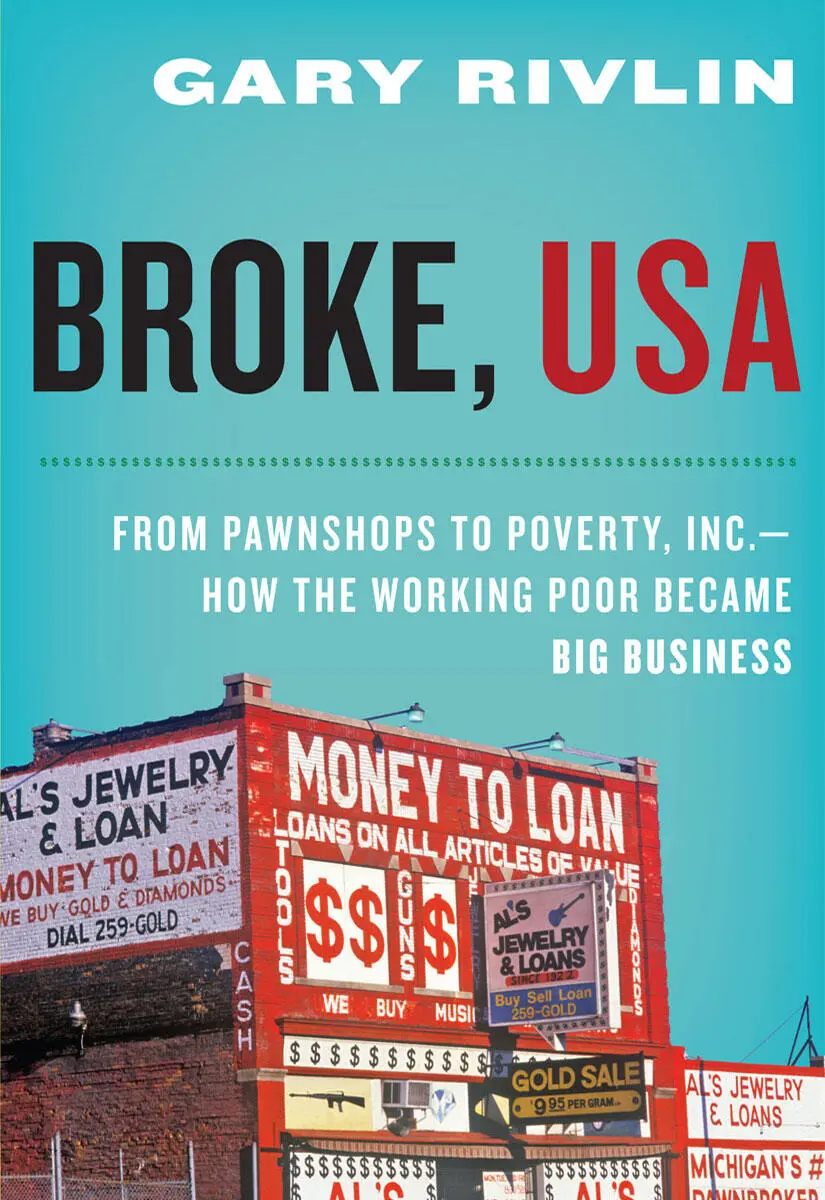
- Название:Broke, USA
- Автор:
- Издательство:HarperCollins Publishers Inc.
- Жанр:
- Год:2010
- Город:New York
- ISBN:978-0-06-199794-5
- Рейтинг книги:3 / 5. Голосов: 1
-
Избранное:Добавить в избранное
- Отзывы:
-
Ваша оценка:
Broke, USA: краткое содержание, описание и аннотация
Предлагаем к чтению аннотацию, описание, краткое содержание или предисловие (зависит от того, что написал сам автор книги «Broke, USA»). Если вы не нашли необходимую информацию о книге — напишите в комментариях, мы постараемся отыскать её.
Broke, USA — читать онлайн бесплатно полную книгу (весь текст) целиком
Ниже представлен текст книги, разбитый по страницам. Система сохранения места последней прочитанной страницы, позволяет с удобством читать онлайн бесплатно книгу «Broke, USA», без необходимости каждый раз заново искать на чём Вы остановились. Поставьте закладку, и сможете в любой момент перейти на страницу, на которой закончили чтение.
Интервал:
Закладка:
The entrepreneurial bug bit when Ogbazion was around sixteen years old and working in the Procter & Gamble mailroom. His inspiration was the articles he was reading in Fortune and Forbes profiling the young titans of technology making mountains of money at an improbably young age. He read about Michael Dell, who had started his computer company in his dorm room, and Bill Gates, who was still at Harvard when he founded Microsoft. “I became obsessed with this idea that I needed to start my business by nineteen or it’d be too late,” he said. He was the president of his class in high school and graduated as valedictorian. But unlike Dell or Gates, Ogbazion didn’t have a passion for computers or for anything really beyond a desire to become rich. “I knew I wanted to start a business,” he said. “I just didn’t know what kind of business.”
Ogbazion was a senior in high school when he received a letter from H&R Block inviting him to have his taxes done at no charge. He drove to an office in a strip mall near his parents’ home, where he was shocked to discover he needed to wait to see a tax preparer. He was still thinking about the packed waiting area days later when a friend mentioned that he too had gone to Block, where he used a nifty new product called the rapid refund. “He tells me, ‘You pay a couple of hundred bucks but you get your money in a few days,’” Ogbazion said. “That’s when the lightbulb went on. I understood why H&R Block was so packed.” H&R Block’s offer of free tax services, he realized, was nothing but a clever marketing ploy to sell RALs to people his age. Thinking back, he realized that the woman who had prepared his taxes had tried to sell him one but Ogbazion was that rare high-schooler who actually owed money to the U.S. Treasury. That fall he would enter the freshman class at the University of Cincinnati, living at home and commuting to school each day. He decided to also find an office in a central location large enough to house a tax preparation business.
Ogbazion still has the fax from 1992 that Bank One sent to a Mail Boxes, Etc. near his parents’ home, laying out the steps he would need to take to offer customers a refund anticipation loan underwritten by the bank. But he got cold feet that first year and almost postponed his plunge the next year as well. That’s when he wrote in his diary that he was depressed. “Bill Gates and Michael Dell had started a company at nineteen and I hadn’t,” he explained. It never seemed to dawn on him to do any research into the pros and cons of the business, as if starting a business required nothing more than nerve. He was probably right.
Ogbazion tells the story of finding his courage, in a hushed voice, as if sharing a moment of divine fortune. “I can still picture it,” he said. “I’m driving along and just happened to look to my left. I think about that sometimes. What if I hadn’t happened to look to the left at that moment?” He was driving to school and he noticed a FOR RENT sign in the window of the very office where he had gone to have his taxes done in high school. The landlord told him H&R Block had moved to a larger office a few miles away and it would cost $3,000 to rent the office for six months.
At that point Ogbazion had saved around $10,000. He had a Sears card and a Discover card that combined carried a cash limit of $5,000. He secured another $5,000 through a low-interest student loan. He re-contacted Bank One, where somebody told him he needed to select a software maker from the vendor list the bank provided. He randomly chose a Columbia, South Carolina, company and spoke to someone there. “They tell me, ‘You don’t need to know anything about the tax business; the software will walk you through everything; you hook up with Bank One and, congratulations, you’re in the RAL business,’” Ogbazion said. But he was also risking everything on this one idea. They offered a two-day tax preparation workshop and Ogbazion elected to pay for a trip to South Carolina.
Ogbazion gets dreamy as he describes those first few months he was in the tax refund business. He was carrying a full load at school and overseeing a staff of five or six he was paying $8 an hour apiece. He was a twenty-year-old African-American running his own business, but the only weirdness he felt was the age gap between him and his employees, one of whom was a retiree in his sixties. “The age thing was something I was much more self-conscious of than race,” he said. He named his new business Instant Refund Tax Service.
Ogbazion doubts he would have survived that first year if he hadn’t had the good fortune to take the place of an established giant like H&R Block. He stretched a cheap sign inside the store’s plate-glass window and distributed some door hangers around the neighborhood but other than that he did nothing to advertise. “I was blessed that six hundred people came back to that spot looking for H&R Block,” he said. “If I had located anywhere else I would have been out of business my first year.” He was fortunate as well that the great majority of his customers also opted for a quick payout that put extra money in his pocket.
Making it through that first year seems to have emboldened Ogbazion. He knew he would have to advertise and recognized that telling people about his one store would cost nearly as much as telling people about four stores. Ogbazion didn’t bother approaching any banks. He knew that he would need to find an alternative funding source.
Once again Ogbazion was fortunate. The credit card industry was also undergoing sweeping changes in the second half of the 1980s, among them the spreading popularity of the subprime credit card. There was no single creator of the subprime credit card (which could be said to have been invented the first time a bank decided to charge some of its customers 19 percent interest instead of 12 percent) but one early innovator and its most avid early champion was Andrew Kahr. An eccentric man with long, stringy hair and a generally antisocial personality, Kahr had earned his Ph.D. from the Massachusetts Institute of Technology when he was twenty years old and spent the next several decades striving to strike it rich. Earlier in his career he had even done some work for Associates, where he created a credit card product aimed at those with a taste for debt. This was in the late 1970s, when around half the people holding a credit card typically carried a debt. That figure was closer to 90 percent for those using Kahr’s Associates card.
Most of Kahr’s biggest breakthroughs, though, came once he ventured off on his own and started a company called First Deposit (later renamed Providian Financial). Making big money in the credit card business, he understood, meant attracting a customer who was at once comfortable owing a lot of money yet loath to default on that debt. Providian was the first to send out mailers with teaser rates so low that a large portion of those already deep in debt were likely to transfer that debt to them. These customers, Kahr’s research showed, weren’t price sensitive but instead preoccupied by the minimum payment they needed to make each month. Providian could get away with charging an APR of 23 percent rather than 18 percent because the company more than halved its minimum payment, from 5 percent of the total owed to 2 percent. Under the Providian model, the credit card was little more than a small loan device—and if Kahr’s ideal targets weren’t the world’s safest customers, they were certainly lucrative. In time, others would follow Providian into these treacherous but financially rewarding waters, including now well-known brands such as Capital One and Advanta (bought by JPMorgan Chase in 2001). Ultimately many of the big banks would brave these same frontiers. It was no wonder. Publications such as American Banker reported that subprime credit card lenders were posting profit rates two or three times greater than those booked by more risk-averse lenders.
Читать дальшеИнтервал:
Закладка:
Похожие книги на «Broke, USA»
Представляем Вашему вниманию похожие книги на «Broke, USA» списком для выбора. Мы отобрали схожую по названию и смыслу литературу в надежде предоставить читателям больше вариантов отыскать новые, интересные, ещё непрочитанные произведения.









Обсуждение, отзывы о книге «Broke, USA» и просто собственные мнения читателей. Оставьте ваши комментарии, напишите, что Вы думаете о произведении, его смысле или главных героях. Укажите что конкретно понравилось, а что нет, и почему Вы так считаете.