Gary Rivlin - Broke, USA
Здесь есть возможность читать онлайн «Gary Rivlin - Broke, USA» весь текст электронной книги совершенно бесплатно (целиком полную версию без сокращений). В некоторых случаях можно слушать аудио, скачать через торрент в формате fb2 и присутствует краткое содержание. Город: New York, Год выпуска: 2010, ISBN: 2010, Издательство: HarperCollins Publishers Inc., Жанр: Старинная литература, на английском языке. Описание произведения, (предисловие) а так же отзывы посетителей доступны на портале библиотеки ЛибКат.
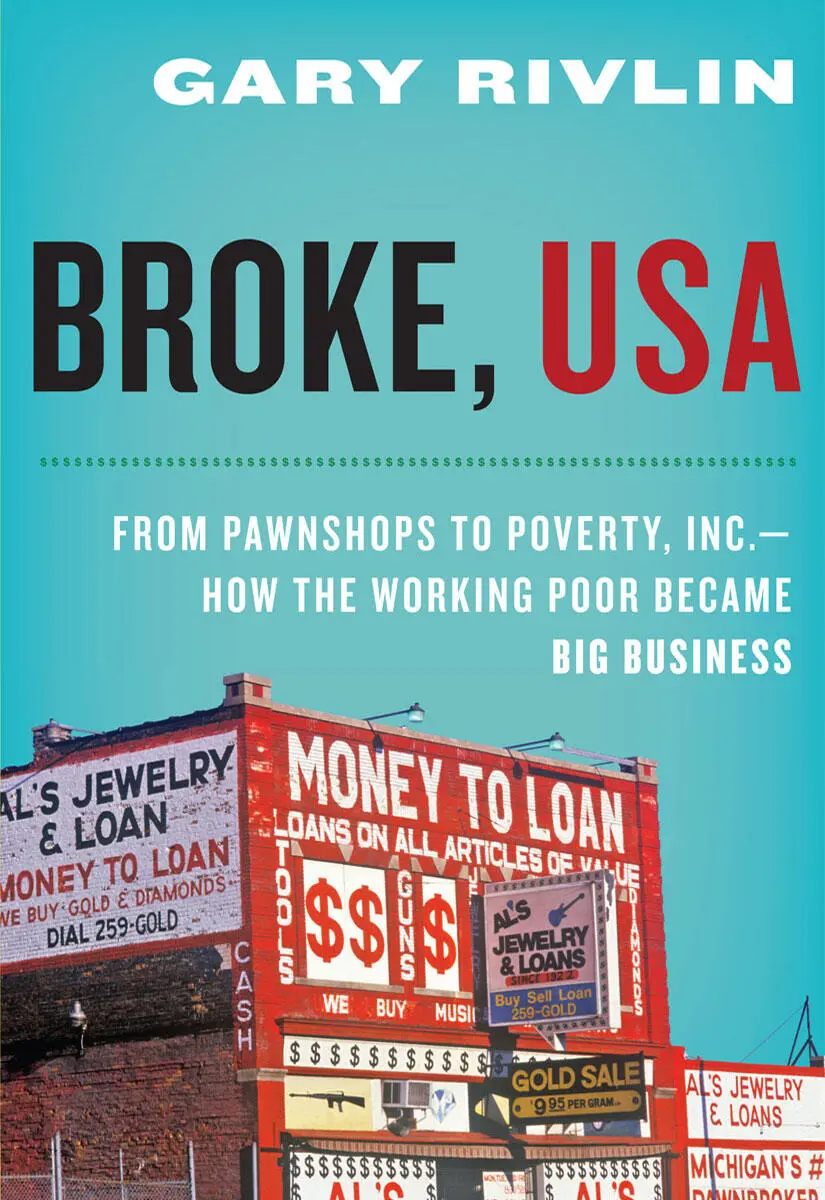
- Название:Broke, USA
- Автор:
- Издательство:HarperCollins Publishers Inc.
- Жанр:
- Год:2010
- Город:New York
- ISBN:978-0-06-199794-5
- Рейтинг книги:3 / 5. Голосов: 1
-
Избранное:Добавить в избранное
- Отзывы:
-
Ваша оценка:
Broke, USA: краткое содержание, описание и аннотация
Предлагаем к чтению аннотацию, описание, краткое содержание или предисловие (зависит от того, что написал сам автор книги «Broke, USA»). Если вы не нашли необходимую информацию о книге — напишите в комментариях, мы постараемся отыскать её.
Broke, USA — читать онлайн бесплатно полную книгу (весь текст) целиком
Ниже представлен текст книги, разбитый по страницам. Система сохранения места последней прочитанной страницы, позволяет с удобством читать онлайн бесплатно книгу «Broke, USA», без необходимости каждый раз заново искать на чём Вы остановились. Поставьте закладку, и сможете в любой момент перейти на страницу, на которой закончили чтение.
Интервал:
Закладка:
Allan Jones describes himself as a born entrepreneur. So eager was he to learn the collections business while he was still a teenager that, after his freshman year, he secured a summer job at another collection agency—and sat in his car for three hours on his first day of work, waiting for the office to open. Jones, however, had nothing on Ogbazion, who held two or three jobs through high school. He hawked snacks as a vendor at Riverfront Stadium, where the Reds and Bengals played, and at different times worked the mailroom at two of Cincinnati’s larger corporations, CIGNA Insurance and Procter & Gamble. When he was nineteen and still a freshman in college, he wrote in his diary that he felt depressed because he still hadn’t started his own business.
“I didn’t drink a single beer in college,” Ogbazion told me when we met in Dayton. “I was that focused.”
I met Ogbazion, whom everyone calls Fez, shortly after the check cashers’ convention in Las Vegas. The roster of attendees at the convention—we all received copies in our goodie bags—included a woman representing a Dayton-based company called Instant Tax Service. That sounded promising. H&R Block, Jackson Hewitt, and Liberty Tax Service were the Big Three in next-day tax refunds, a product that generates more than $1 billion in annual revenues, but I thought it might be interesting to talk with a smaller player seeking to strike it rich in this corner of the poverty economy. I wrote her a note proposing that we meet the next time I was in Dayton and she suggested I talk with Ogbazion, whom she described as the company’s founder and chief executive. Their offices, she said, were downtown, at the corner of Third and Main.
That made sense. Third and Main is a major transfer point on the Dayton city bus system—an ideal locale for a business catering to the working poor. Spotting the Instant Tax Service sign, I peeked inside. It was a run-down storefront with walls pleading for a new coat of paint. Founder and CEO—the dual titles seemed a bit much. I imagined myself sitting in a banged-up folding chair while Ogbazion sat behind a battered metal desk like one you might find in a county welfare department or a homicide detectives bullpen while outside a large plate-glass window half of Dayton milled about waiting for the 41 crosstown bus.
I began to suspect I was wrong when I found a human-interest article in the Dayton Daily News about this émigré from East Africa who had founded one of the city’s more successful new businesses. By the time the article appeared in 2004, Ogbazion was running more than one hundred Instant Tax Service storefronts in ten states and crowing about opening a thousand more. The woman from my initial email exchange hadn’t flown to Las Vegas to learn more about the business. She was there to woo potential partners interested in opening a franchise. Their come-on seemed particularly effective: “Work just seventeen weeks a year! No prior tax experience necessary! Low start-up costs! Franchise fee deferment!”
It wasn’t until the day I was scheduled to meet with Ogbazion, though, that I looked more closely at the address. It was located across the street from the Instant Tax Service storefront I had perused a few days earlier, in one of the town’s marquee buildings, a brown granite structure grandly dubbed One Dayton Centre. I took an elevator to the fourteenth floor. The waiting room was richly appointed, with blond wood paneling and handsome wingback chairs. When I was ushered in to see Ogbazion, he gave me a choice between a leather couch or the seat opposite him at the handsome wood desk where he worked.
Instant Tax Service’s archetypal customer, Ogbazion said, is the assistant manager at a McDonald’s earning $19,000 a year. Yet clearly business was booming. There are well-regarded law firms in town that can’t afford the rents at One Dayton Centre but Ogbazion leased the entire fourteenth floor and much of the fifteenth. At thirty-five, he was running a business with 1,200 stores and kiosks scattered across thirty-nine states, ranking it just behind the Big Three in a listing of the largest tax preparation firms in the country. It was an enterprise he built using another element of the fringe economy: the subprime credit card.
In Silicon Valley, young upstarts generally innovate and the big boys play catch-up. The same can’t be said of Ogbazion’s business: H&R Block first started offering its customers the “refund anticipation loan” (RAL), more commonly (and not quite accurately) known as the “instant tax refund.”
A taxpayer opting for an instant tax refund is not receiving his or her refund any faster than anyone else. What they’re receiving is actually a loan arranged by a tax preparer. The collateral is the refund that the IRS typically mails out in two or three weeks after an electronic return is filed. That loan generally comes at a stiff price. Unlike a payday advance, there’s little risk that the IRS won’t pay a tax refund. Yet, like the payday lenders, the rates vendors charge for RALs, when expressed as an annual percentage rate, are typically in the triple digits, commonly in the 100 to 200 percent range.
The roots of the refund anticipation loan can be traced to the Nixon administration and a welfare reform measure called the earned income tax credit. The idea as conceived was a sound one. Rather than give cash payments to a mother with two children, provide her with a tax credit. It’s simpler and cheaper to administer and the incentive is tied to the amount of income that a low-wage parent is able to generate. In 2009, a mother with two children receives a cash refund equal to 40 percent of the first $12,000 or so she earns each year (that figure is closer to $14,000 for a couple); the credits start declining once she starts earning more than $16,420 in a year. A home-care nurse with two kids making $15,000 a year would receive an earned income credit of more than $5,000. An LPN with those same two kids and earning $22,000 would receive a refund closer to $3,000. This provision of the tax code put an additional $43 billion in the pockets of the poor and working poor in 2008, according to federal data.
“There would be a depression in this country every year if the earned income tax credit wasn’t there,” Ogbazion said. “It means billions of dollars each year that goes to buy cars, to pay the landlord, to pay the Christmas bills, to buy furniture.” And of course that same $42 billion has served as the honey pot allowing Ogbazion and a host of others to grow very wealthy despite the most modest clientele.
“It’s a beautiful, beautiful thing that Richard Nixon gave the country,” he said.
“We focused on the low-hanging fruit.” That’s how John Hewitt, one of the early champions of the refund anticipation loan, explained the idea in a newspaper interview. They targeted, he said, “the less affluent people who wanted their money quick.” Hewitt, who founded Jackson Hewitt and Liberty, two of the Big Three, recognized a simple truth: People who earn $15,000 or $20,000 a year live in a perpetual state of financial turmoil. They’re constantly behind in their bills, put off all but the most essential of purchases, learn to do without. And then once a year they receive a check from the IRS that can be equal to several months’ pay. Are they willing to pay one hundred dollars or more on top of tax preparation fees to receive the money tomorrow rather than anxiously watching the mail for two or three weeks? Financial planners might scoff but instant gratification is one of our defining national traits.
Beneficial Finance, one of the giant consumer finance companies, invented the concept of these specialized, tax-time, short-term loans but H&R Block jumped when Beneficial pitched the idea. Starting in the late 1980s, the tax giant became the first tax preparer to offer its customers a “rapid refund” arranged by Beneficial. By 1993, when Ogbazion entered the business, Bank One, based in Chicago and then the country’s sixth-largest bank, was also offering these instant gratification loans. It was Bank One, in fact, that agreed to partner with a twenty-year-old sophomore at the University of Cincinnati who wanted into the business.
Читать дальшеИнтервал:
Закладка:
Похожие книги на «Broke, USA»
Представляем Вашему вниманию похожие книги на «Broke, USA» списком для выбора. Мы отобрали схожую по названию и смыслу литературу в надежде предоставить читателям больше вариантов отыскать новые, интересные, ещё непрочитанные произведения.










Обсуждение, отзывы о книге «Broke, USA» и просто собственные мнения читателей. Оставьте ваши комментарии, напишите, что Вы думаете о произведении, его смысле или главных героях. Укажите что конкретно понравилось, а что нет, и почему Вы так считаете.