Gary Rivlin - Broke, USA
Здесь есть возможность читать онлайн «Gary Rivlin - Broke, USA» весь текст электронной книги совершенно бесплатно (целиком полную версию без сокращений). В некоторых случаях можно слушать аудио, скачать через торрент в формате fb2 и присутствует краткое содержание. Город: New York, Год выпуска: 2010, ISBN: 2010, Издательство: HarperCollins Publishers Inc., Жанр: Старинная литература, на английском языке. Описание произведения, (предисловие) а так же отзывы посетителей доступны на портале библиотеки ЛибКат.
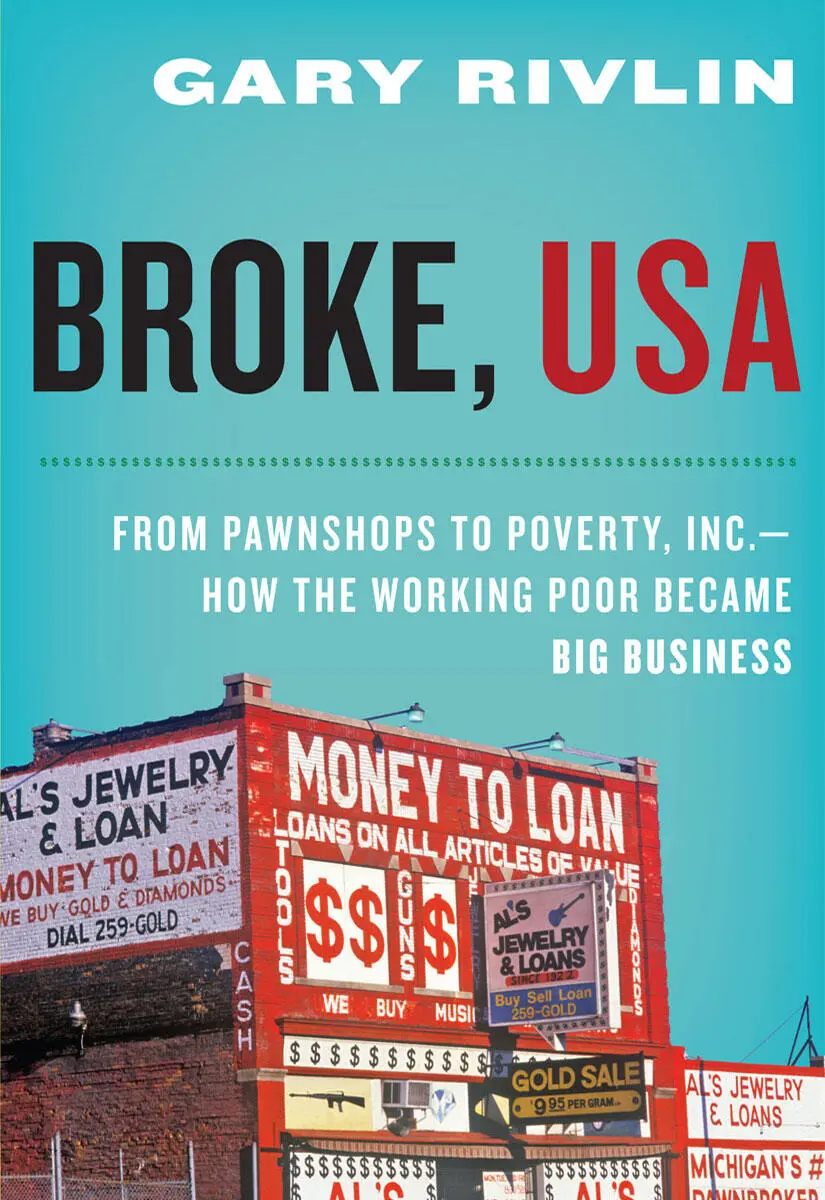
- Название:Broke, USA
- Автор:
- Издательство:HarperCollins Publishers Inc.
- Жанр:
- Год:2010
- Город:New York
- ISBN:978-0-06-199794-5
- Рейтинг книги:3 / 5. Голосов: 1
-
Избранное:Добавить в избранное
- Отзывы:
-
Ваша оценка:
Broke, USA: краткое содержание, описание и аннотация
Предлагаем к чтению аннотацию, описание, краткое содержание или предисловие (зависит от того, что написал сам автор книги «Broke, USA»). Если вы не нашли необходимую информацию о книге — напишите в комментариях, мы постараемся отыскать её.
Broke, USA — читать онлайн бесплатно полную книгу (весь текст) целиком
Ниже представлен текст книги, разбитый по страницам. Система сохранения места последней прочитанной страницы, позволяет с удобством читать онлайн бесплатно книгу «Broke, USA», без необходимости каждый раз заново искать на чём Вы остановились. Поставьте закладку, и сможете в любой момент перейти на страницу, на которой закончили чтение.
Интервал:
Закладка:
“Their proposed changes are generally consistent with the stringent policies and procedures that have long been in place at Household,” Household Finance said in a statement expressing its support for the Citigroup plan. This was near the end of 2000, just about one year before Tommy and Marcia Myers would step into a Household office just outside Dayton and two years before the company was forced to pay a $484 million fine for its bad loan practices.
Martin Eakes dismissed Citigroup’s concessions as “baby steps” on the path to reform and then, in a Q&A in the New York Times ’s Sunday business section, seemed to be talking directly to the people inside Citigroup’s executive offices. “I have been in meetings where black ministers made the statement that this will become the civil rights movement of this decade, the confronting of the systematic destruction of wealth by abusive lenders,” Eakes said, turning up the heat considerably. “Will it take street demonstrations? Boycotts? I hope not. But many of us are prepared if necessary to spend the next 15 years battling Citibank.”
Eakes might have known how to push all the right buttons inside Citigroup, but in that same article he proved himself an awful prognosticator. Subprime, he said, seemed a “fad” unlikely to gain momentum. “Is it a trend that will be picked up across the banking industry?” Eakes asked himself. “I rather doubt it. I think that Citigroup will find itself somewhat isolated.”
Weill, for his part, chose to ignore the activists. He and his staff had met with any number of community groups, Weill wrote in a letter to regulators. They had spoken with elected officials and their representatives. They had listened to everyone’s concerns. And he felt satisfied that the company had reached a good balance between its responsibilities to its investors and the communities it served.
More than seventy community lenders and advocates had signed a letter addressed to the FDIC and Office of the Comptroller of the Currency asking the two agencies to hold hearings into the Citigroup-Associates deal. Regulators were limited in the conditions they could impose on a company but by holding hearings and threatening to withhold their approval they can often extract reforms. That’s what the Clinton-era Office of the Comptroller did when First Union bought the Money Store. It approved the deal only after First Union pledged that its new subsidiary would not sell subprime loans to borrowers who qualified for conventional financing. In this case, though, representatives from both the FDIC and Office of the Comptroller complimented Citigroup for voluntarily agreeing to change select policies inside Associates. Both agencies declined to hold hearings.
In the end, only the New York State Banking Department held a hearing to review the proposed merger. Dozens of critics spoke against the deal, including Sarah Ludwig, executive director of the New York City–based Neighborhood Economic Development Advocacy Project. For years she had joined others in criticizing Citibank for its lack of branches in low-income and minority neighborhoods. If you allow Citi to buy this high-priced and unscrupulous lender, Ludwig argued, “you’re giving Citibank a perverse incentive” to stay away from the communities most in need of traditional banking services. Citigroup claimed that it had significantly increased lending to blacks and Latinos since 1997 but the activists countered with studies of their own, including one that showed that more than 80 percent of the loans Citi had made in the greater New York City area over the prior year had been small, unsecured, high-interest loans of $1,000 or less. Regulators in New York state managed to wrangle from Citigroup several written concessions, including a promise that it would at least temporarily stop selling single-premium credit insurance—but only inside New York’s borders.
Activists were disappointed, but Eakes and others told reporters they were not about to quit. With its acquisition of Associates, Citigroup ranked as the country’s largest subprime lender. “Look, if Citigroup thinks we’re going to go away, they’re in for a big surprise,” Eakes told the Raleigh News & Observer . “We’re just getting warmed up.” Among other tactics, Eakes and his allies took to inundating Weill with thousands of emails each week and ultimately would try confronting Weill more directly in New York.
Martin Eakes worried that he was spreading himself and his organization too thin. But he also saw himself as having no choice, given the nature of the Citigroup fight, just as he felt he didn’t have the option to say no when people asked him and Self-Help to join in the pending battle over the future of the payday advance business in North Carolina.
The Tar Heel State had opened the door to the payday lenders in 1997. “They had a compelling story,” said Wib Gulley, Eakes’s old law partner, who voted in favor of the original bill authorizing payday lending in North Carolina. “Times were tough here back then. People needed access to credit and payday seemed a reasonable way of offering poor people quick emergency loans.” But to make sure they weren’t institutionalizing something they didn’t fully understand, Gulley and his allies included a sunset provision in the bill. If new enabling legislation were not passed by July 31, 2001, then payday lending would no longer be legal in the state. “Within two or three years,” Gulley said, “it was clear we were not getting what we thought we were getting.”
Gulley helped enlist Eakes in the anti-payday cause, as did Eakes’s old ally from the predator mortgage fight, Peter Skillern. Skillern and his staff had even written a small book about the payday loan industry in North Carolina called Too Much Month at the End of the Paycheck. At that point, North Carolina was home to more than one thousand payday stores and, if nothing else, Skillern thought lawmakers should at least have a better understanding of what was going on. The book included interviews with store owners and industry representatives but its emotional heft was in the stories of North Carolinians who went to a payday lender for help but ended up feeling trapped. One woman had borrowed $300 after falling behind in her car payments. She ended up paying $2,000 in fees over a two-year period before she finally caught up. A second borrower said he was paying rates so high it’s “pretty much impossible not to get in a cycle there” and a third was quoted as saying, “It’s worse than crack.” The book wasn’t written specifically to engage Martin Eakes in the fight against payday lending but it might as well have been.
“The time wasn’t right for us,” Eakes said. “But we knew if we didn’t take it now, we might never have another chance again.” There are a thousand ways to kill a bill, he reasoned, and passing one is always difficult. It was the spring of 2001 and he was barely six months into Associates’ fight but Self-Help would add its considerable muscle to prevent the payday lenders from obtaining a majority for the legislation they would need to continue operating legally in the state.
Allan Jones and Billy Webster said they felt blindsided by the North Carolina fight. Maybe so, but then they had only themselves (or at least their government affairs people) to blame and it didn’t seem to take them long to recover. There were so many lobbyists running around the state on behalf of the payday lenders, Wib Gulley said, that it was as if each legislator who hadn’t yet committed to the payday side had his or her own personal lobbyist—if not more than one. When the first two lobbyists sent to talk with Gulley couldn’t convince him to support the payday lenders, they sent a young and attractive woman to see if she could be more persuasive. “I could almost hear them saying, ‘Well, we tried the policy approach with Gulley; let’s go this other route,’” he said. Gulley described the ensuing political fight as probably the hardest-fought donnybrook he had witnessed in his twelve years serving in the state senate.
Читать дальшеИнтервал:
Закладка:
Похожие книги на «Broke, USA»
Представляем Вашему вниманию похожие книги на «Broke, USA» списком для выбора. Мы отобрали схожую по названию и смыслу литературу в надежде предоставить читателям больше вариантов отыскать новые, интересные, ещё непрочитанные произведения.








Обсуждение, отзывы о книге «Broke, USA» и просто собственные мнения читателей. Оставьте ваши комментарии, напишите, что Вы думаете о произведении, его смысле или главных героях. Укажите что конкретно понравилось, а что нет, и почему Вы так считаете.