Gary Rivlin - Broke, USA
Здесь есть возможность читать онлайн «Gary Rivlin - Broke, USA» весь текст электронной книги совершенно бесплатно (целиком полную версию без сокращений). В некоторых случаях можно слушать аудио, скачать через торрент в формате fb2 и присутствует краткое содержание. Город: New York, Год выпуска: 2010, ISBN: 2010, Издательство: HarperCollins Publishers Inc., Жанр: Старинная литература, на английском языке. Описание произведения, (предисловие) а так же отзывы посетителей доступны на портале библиотеки ЛибКат.
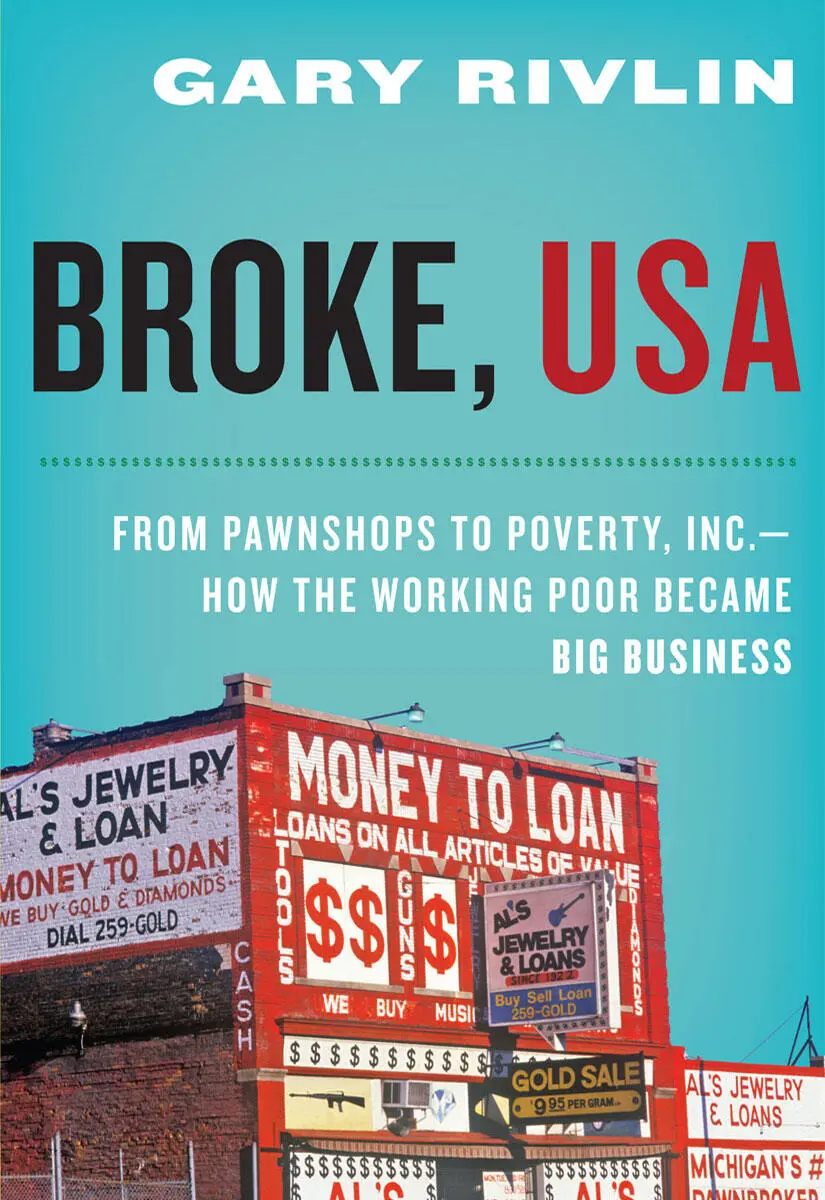
- Название:Broke, USA
- Автор:
- Издательство:HarperCollins Publishers Inc.
- Жанр:
- Год:2010
- Город:New York
- ISBN:978-0-06-199794-5
- Рейтинг книги:3 / 5. Голосов: 1
-
Избранное:Добавить в избранное
- Отзывы:
-
Ваша оценка:
Broke, USA: краткое содержание, описание и аннотация
Предлагаем к чтению аннотацию, описание, краткое содержание или предисловие (зависит от того, что написал сам автор книги «Broke, USA»). Если вы не нашли необходимую информацию о книге — напишите в комментариях, мы постараемся отыскать её.
Broke, USA — читать онлайн бесплатно полную книгу (весь текст) целиком
Ниже представлен текст книги, разбитый по страницам. Система сохранения места последней прочитанной страницы, позволяет с удобством читать онлайн бесплатно книгу «Broke, USA», без необходимости каждый раз заново искать на чём Вы остановились. Поставьте закладку, и сможете в любой момент перейти на страницу, на которой закончили чтение.
Интервал:
Закладка:
Still, does a Sandy Weill ever lose his appetite for the profits generated by a subprime lender? Years later Weill would declare Commercial Credit the single best investment he had made during a career marked by smart deals, and it was the bushels of cash Commercial Credit was spinning off, especially in the early years, that allowed Weill to launch his ambitious buying spree. And Commercial Credit continued to be a robust if not minor producer within Citi throughout the 1990s. Under Weill, the company had tripled to 1,200 the number of consumer finance stores under its control by the time it renamed them CitiFinancial in 2000—and each new branch more than pulled its weight on the ledger sheet. Where Commercial Credit was earning about a 2.5 percent return on its assets inside Citigroup, the conventional banking side of things was generating close to a 1 percent return. A year before the proposed Associates deal, Citigroup snapped up the assets of a relatively small failed lender called IMC Mortgage in Tampa, Florida. Sandy Weill was not a man to turn up his nose at a rough-style lender like Associates, not when the company was spinning off $1 billion in profits each year.
CEOs love talking about their “vision.” For Weill that was the dream of creating a full-service global supermarket of financial products. That provided Weill with another rationale for pursuing Associates. The very rich could avail themselves of the advice offered in the well-appointed offices of Citigroup’s Private Wealth Management. Citi sold any number of products to the country’s professional class, including insurance, standard banking, and the brokerage services offered by the hundreds of Shearson and Smith Barney outposts that Citigroup owned. But what about those of modest means who had bounced too many checks in their lives or who didn’t carry a credit card?
If Weill was always on the prowl for his next deal, his target in this case, Associates, was a battered company eager to find a suitor. North Carolina had proven a blow to Associates and the bad news only seemed to pile up in the intervening months. Even the Dallas Morning News , the hometown newspaper, got into the act, reporting on a leaked memo, “The Roadmap to Continued Record Profits in 1995,” that showed that flipping loans wasn’t happenstance but company policy. Older loans are far less profitable than new ones, the memo pointed out, so it was crucial to continued success to convince existing customers to refinance. “Your controller can provide lists to you of aged personal loans to target for renewal,” the memo suggested. Not surprisingly, the paper found, half of all customers had refinanced with the company and one in four had refinanced with Associates two or more times.
Credit insurance products were another huge source of profits for the company. Sixty percent of all loans included some kind of credit insurance, according to the “Roadmap” memo, but that apparently wasn’t a high enough penetration rate. The key to selling more credit insurance, Gary Ayala, a former assistant branch manager at Associates in Tacoma, Washington, said in a deposition, was to never use the word “insurance.” Call it a “payment protection plan,” his bosses instructed him. Use phraseology like “Just so you know, that includes a payment protection plan if anything happens to you.” Anything to make it sound like a policy came automatically with the loan and hide the fact that it could add as much as 20 percent to the amount of principal owed.
Negative news accounts, however, might have been the least of the worries inside Associates as 1999 turned into 2000. The U.S. Justice Department, the Federal Trade Commission (FTC), and the North Carolina attorney general’s office were all investigating its lending practices, and the economy, suffering a brief recession following the collapse of the tech bubble, was putting a big dent in its earnings. They were in the mobile home financing business but what had once been a lucrative field had blown up once people realized that the thirty-year loans companies were typically writing were outlasting the trailers themselves. The market was beset by defaults. Even one of the company’s great strengths, its place as a top-five lender in Japan, had turned into a weakness by mid-2000, when that country lowered the cap on allowable interest rates from 40 percent a year to 29 percent for the type of loans Associates made, forcing the company to warn its investors that the change would hurt their profits there.
“They were in any number of businesses that basically blew up on them,” a Credit Suisse First Boston financial analyst told the New York Times . Associates’ stock price sagged and Sandy Weill, a bargain hunter with a nose for weakness, pounced.
The first batch of articles reporting Associates’ acquisition focused on Weill’s deal-making acumen. The financial analysts seemed especially impressed by the deal’s potential to spin off huge profits for Citi overseas. Through its various subsidiaries, they pointed out, Citigroup had $77 billion in overseas deposits. What better way for a burgeoning global colossus to put that money to work than loaning money to the working class the world over? Buying Associates meant Citigroup would be the fifth-largest consumer finance provider in Japan, which Weill described as the second-largest market for consumer lending, behind only the United States. “I really think Sandy scored,” a money manager named Robert Albertson gushed in a Times article announcing the deal. The piece ran on page one, but made only glancing reference to Associates’ reputational troubles.
The trade press seemed to know better, though. “If there has ever been a deal that community and consumer activists would want to block,” American Banker predicted a few days after the announcement, “it is Citigroup Inc.’s planned acquisition of Associates.” The article quoted at length a spokesman for Associates who said there was no doubt that “certain groups” would use the merger “to draw attention to their cause.” Citigroup, however, had nothing to worry about. “Associates regards predatory lending as an abhorrent practice and is committed at every level to treating customers fairly,” said the spokesperson, who was left nameless in the article.
The first time Martin Eakes was set to meet with someone at Citi he thought he was going to have a private session with Chuck Prince, the company’s general counsel and chief operating officer, at a Washington, D.C., law firm. But apparently Prince sought to send a message at that first meeting. “It was me and twenty Citibank lawyers,” not just Prince, Eakes said. Eakes delivered his change-or-else threat and Prince just leaned back in his chair and with a bemused smile said, “You know, we’re not accustomed to having anyone tell us what we have to do.”
Their next meeting was held six weeks later in Durham. This time it was Eakes’s turn to flex his muscle. Eakes assembled a posse of around fifty activists and community leaders, including Bill Brennan, who had flown from Atlanta for the occasion. They dubbed themselves the Coalition for Responsible Lending, just as they had done during the 1999 North Carolina predatory lender fight. To drive home his point, Eakes had arranged for the testimony of a half dozen homeowners who believed Associates had defrauded them. Those in attendance described Chuck Prince as genuinely moved by what he had heard. He gave the group his fax number and asked them to send him the details of specific cases. He also designated one of the aides who had flown down with him, a top Citigroup lawyer, as his point person in charge of all Associates-related complaints.
“He tells us, ‘We’re going to fix everything,’” Bill Brennan recalled. “He assures us, ‘We’re going to straighten this company out.’” Brennan ate up every word Prince said—and then felt like a fool after doing some research. Commercial Credit might have been smaller than Associates but that only meant they had been less successful following more or less the same formula. Gail Kubiniec, for instance, who ran a CitiFinancial branch just outside of Buffalo, sounded like she was reading from Associates’ playbook when she told FTC investigators about her secrets for boosting revenues by packing loans with unnecessary insurance policies. “The more gullible the consumer appeared,” Kubiniec said, “the more coverage I would try to include in the loan.” By “gullible,” she explained, she meant the very young or very old, minorities and those who “appeared uneducated, inarticulate.” And then there was Prince. For years Chuck Prince had served as the general counsel at Commercial Credit. He had risen to the top of Citigroup in no small part because of the deftness with which he helped Weill take care of political messes like the one he faced with his planned purchase of Associates. “Chuck Prince didn’t know what Associates was up to? He was blindsided by all these subprime mortgages? What a joke,” Brennan said.
Читать дальшеИнтервал:
Закладка:
Похожие книги на «Broke, USA»
Представляем Вашему вниманию похожие книги на «Broke, USA» списком для выбора. Мы отобрали схожую по названию и смыслу литературу в надежде предоставить читателям больше вариантов отыскать новые, интересные, ещё непрочитанные произведения.








Обсуждение, отзывы о книге «Broke, USA» и просто собственные мнения читателей. Оставьте ваши комментарии, напишите, что Вы думаете о произведении, его смысле или главных героях. Укажите что конкретно понравилось, а что нет, и почему Вы так считаете.