Gary Rivlin - Broke, USA
Здесь есть возможность читать онлайн «Gary Rivlin - Broke, USA» весь текст электронной книги совершенно бесплатно (целиком полную версию без сокращений). В некоторых случаях можно слушать аудио, скачать через торрент в формате fb2 и присутствует краткое содержание. Город: New York, Год выпуска: 2010, ISBN: 2010, Издательство: HarperCollins Publishers Inc., Жанр: Старинная литература, на английском языке. Описание произведения, (предисловие) а так же отзывы посетителей доступны на портале библиотеки ЛибКат.
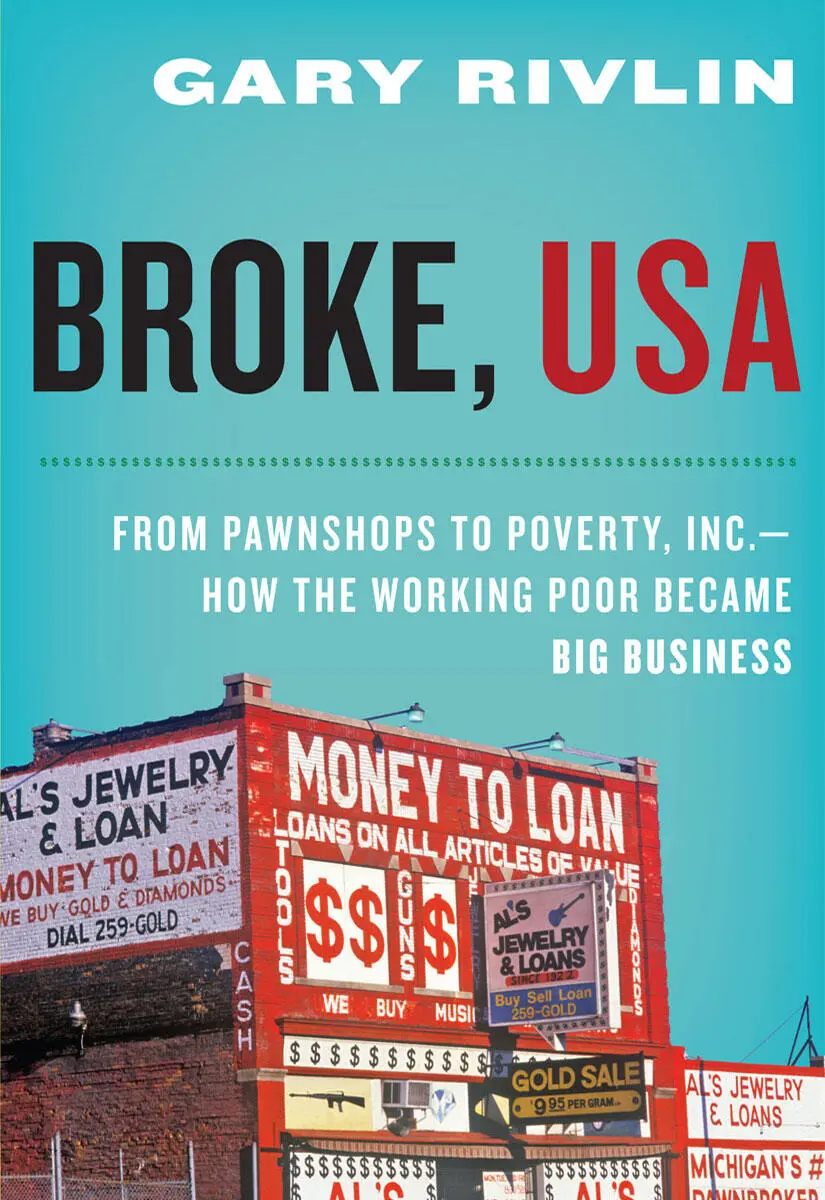
- Название:Broke, USA
- Автор:
- Издательство:HarperCollins Publishers Inc.
- Жанр:
- Год:2010
- Город:New York
- ISBN:978-0-06-199794-5
- Рейтинг книги:3 / 5. Голосов: 1
-
Избранное:Добавить в избранное
- Отзывы:
-
Ваша оценка:
Broke, USA: краткое содержание, описание и аннотация
Предлагаем к чтению аннотацию, описание, краткое содержание или предисловие (зависит от того, что написал сам автор книги «Broke, USA»). Если вы не нашли необходимую информацию о книге — напишите в комментариях, мы постараемся отыскать её.
Broke, USA — читать онлайн бесплатно полную книгу (весь текст) целиком
Ниже представлен текст книги, разбитый по страницам. Система сохранения места последней прочитанной страницы, позволяет с удобством читать онлайн бесплатно книгу «Broke, USA», без необходимости каждый раз заново искать на чём Вы остановились. Поставьте закладку, и сможете в любой момент перейти на страницу, на которой закончили чтение.
Интервал:
Закладка:
Martin Eakes was similarly disgusted. “Citigroup has stated that they would solve the problems in Associates by bringing Associates up to Citigroup’s standards,” Eakes told a New York Times reporter around the time of the Durham meeting. “But it’s not totally clear that Citigroup’s standards are any tighter.” During the conference call announcing the deal, Weill had told analysts that he thought that Citi could squeeze much more profit per customer once Associates was under his control. “I remember thinking,” Eakes said, “More per customer? You need to extract much, much less from every customer.”
In 1998, when First Union, then the country’s sixth-largest bank, announced it was buying the Money Store, then the nation’s third-largest subprime lender, for $2.1 billion, a monthly magazine called Mortgage Banking ran a cover story expressing its shock. Bankers, after all, were “the staid elder statesmen of the financial world.” The “go-go entrepreneurs of sub-prime” operated “out of nondescript strip malls [and used] veteran sports celebrities as TV spokesmen” (Terry Bradshaw for Associates, Phil Rizzuto for the Money Store). There would be some occasional intermingling between those Mortgage Banking dubbed the “odd couple of financial services,” as when NationsBank bought Chrysler First and EquiCredit, but then people concluded that NationsBank was a different breed of bank. But it was becoming increasingly plain that NationsBank hadn’t been an outlier but instead a trailblazer.
The motivator, of course, was the same thing that had first drawn Sandy Weill to subprime: the spread. At its core, banking is a pretty straightforward business. A bank pays a depositor an interest rate that’s not as high as the interest rates a bank charges those who borrow money—and the Money Store was charging its customers as much as 14.95 percent on a home equity loan. “These two sectors of the financial world rarely crossed paths until recently,” Mortgage Banking reported, “when the profit potential of the sub-prime industry convinced banks this might be a business opportunity.” Was it any wonder, then, that a man named Hugh Miller, the president of Delta Funding, a large New York–based subprime lender, boasted, “my phone has been ringing hot and heavy,” though his company was under federal investigation. The “profit potential” of players in this “promising sector,” the magazine reported, were making such deals “irresistible.”
Yet never before had there been a deal of this magnitude, and never before had it involved a player like Citibank. The Times may have put Weill’s blockbuster announcement on page one because of the flabbergasting price tag—$31 billion for a lender whose name few readers of the Times even recognized—but more likely it was because of the star power of Citigroup and its flamboyant CEO and chairman. Under Weill’s direction, Citigroup ranked among the most valuable corporations in the world.
There was opportunity for Eakes and his allies in the business press’s interest in all things Sandy Weill and Citigroup. Citi offered both a big target and a large stage; the same bright light that shined on this Wall Street giant might also help expose the predatory lending spreading within working-class enclaves across the country and finally make subprime part of the national dialogue. There was also the potential to make an example of Citigroup. If they could force reform on a corporation powerful enough to steamroll its way over one of the key reforms enacted following the 1929 crash, then maybe other lenders would fall into line.
Yet Citigroup’s might and its prodigious reach also raised the stakes. Citi had burnished and polished its brand through hundreds of millions of dollars’ worth of advertising, building up trust. If the deal with Associates was consummated, Weill and his team would be running nearly two thousand storefronts in forty-eight states, all carrying the CitiFinancial name. Weill, when announcing the deal, promised the Street that the addition of Associates to his holdings would add at least ten cents a share in additional earnings, or about $500 million. Everything from the stock price to the size of next year’s bonuses depended on hitting that number. “The Citi Never Sleeps”: Citigroup was large and ravenous, and if the activists were to fail, there might be no stopping the company and its copycats from treading unrestricted through a deregulated landscape in search of new profits.
Bill Brennan remembered the early 1990s when he was fighting NationsBank’s purchase of Chrysler First. “[If] there [have] been problems with prior business practices, this acquisition may well be the most effective way to fix them,” a spokesman for NationsBank told the Charlotte Observer . In Brennan’s view, the opposite happened. NationsBank was a scrappy regional player striving to show Wall Street what it could do, and as a consequence, complaints against NationsCredit, Brennan said, had skyrocketed. Over the years he kept hearing the same story. A bank would say it was bringing integrity to the subprime enterprise it had just purchased, but invariably the opposite happened. “The problems always got worse,” Brennan said flatly. Citigroup’s purchase of Associates seemed destined to turn out the same way. Citigroup was a company carrying too much debt and run by a CEO anxious to demonstrate for the Street that his company, despite its size, was still a top-pick growth stock—a company, in other words, always on the lookout for ways to jack revenues.
Hoping to avoid a generic we’ll-bring-them-up-to-our-standards kind of statement, in advance of the Durham meeting the Coalition for Responsible Lending had worked up a list of specific business practices they wanted changed. The boilerplate language of an Associates contract included a prepayment penalty and a provision that waived a person’s right to sue in case of a dispute. The activists called on Citigroup to drop the prepayment penalty and the mandatory arbitration clause. They also wanted Citi to cap up-front fees at 3 percent of a loan and to stop the noxious practice of charging borrowers the full price of a credit insurance policy and then financing it as part of the loan. They also said there should be some limit on the interest rates CitiFinancial could charge. Lenders deserved a healthy return on their investment, Eakes and his cohorts acknowledged, but a signature of the subprime market was the unmooring of interest rates from any calculation of risk. “Risk-based pricing,” it seemed, had become an excuse for whatever a lender could get away with—demonstrated by the sky-high profits the subprime industry was producing.
But Citigroup had no intention of agreeing to a sweeping set of concessions certain to dampen profits. Instead the company, in a letter addressed to regulators, made some vague promises about better training and an improvement in their compliance review procedures. They promised, too, to review CitiFinancial and Associates loans that had ended in foreclosure during the prior twelve months to see if any should be reversed. They would also disappoint activists on the issue of credit insurance. A study released by HUD and the Treasury Department in the final months of the Clinton administration concluded that the consumer finance companies often employed “unfair, abusive and deceptive” techniques to sell lump-sum credit insurance products that were, more often than not, “unnecessary.” Citigroup said it would offer people the option of making monthly payments rather than financing the entire sum at once but it would continue to sell the lump-sum product. Citigroup agreed to cap its up-front fees at 8 percent (the HOEPA trigger) and not 3 percent, as activists wanted, and while it wouldn’t drop prepayment penalties altogether, they shortened the penalty period from five years to three years. The company also promised not to target borrowers with a no-interest or low-interest loan written by a government entity or a nonprofit such as Habitat for Humanity, and to at least experiment with the idea of treating people more fairly. One might have thought it was already Citi policy to give a customer the best rate possible given a person’s credit history but Citigroup announced it was testing a pilot program called “referring up,” whereby CitiFinancial employees would let those with good credit know they could get a conventional loan at a significantly lower interest rate with Citibank.
Читать дальшеИнтервал:
Закладка:
Похожие книги на «Broke, USA»
Представляем Вашему вниманию похожие книги на «Broke, USA» списком для выбора. Мы отобрали схожую по названию и смыслу литературу в надежде предоставить читателям больше вариантов отыскать новые, интересные, ещё непрочитанные произведения.







Обсуждение, отзывы о книге «Broke, USA» и просто собственные мнения читателей. Оставьте ваши комментарии, напишите, что Вы думаете о произведении, его смысле или главных героях. Укажите что конкретно понравилось, а что нет, и почему Вы так считаете.