Gary Rivlin - Broke, USA
Здесь есть возможность читать онлайн «Gary Rivlin - Broke, USA» весь текст электронной книги совершенно бесплатно (целиком полную версию без сокращений). В некоторых случаях можно слушать аудио, скачать через торрент в формате fb2 и присутствует краткое содержание. Город: New York, Год выпуска: 2010, ISBN: 2010, Издательство: HarperCollins Publishers Inc., Жанр: Старинная литература, на английском языке. Описание произведения, (предисловие) а так же отзывы посетителей доступны на портале библиотеки ЛибКат.
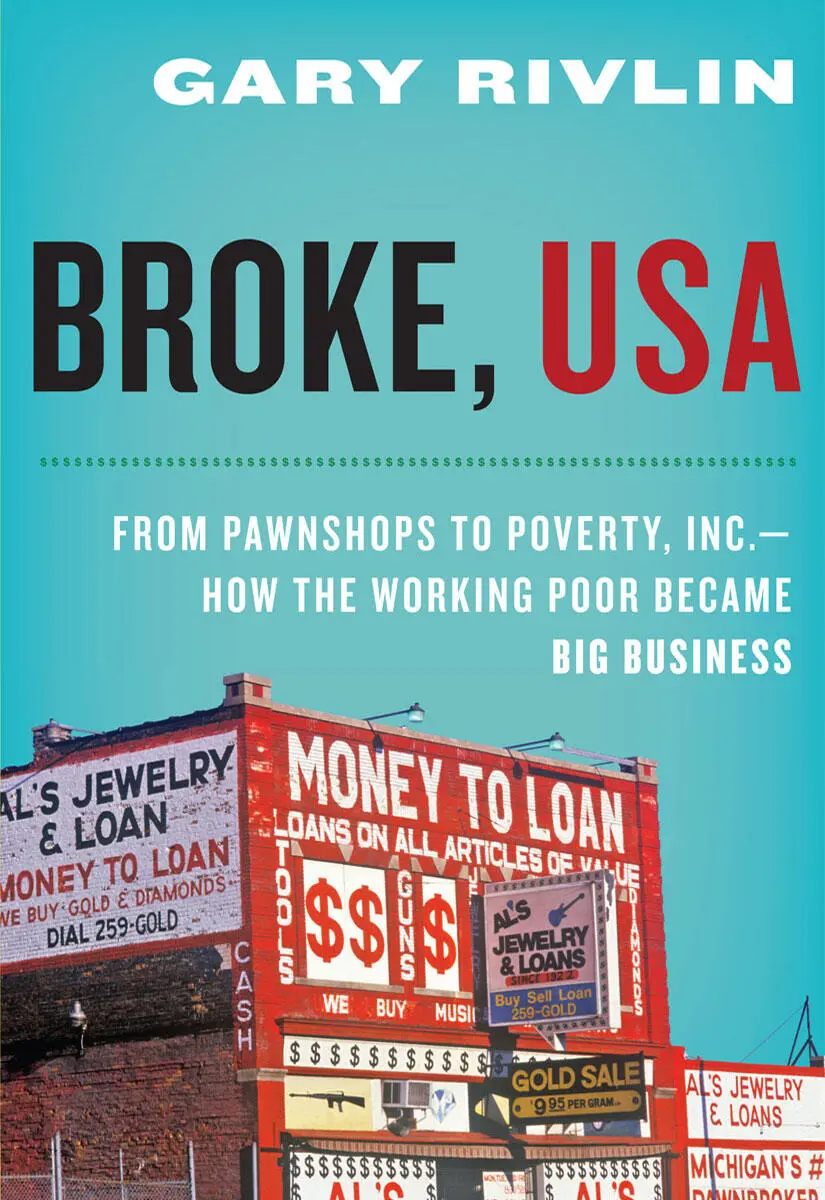
- Название:Broke, USA
- Автор:
- Издательство:HarperCollins Publishers Inc.
- Жанр:
- Год:2010
- Город:New York
- ISBN:978-0-06-199794-5
- Рейтинг книги:3 / 5. Голосов: 1
-
Избранное:Добавить в избранное
- Отзывы:
-
Ваша оценка:
Broke, USA: краткое содержание, описание и аннотация
Предлагаем к чтению аннотацию, описание, краткое содержание или предисловие (зависит от того, что написал сам автор книги «Broke, USA»). Если вы не нашли необходимую информацию о книге — напишите в комментариях, мы постараемся отыскать её.
Broke, USA — читать онлайн бесплатно полную книгу (весь текст) целиком
Ниже представлен текст книги, разбитый по страницам. Система сохранения места последней прочитанной страницы, позволяет с удобством читать онлайн бесплатно книгу «Broke, USA», без необходимости каждый раз заново искать на чём Вы остановились. Поставьте закладку, и сможете в любой момент перейти на страницу, на которой закончили чтение.
Интервал:
Закладка:
By that point McCarthy was spending his days listening to old people frightened about losing homes they had owned for thirty years, angry at themselves for making the mistake of walking into the wrong office door. His pent-up frustration and anger boiled over during a meeting on behalf of several CitiFinancial customers. “I’m telling them, ‘I’ll get in front of the television cameras and just blast you for what you’re doing to these people. I’ll put them in front of the camera so they can tell everyone what you did to them. I’ll bully you in every way we can think of in front of the media.’” McCarthy had no idea whether he could back up any of these threats, but to his amazement, the gambit worked. Citi agreed to write off the loans, essentially letting the three borrowers off the hook. “These were the early days of all this stuff,” McCarthy said with a laugh, “so it was still possible to talk about hurting the reputation of one of these lenders.”
Citi followed with other concessions aimed at appeasing its critics, including the announcement in June 2001, ten months after its purchase of Associates and six months after the FTC announced its suit, that it was phasing out its single-premium credit insurance product. It would continue to sell credit insurance, Citi said, but it would be sold separately from the mortgage and be paid for with regular premiums through the life of the policy. Perhaps Citigroup was motivated by a sense of moral responsibility but an alternative explanation was that the financial giant wanted to avoid additional criticism. The Democrats had recently taken control of the Senate, and Paul Sarbanes, the new chairman of the Finance Committee, had just announced that he would hold hearings to look deeper into predatory lending.
Another year would pass before Citigroup agreed to pay $215 million to settle its suit with the FTC. At the time it stood as the largest consumer protection settlement in FTC history. Citigroup also agreed to pay up to $20 million to settle an investigation into Associates that Attorney General Roy Cooper of North Carolina initiated shortly after he took office.
Citigroup would set another record in 2004, when the Federal Reserve hit the company with a $70 million penalty—the largest fine the Fed had ever imposed for a consumer lending violation. This wasn’t for misdeeds committed by Associates pre-Citigroup but for newer improprieties that dated back to 2001. CitiFinancial, the Fed claimed, was routinely converting personal loans into equity loans secured by a person’s home without regard to a borrower’s ability to pay. The Fed also charged CitiFinancial with trying to mislead regulators once they started to investigate.
Eakes, meanwhile, had never stopped trying to convince Citigroup to change. In May 2005, five years after Citi announced it was acquiring Associates, Eakes stood at a podium and publicly praised Citigroup. The company had finally agreed to drop a clause from its subprime contracts requiring borrowers to agree to mandatory arbitration. The lender also greatly reduced the penalties it charged for early payment on a loan. “It only took them five years to do the right thing,” Eakes said. Goliath had not been killed, but he had also not emerged from the competition unscathed.
Among those noticing Eakes as he fought with Citigroup while simultaneously doing battle against the payday lenders were Herbert and Marion Sandler, who ran the World Savings Bank, one of the country’s largest savings and loans. In 2002, Herb Sandler started phoning Eakes in the hopes that he could convince him to create a national organization to build on the work he had been doing fighting Citi in North Carolina.
The Sandlers were hardly the first to broach the idea, but Eakes always offered the same stock answer when anyone proposed this idea of broadening Self-Help’s scope beyond the state’s borders. “We’ll look at other places,” he would say, “when the job has been completed in North Carolina.”
Yet the Citigroup fight had forced Eakes onto the national stage, and Self-Help’s fight against first the predatory subprime mortgage lenders in North Carolina, and then the payday lenders, had raised its profile to the point where people were expecting them to act like a national advocacy organization. “Basically, we realized we [at Self-Help] were spending all this time on these requests anyway, so why not get some help?” Mark Pearce said. One key turning point, Mike Calhoun said, occurred while he was reading through a predatory lending bill that activists were championing in Alabama. “It copied verbatim our bill, down to the references to North Carolina statutes,” Calhoun said.
Still, Herb Sandler needed to phone several times before Eakes finally decided to get serious about launching a national organization. “He’s been calling and calling,” Calhoun said, “until finally he has to say to Martin, ‘I really mean it, I’ll provide you some money. So would you goddamn send us a proposal?’” Sandler had looked at others but, to him, “Martin was the only one up to the enormity of the challenge,” he said. “He was the only one with the capability and the passion and the strategic ability and the leadership quality to get his arms around a challenge of this size.”
Inside Self-Help, they huddled to figure out how much money they might need to start such a group. It was Eakes, Pearce said, who suggested asking for a number large enough to provide an endowment sufficient to remain independent and not constantly fret over raising money and uncertainty about next year. “Are you fucking crazy?” Sandler cried out over the phone, or something to that effect, when Eakes told him of the tens of millions of dollars he thought he needed to start a national Center for Responsible Lending. Sandler remembered Eakes telling him he wanted an endowment big enough to generate $8 or $9 million per year: a sum well over $100 million. In time, however, it would become clear that money would not be a problem for Herb and Marion Sandler.
Nine
“No Experience Necessary”
Allan Jones had inherited his father’s debt collection business; Jared and David Davis had a wealthy father who served as the chief executive and president of Cincinnati’s second-largest bank, a publicly traded corporation. And there were all those executives from Citigroup, First Union, and other financial behemoths who had stooped down to see the riches that could be made operating on the fringes of the economy. They had near-limitless access to whatever capital they might need to move aggressively into a new business.
By contrast, Fesum Ogbazion, who would also find his fortune in the poverty industry, began with nothing. His parents had been born in a tiny farming village in Eritrea, a small country on the northeast tip of Africa sandwiched between the Sudan and Ethiopia. His father had been taught to read and write by Christian missionaries who opened a school in his town in the 1950s. His mother attended school there as well. Back then, Eritrea was under the rule of Ethiopia, a communist-ruled country that didn’t have much tolerance for people preaching the gospel. His parents were jailed several times, Ogbazion said, and nearly killed “for being Protestant, for speaking out, for not being happy with Ethiopian rule.” Ogbazion was nine years old when the family moved to Florida to join their father, who had gone ahead to study at Hobe Sound Bible College, and then to Ohio, where the senior Ogbazion earned a master’s degree at Cincinnati Christian College. His father found work as a pastor at an area church while his mother settled into the role of pastor’s wife. They no doubt had a great deal to contribute to their eldest son’s moral and spiritual development but they could offer little in the way of working capital.
Читать дальшеИнтервал:
Закладка:
Похожие книги на «Broke, USA»
Представляем Вашему вниманию похожие книги на «Broke, USA» списком для выбора. Мы отобрали схожую по названию и смыслу литературу в надежде предоставить читателям больше вариантов отыскать новые, интересные, ещё непрочитанные произведения.








Обсуждение, отзывы о книге «Broke, USA» и просто собственные мнения читателей. Оставьте ваши комментарии, напишите, что Вы думаете о произведении, его смысле или главных героях. Укажите что конкретно понравилось, а что нет, и почему Вы так считаете.