Gary Rivlin - Broke, USA
Здесь есть возможность читать онлайн «Gary Rivlin - Broke, USA» весь текст электронной книги совершенно бесплатно (целиком полную версию без сокращений). В некоторых случаях можно слушать аудио, скачать через торрент в формате fb2 и присутствует краткое содержание. Город: New York, Год выпуска: 2010, ISBN: 2010, Издательство: HarperCollins Publishers Inc., Жанр: Старинная литература, на английском языке. Описание произведения, (предисловие) а так же отзывы посетителей доступны на портале библиотеки ЛибКат.
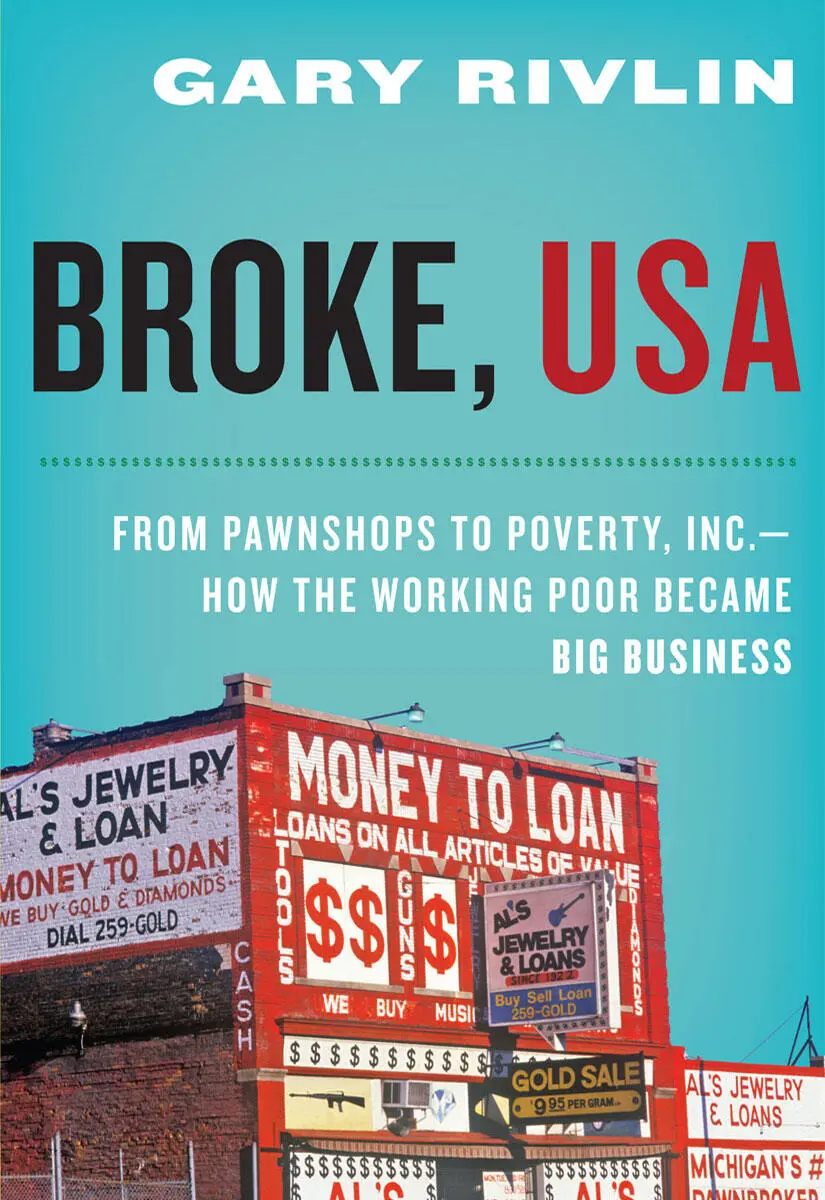
- Название:Broke, USA
- Автор:
- Издательство:HarperCollins Publishers Inc.
- Жанр:
- Год:2010
- Город:New York
- ISBN:978-0-06-199794-5
- Рейтинг книги:3 / 5. Голосов: 1
-
Избранное:Добавить в избранное
- Отзывы:
-
Ваша оценка:
Broke, USA: краткое содержание, описание и аннотация
Предлагаем к чтению аннотацию, описание, краткое содержание или предисловие (зависит от того, что написал сам автор книги «Broke, USA»). Если вы не нашли необходимую информацию о книге — напишите в комментариях, мы постараемся отыскать её.
Broke, USA — читать онлайн бесплатно полную книгу (весь текст) целиком
Ниже представлен текст книги, разбитый по страницам. Система сохранения места последней прочитанной страницы, позволяет с удобством читать онлайн бесплатно книгу «Broke, USA», без необходимости каждый раз заново искать на чём Вы остановились. Поставьте закладку, и сможете в любой момент перейти на страницу, на которой закончили чтение.
Интервал:
Закладка:
All the well-wishers offering their sympathies kept Weill busy during those first weeks. His wife thought the two of them would travel the world together, but Weill was impatient and hyperactive; he was not a man to ease into the comfortable life of the rich gentleman farmer. The most she got from him was a fortnight in Europe. “The prospects of being away for more than a few weeks from whatever action might arise,” wrote Monica Langley, author of the Weill biography Tearing Down the Walls , “was more than Sandy could bear.” Back in town, he sifted through newspapers and business magazines in search of inspiration. He put out feelers about any number of companies. He played golf and gave generously to Carnegie Hall and other charitable causes if for no other reason, Langley wrote, than to remind the world that he was still here. He made a clumsy public play to take over Bank of America, then a financial giant going through a rough patch, but his bid was rebuffed and then exposed. The “definition of chutzpah,” sniffed Fortune in an article that appeared under the headline SANFORD WEILL, 53, EXP’D MGR, GD REFS.
Who knows what Weill might have said to the two junior executives traveling to New York to pitch him on a business called the Commercial Credit Corporation, had they visited him shortly after he resigned from American Express rather than one year into his exile. Commercial Credit was a consumer finance company whose owner, Control Data, the computer maker, had been trying to sell it for at least a couple of years. Weill, in fact, Langley reports, was among those who had passed on a deal while he was still at American Express. But back then he was serving as president of a credit card giant with dreams of one day taking over as chief executive. Now he was a man trying to keep sane in search of a platform that would let him rebuild his empire. And if his vehicle had to be this ailing, grubby competitor to Household Finance, so be it.
The woman Weill had hired as his personal assistant tried to talk him out of Commercial Credit. It’s the loan-sharking business, she chided him—and he barked back that she was being a snob. Regular people have the same right to capital as Wall Street rich guys, he told her. He would be like a Walmart or a McDonald’s, selling to ordinary Americans. A friend from his American Express days was equally incredulous. Weill had reached the pinnacle of the corporate world and Commercial Credit was a third-rate company with a mangy reputation. It’s beneath you, he counseled. But Weill had looked at Commercial Credit’s numbers and if nothing else he was a pragmatic businessman. The publicly traded giants like Household and Beneficial were reporting double-digit profits but Commercial Credit’s profit margin was 4 percent. Commercial Credit had 600,000 customers and he wondered why it couldn’t have 5 million. There seemed a huge upside in operating a business that made small loans at high rates to blue-collar customers, and especially this one, which by Weill’s standards had not come close to reaching its potential.
On Wall Street they call it “the spread.” In short, it’s the difference between what money costs a company to borrow and the rate at which they can loan it out to others. The loan sizes inside Commercial Credit were minuscule by Weill’s standards—a thousand dollars plus fees to buy a new dining room set—but they were loaning money at a spectacular interest rate of 18, 20, or as much as 23 percent. If Weill could whip the company’s finances into shape and improve Commercial Credit’s lousy credit rating, he could further widen that spread. Everywhere Weill looked he seemed to see only upside and so he decided to move to Baltimore to take over a company so sleepy that he had nicknamed it “Rip Van Winkle.” By dangling generous stock option packages in front of old friends from Wall Street, he was able to lure more than a few of them to Baltimore to join him.
For years, Commercial Credit had been run by a CEO who had started in the business as a repo man thirty-five years earlier. The company hadn’t opened a new branch in years but perhaps more offensive to Weill and the A-team he had assembled was Commercial Credit’s compensation system. Bonuses weren’t based on performance, as they are on Wall Street, but instead every branch manager throughout the company was given an automatic increase of 5 percent a year. One of Weill’s earliest changes was a new bonus system to inspire managers to think more entrepreneurially about the small office under their charge. Those who ran a branch whose performance ranked in the company’s top 10 percent would receive double their salary for the year; those whose stores ranked in the bottom tenth would be out of a job.
Among those eager to accept the new boss’s challenge was Henry Smith, a Commercial Credit branch manager in Hazard, Kentucky. That’s what he told a BusinessWeek reporter whom Weill, anxious to show his former compatriots back home that he was still on the hunt, had invited inside the company to profile the turnaround. Commercial Credit peddled a high-priced, potentially dangerous product designed expressly for people living on the economic margins. Yet as Smith described it, the brilliance of Weill’s system was that he turned the company’s business model on its head: Where once the branch manager and his sales team spent their days deciding whether to extend credit to those who applied for it, they were now aggressively soliciting new business. Smith had lived in Hazard his whole life and his plan, he told BusinessWeek , was to tap into his extensive network of families, friends, and acquaintances in search of extra revenues. To save costs, Weill had fired most of the company’s human resources department and given the individual branch managers responsibility for hiring, training, and disciplining their staff. That meant one less check on the branch manager operating in the hinterlands, determined to run a top store. To no one’s surprise, profits inside Commercial Credit soon reached into the double digits. Eventually, Weill would declare that it was Commercial Credit, more than any other enterprise he had ever owned, that had rendered him a very, very wealthy man.
It didn’t take Weill long to expand his focus beyond consumer finance. He had purchased Commercial Credit in the middle of 1986; in 1988, he bought Primerica, the parent company that owned Smith Barney, and in 1992 he snapped up a 27 percent share of Travelers Corporation, the insurance giant. In 1993, he paid $1.2 billion to buy his old brokerage house from American Express, and that same year he bought the remainder of Travelers for $4 billion in stock and changed the name of his company to the Travelers Group. In 1996, he paid $4 billion for the property and casualty division of Aetna Life & Casualty, and in 1997 he traded more than $9 billion in stock for control of Salomon Brothers, another Wall Street giant. Weill’s signature deal took place the next year, in 1998, when he brokered a merger between Travelers and Citicorp. That meant tearing down the wall that for seventy years had existed between commercial banking, investment banking, and insurance but Weill and his minions were able to do just that with passage of the Gramm-Leach-Bliley Act.
As the new millennium dawned, Citigroup, a $250 billion behemoth, was being described by the New York Times as the most powerful financial institution since the House of Morgan a century earlier and its CEO and chairman was being richly compensated for his efforts. Weill owned tens of millions of shares in Citigroup, and already his net worth was tied to his company’s fortunes. But that was the advantage of handpicking your own board of directors and having a close relationship with people on the executive compensation committee. Weill would pay himself $15.5 million in 1999 and then grant himself nearly twice that amount the next year: $1 million in salary, an $18.5 million bonus, and $8.7 million in restricted stock. In short order, he would make the Forbes 400 with a net worth of more than $1 billion.
Читать дальшеИнтервал:
Закладка:
Похожие книги на «Broke, USA»
Представляем Вашему вниманию похожие книги на «Broke, USA» списком для выбора. Мы отобрали схожую по названию и смыслу литературу в надежде предоставить читателям больше вариантов отыскать новые, интересные, ещё непрочитанные произведения.









Обсуждение, отзывы о книге «Broke, USA» и просто собственные мнения читателей. Оставьте ваши комментарии, напишите, что Вы думаете о произведении, его смысле или главных героях. Укажите что конкретно понравилось, а что нет, и почему Вы так считаете.