Gary Rivlin - Broke, USA
Здесь есть возможность читать онлайн «Gary Rivlin - Broke, USA» весь текст электронной книги совершенно бесплатно (целиком полную версию без сокращений). В некоторых случаях можно слушать аудио, скачать через торрент в формате fb2 и присутствует краткое содержание. Город: New York, Год выпуска: 2010, ISBN: 2010, Издательство: HarperCollins Publishers Inc., Жанр: Старинная литература, на английском языке. Описание произведения, (предисловие) а так же отзывы посетителей доступны на портале библиотеки ЛибКат.
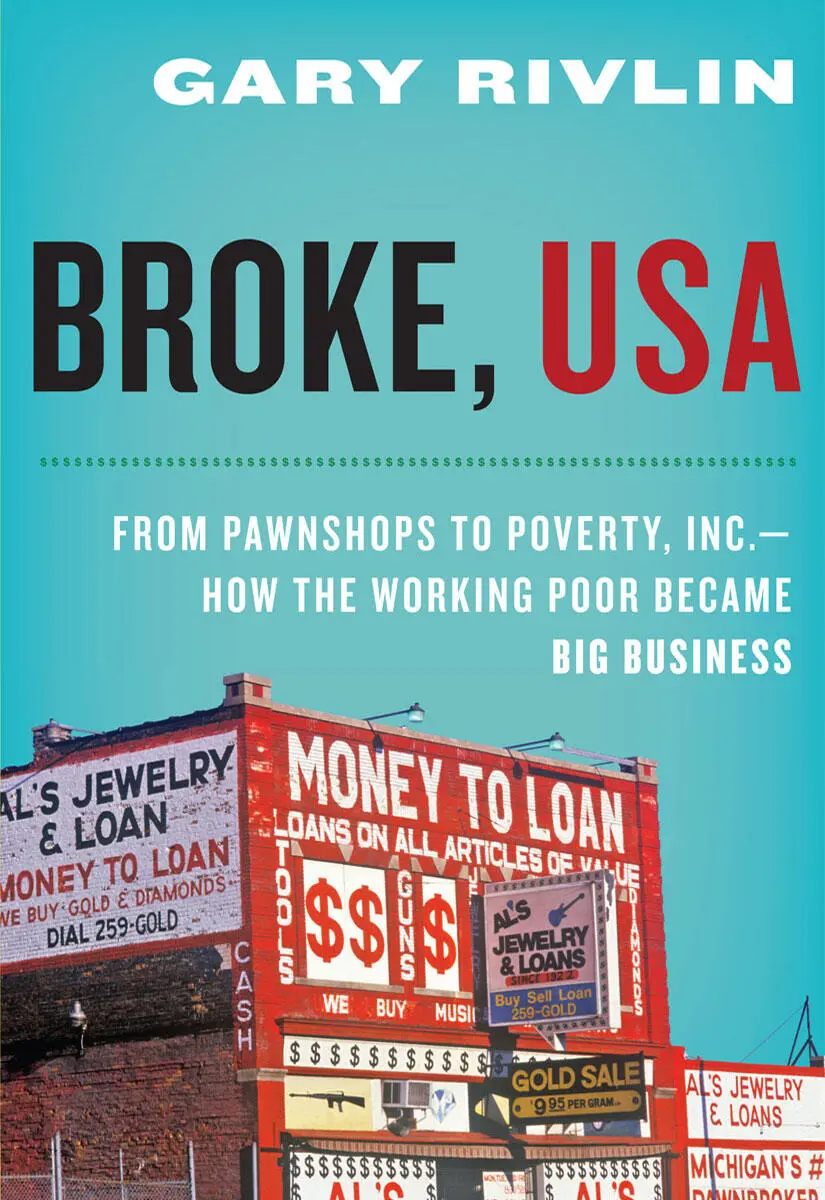
- Название:Broke, USA
- Автор:
- Издательство:HarperCollins Publishers Inc.
- Жанр:
- Год:2010
- Город:New York
- ISBN:978-0-06-199794-5
- Рейтинг книги:3 / 5. Голосов: 1
-
Избранное:Добавить в избранное
- Отзывы:
-
Ваша оценка:
Broke, USA: краткое содержание, описание и аннотация
Предлагаем к чтению аннотацию, описание, краткое содержание или предисловие (зависит от того, что написал сам автор книги «Broke, USA»). Если вы не нашли необходимую информацию о книге — напишите в комментариях, мы постараемся отыскать её.
Broke, USA — читать онлайн бесплатно полную книгу (весь текст) целиком
Ниже представлен текст книги, разбитый по страницам. Система сохранения места последней прочитанной страницы, позволяет с удобством читать онлайн бесплатно книгу «Broke, USA», без необходимости каждый раз заново искать на чём Вы остановились. Поставьте закладку, и сможете в любой момент перейти на страницу, на которой закончили чтение.
Интервал:
Закладка:
People in Dayton reached out to their congressional delegation hoping for help in Washington. They did their homework, and Jim McCarthy made contact with Martin Eakes and Bill Brennan. They were fighting national banks and other publicly traded companies with a broad geographical reach. This was a problem best fought in Washington, D.C., not Dayton city hall.
Those hoping to warn the rest of the country about the threat posed by the subprime lenders had their successes. Andrew Cuomo, in his final days as HUD secretary under Bill Clinton, spoke out publicly against the problem and Cuomo, along with Larry Summers, the Treasury secretary, created a short-lived task force in April 2000 to examine predatory lending in the United States. That same year Congress would again turn its attention to the subprime lending industry when Congressman Jim Leach, a Republican from Iowa and the chairman of the House Committee on Banking and Financial Services, held a hearing to look at the situation. But it was the misfortune of those advocating reform that in the 1950s, a woman named Florence Gramm managed to buy a small bungalow home in Columbus, Georgia, despite the risks inherent in extending her credit.
There’s no doubting Florence Gramm’s grit and fortitude. Her husband, Kenneth, suffered a stroke shortly after she gave birth to their son Phil. That left him partially paralyzed and unable to work. But Florence Gramm, a nurse, convinced a finance company to loan them the money they needed to buy a home, even though that meant she would need to work double shifts. Throughout his political career, which included three terms as a U.S. senator, Phil Gramm spoke frequently about the subprime loan that enabled his mother to become the first person in her family to own a home.
Gramm wasn’t just any senator; he was determined to serve as his party’s resident expert on the financial industry—once he settled on a political party. He held a Ph.D. in economics and had taught at Texas A&M, while running an economic consulting firm on the side, before deciding to get into politics in the 1970s. The surest route to victory in Texas back then was to run as a Democrat, and that was what Gramm did when he was first elected to Congress, but he had switched to the Republican Party by the time of his election to the Senate in 1984. He is probably best known for his co-authorship of the landmark Gramm-Rudman-Hollings Act, which in the 1980s established deficit reduction targets for the federal budget. More recently, he was the primary sponsor of the Gramm-Leach-Bliley Act, the bill that undid the post-1929 crash reform mandating that banking, brokerage, and insurance businesses remain separate. There was no denying his power through the 1990s and into the 2000s. Any federal legislation curbing the behavior of the country’s subprime lenders would need to first pass muster with the powerful chairman of the Senate Committee on Banking, Housing and Urban Affairs, and Senator Phil Gramm of Texas was not about to meddle with this corner of the free enterprise system that had played so exalted a role in his family’s history.
“Some people look at subprime lending and see evil,” he said on the Senate floor during debate over a bill to clamp down on subprime lenders in 2001. “I look at subprime lending and I see the American dream in action. My mother lived it as a result of a finance company making a mortgage loan that a bank would not make.” And if nostalgia were not enough to ensure his gung-ho support, then there was also the generosity of these lenders who helped to keep him in office year after year. Between 1989 and 2002, commercial banks were more generous with Gramm than with anyone else in the Senate and he received more from Wall Street than all but a few colleagues. In 2000, the National Association of Mortgage Brokers praised Gramm for killing an anti–predatory lending bill that was gaining momentum in Congress.
There’s a difference, of course, between a subprime loan that costs a borrower a couple of percentage points above standard mortgage rates and those costing five or ten percentage points more. Gramm told of the 50 percent premium his parents paid in interest rates because she was a higher credit risk, but Tommy Myers, Freddie Rogers, and Dora Byrd could only dream that they had been paying interest rates only 50 percent higher than the conventional rate. There were no doubt other differences between the mortgage that Florence and Kenneth Gramm received in the 1950s and the high-fee, high-interest-rate loans that some of Gramm’s colleagues wanted to curb. The Gramms received their loan prior to the deregulation of the 1980s, when lenders were still prohibited from charging more than 1 percent of the loan amount in up-front fees. It’s also doubtful that Florence Gramm’s loan would have been saddled by lump-sum credit insurance policies, giant balloon payments they couldn’t possibly afford, or any of the other practices critics were trying to curb.
“We wanted to go for a federal fix,” McCarthy said. “Because that was really the way to deal with predatory lending. [But] basically, Senator Gramm’s view was, ‘Over my dead body,’ and so we said fine, we’ll start from the bottom up.”
Maybe the biggest surprise following the success of Martin Eakes and his allies in North Carolina was that their victory didn’t inspire copy-cat bills in states across the country. Their victory had inspired people in Ohio, but the activist leading the charge in favor of an anti–predatory lending bill, Bill Faith, the executive director of a group called the Coalition on Homelessness and Housing in Ohio, was telling people it wasn’t time. “The banks and mortgage brokers and these other characters have the place completely locked down,” Faith told them. “We’re trying everything—and all it’s meant is our heads are bloody from hitting them against a wall.” California passed a watered-down subprime lender bill in October 2001, more than two years after North Carolina, but mainly the fight fell to a few cities like Chicago, Philadelphia, and Dayton.
The Chicago legislation came first, but it was a largely symbolic law, a bill that claimed jurisdiction only over those banks already doing business with the city. “We have very limited power as a city,” Mayor Richard M. Daley told the Chicago Sun-Times . “It’s basically building a groundswell.”
Philadelphia’s law, passed in April 2001, was anything but symbolic. Tougher than even North Carolina’s, Philadelphia’s dictated that lenders operating inside the city limits could not charge more than 4 percent in up-front costs or interest rates more than 6.5 percent higher than a long-term Treasury bill. Philadelphia, a city with a population greater than that of twelve states, had its own Bill Brennan: Irv Ackelsberg, an attorney with Community Legal Services who as far back as the mid-1990s was talking about subprime lending as a “public crisis.” It’s as though society has dealt with the problem of inadequate credit among low-income people, Ackelsberg would say, by drowning them in destructive debt that only increases their chances of reaching financial ruin. Access to credit wasn’t necessarily a positive thing.
The next locale to draw the industry’s attention, improbably, was the country’s 152nd-largest city, with slightly more people than Joliet, Illinois, but not nearly as many as Amarillo, Texas, or Newport News, Virginia.
Dean Lovelace had never been the most popular fellow inside Dayton city hall. For starters there was the way he was elected, running against the political establishment in tandem with a white man who would be elected Dayton’s first Republican mayor in twenty-five years. And if that were not enough to earn the ire of his new colleagues, he ensured their antipathy by voting against the emergency measure they sponsored to grant themselves a raise. Lovelace would begin his crusade to champion an anti–predatory lending bill with the activist community at his side as well as the town’s main newspaper (“a striking jump in unscrupulous lending,” the Daily News wrote in a 2000 editorial, “[is] putting more low-income homeowners at increasingly higher risk of losing their homes”), but no solid allies among his fellow commissioners.
Читать дальшеИнтервал:
Закладка:
Похожие книги на «Broke, USA»
Представляем Вашему вниманию похожие книги на «Broke, USA» списком для выбора. Мы отобрали схожую по названию и смыслу литературу в надежде предоставить читателям больше вариантов отыскать новые, интересные, ещё непрочитанные произведения.






Обсуждение, отзывы о книге «Broke, USA» и просто собственные мнения читателей. Оставьте ваши комментарии, напишите, что Вы думаете о произведении, его смысле или главных героях. Укажите что конкретно понравилось, а что нет, и почему Вы так считаете.