Gary Rivlin - Broke, USA
Здесь есть возможность читать онлайн «Gary Rivlin - Broke, USA» весь текст электронной книги совершенно бесплатно (целиком полную версию без сокращений). В некоторых случаях можно слушать аудио, скачать через торрент в формате fb2 и присутствует краткое содержание. Город: New York, Год выпуска: 2010, ISBN: 2010, Издательство: HarperCollins Publishers Inc., Жанр: Старинная литература, на английском языке. Описание произведения, (предисловие) а так же отзывы посетителей доступны на портале библиотеки ЛибКат.
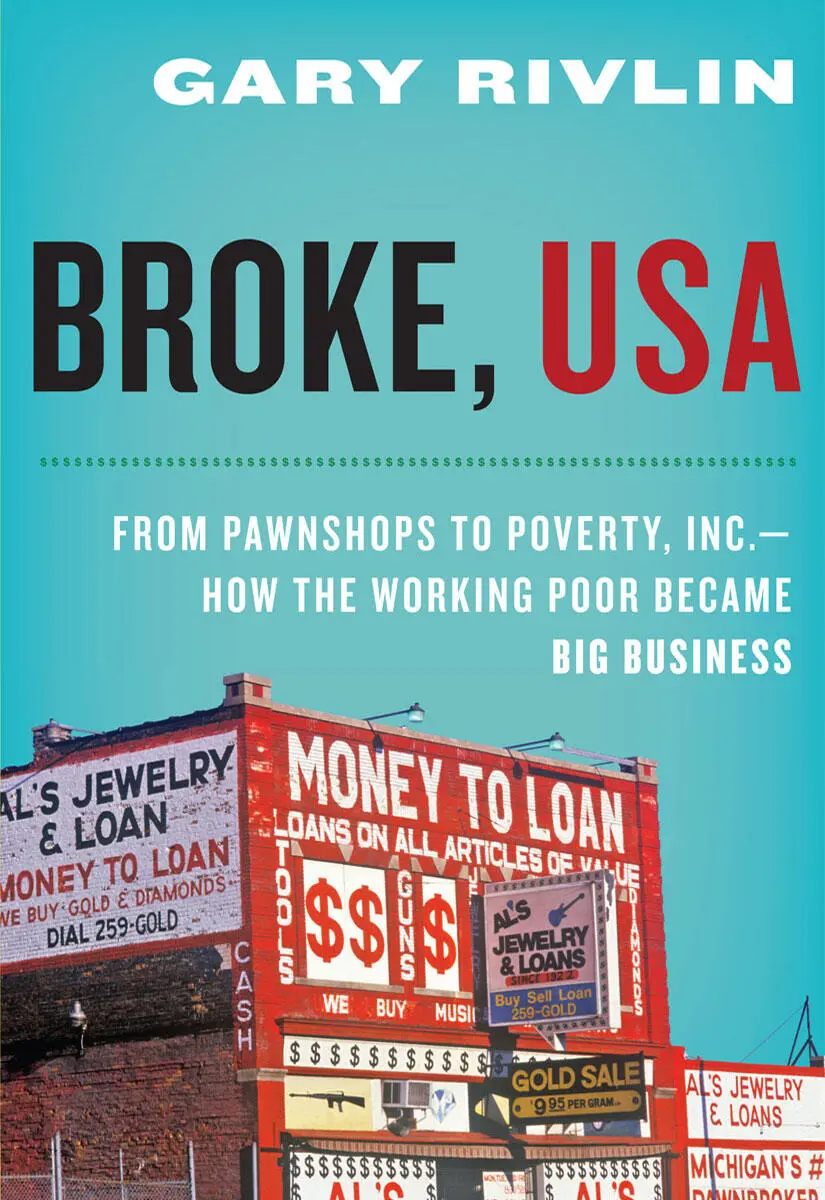
- Название:Broke, USA
- Автор:
- Издательство:HarperCollins Publishers Inc.
- Жанр:
- Год:2010
- Город:New York
- ISBN:978-0-06-199794-5
- Рейтинг книги:3 / 5. Голосов: 1
-
Избранное:Добавить в избранное
- Отзывы:
-
Ваша оценка:
Broke, USA: краткое содержание, описание и аннотация
Предлагаем к чтению аннотацию, описание, краткое содержание или предисловие (зависит от того, что написал сам автор книги «Broke, USA»). Если вы не нашли необходимую информацию о книге — напишите в комментариях, мы постараемся отыскать её.
Broke, USA — читать онлайн бесплатно полную книгу (весь текст) целиком
Ниже представлен текст книги, разбитый по страницам. Система сохранения места последней прочитанной страницы, позволяет с удобством читать онлайн бесплатно книгу «Broke, USA», без необходимости каждый раз заново искать на чём Вы остановились. Поставьте закладку, и сможете в любой момент перейти на страницу, на которой закончили чтение.
Интервал:
Закладка:
In Spartanburg, Webster tried not to get angry as he read Fox’s reports. Instead he flew to Washington to meet with her. Webster prides himself on his ability to get along with anyone but he confessed Fox proved the exception. “A person says stuff like ‘legalized loan-sharking,’” he said, “and it’s hard not to take this stuff very personally.” But he had to agree with Fox on at least one point: the need to state the cost of their loans as an annual percentage rate. That was what Advance America’s general counsel had concluded after researching the law. Webster could have overruled her, but he figured people didn’t care about the APR, they only cared that they could have $300 today and what they would owe in two weeks. And so Advance America, alone among the big chains, started posting its rates not only as a dollar figure but also as an APR.
It bothers Webster when people think there’s a taint to the way he’s made his money. People don’t say anything directly to him, he told me when I visited with him in Spartanburg in early 2009; they are too polite for that. But he hears things secondhand and he always addresses it immediately when it comes up. He prefers to give someone a tour of an Advance America store but, if they’re not willing to do that, all he asks for is a bit of their time. “I have to say that virtually to a person, if I have thirty minutes to explain the business to them, they’ll let me know that it makes perfect sense: ‘I didn’t understand that.’”
The hallways of the handsome postmodern brick building that Advance America has built as its headquarters in central Spartanburg are lined with posters that express good feelings in words and images. The self-affirming artwork justifying what everyone inside does for a living seems a staple of the big Poverty, Inc. chains. More typically they are more wholesome and upbeat, leftovers from old advertising campaigns that depict a veritable Rainbow Coalition of handsome, extraordinarily happy young people (“They showed me the money!” the young Latino man with the smoldering brown eyes and thousand-watt smile exclaimed in an ad for a company called Instant Tax Service) but at Advance America, at least in the winter of 2009, they were more playful and droll, a series of small testimonials to some of its archetypal customers. For the postal worker, the payday loan is for when “the mail bag’s heavy but your pockets are light.” The working mom needs Advance America for “those times when your eyelids weigh a little more than your wallet.”
Webster is a slight man, with angular features and a tiny pug nose. Dressed in jeans and running shoes, he bobbed his foot incessantly through our few hours together. Webster had served as chief executive through Advance America’s first nine years but several years ago, when he was in his late forties, he stepped down because his wife was sick and he wanted to take care of the couple’s four children. He had recently returned, replacing George Johnson as board chairman, but he started by telling me that he had been reluctant to meet with me, despite being back at the helm. It was the APR. “Most journalists stop at the 391 percent interest rate, and the only question is, ‘How on earth can you charge so much?’” he said. He had his answers, just like the other payday lenders did when I visited them. But to him, it’s a meaningless number—like saying salmon costs $15,980 per ton or advertising a hotel room as costing $36,500 per year. A flat fee is not an interest rate. Webster shakes his head. He had been the first to post the APR and had to confess, “It has been a millstone around our neck ever since.”
Webster listed his decision to post the eye-popping, three-digit APRs as one of his “two gross misjudgments.” The other was his failure to anticipate the hailstorm of criticism that would rain down on the payday lenders. “If there’s an irony to all this, it’s that we both should have been more politically aware that there was a political dimension to this business,” he said of himself and Johnson. “It’s hard to imagine but back then there was little controversy about payday lending.” Sure, there were companies overly aggressive in their collections and lax about posting their fees. But Advance America, Webster said, was trying to clean things up. They refused to criminally prosecute anyone who failed to pay them back and unilaterally announced that they would give people twenty-four hours to change their mind about a loan. Along with the other big chains, Advance America, in 1999, formed a trade association they called the Community Financial Services Association, or CFSA, so they could offer a narrative that might serve as a counterforce to the shock of a three-digit APR. “With a trade association in place,” Jared Davis said, “we thought we could actually get back to doing what we do, which is create new jobs and give people access to credit when they need it.”
As the 1990s turned into the 2000s, worried payday lenders told themselves to relax. Theirs was a young industry experiencing a bit of turbulence but that was to be expected. The rent-to-own furniture stores had gone through a similar boom period in the late 1980s and early ’90s; their brethren in the check-cashing business had been fighting with regulators and their critics for more than a decade. Legislatures around the country had implemented caps on the fees check cashers could charge and regulators frustrated the more aggressive rent-to-own entrepreneurs by dictating new business practices that cut into their profits, but both industries adjusted and both were posting big profits.
For all the bad publicity the industry was receiving, the payday lenders were also thriving. The check cashers would hold workshops at their annual meeting about getting into the payday loan business and the session would be standing room only. For many it was a no-brainer given it required no special expertise. Small-time pawnbrokers might resent the intrusion of payday as an option for those with bad credit seeing quick cash, but the bigger pawn chains were now seeing only opportunity in these quick, unsecured, cash loans that earned triple-digit interest per year, and they jumped. “It was an easy way to add rocket fuel to the bottom line,” said Jerry Robinson, the former Stephens, Inc. banker. The industry passed the 10,000-store mark by 2001 and entrepreneurs with national ambitions were still lined up at the industry’s door, hoping to get in.
“It got unbelievably competitive,” Jared Davis said. “It was literally a race from space to space.” It was, Davis said, like all those horses and wagons lined up on the Oklahoma border in 1889 for the great land rush. And, oddly, probably the most frantic opening of a new market took place in 2003—in Oklahoma. “If I could do anything differently,” Billy Webster told me, “it would be to spend more time telling our story to journalists, editorial boards, and opinion leaders.” But who had the time when there were still great stretches of the country to conquer?
Seven
Subprime City
Dean Lovelace first focused on all the payday lending shops sprouting up around Dayton. It was the second half of the 1990s and to Lovelace, who had served on the Dayton City Commission since 1993, it felt like his hometown was under attack. It was no wonder. By 1999, Allan Jones and Billy Webster had each opened seven stores in the greater Dayton area and Toby McKenzie had opened six. Jared and David Davis, the brother tandem behind Check ’n Go, had added another four. It was as if the demographics from this one unprepossessing blue-collar city in the heartland had been poured into a database and bells started clanging and lights started flashing JACKPOT! on computer screens in the corporate development offices of payday chains across the country. Closer to home, there was Lee Schear, a local entrepreneur whom Lovelace was inclined to describe as a “profiteer.” For years Schear had been making plenty off the working poor, cashing checks (for a fee) and selling lottery tickets at the small chain of grungy grocery stores he ran in Dayton’s poorer precincts. But with the legalization of payday, he was now operating two dozen of these storefronts in and around town. By the end of the 1990s, Dayton, a city of 150,000, and the surrounding suburbs were home to more than fifty payday shops.
Читать дальшеИнтервал:
Закладка:
Похожие книги на «Broke, USA»
Представляем Вашему вниманию похожие книги на «Broke, USA» списком для выбора. Мы отобрали схожую по названию и смыслу литературу в надежде предоставить читателям больше вариантов отыскать новые, интересные, ещё непрочитанные произведения.








Обсуждение, отзывы о книге «Broke, USA» и просто собственные мнения читателей. Оставьте ваши комментарии, напишите, что Вы думаете о произведении, его смысле или главных героях. Укажите что конкретно понравилось, а что нет, и почему Вы так считаете.