Gary Rivlin - Broke, USA
Здесь есть возможность читать онлайн «Gary Rivlin - Broke, USA» весь текст электронной книги совершенно бесплатно (целиком полную версию без сокращений). В некоторых случаях можно слушать аудио, скачать через торрент в формате fb2 и присутствует краткое содержание. Город: New York, Год выпуска: 2010, ISBN: 2010, Издательство: HarperCollins Publishers Inc., Жанр: Старинная литература, на английском языке. Описание произведения, (предисловие) а так же отзывы посетителей доступны на портале библиотеки ЛибКат.
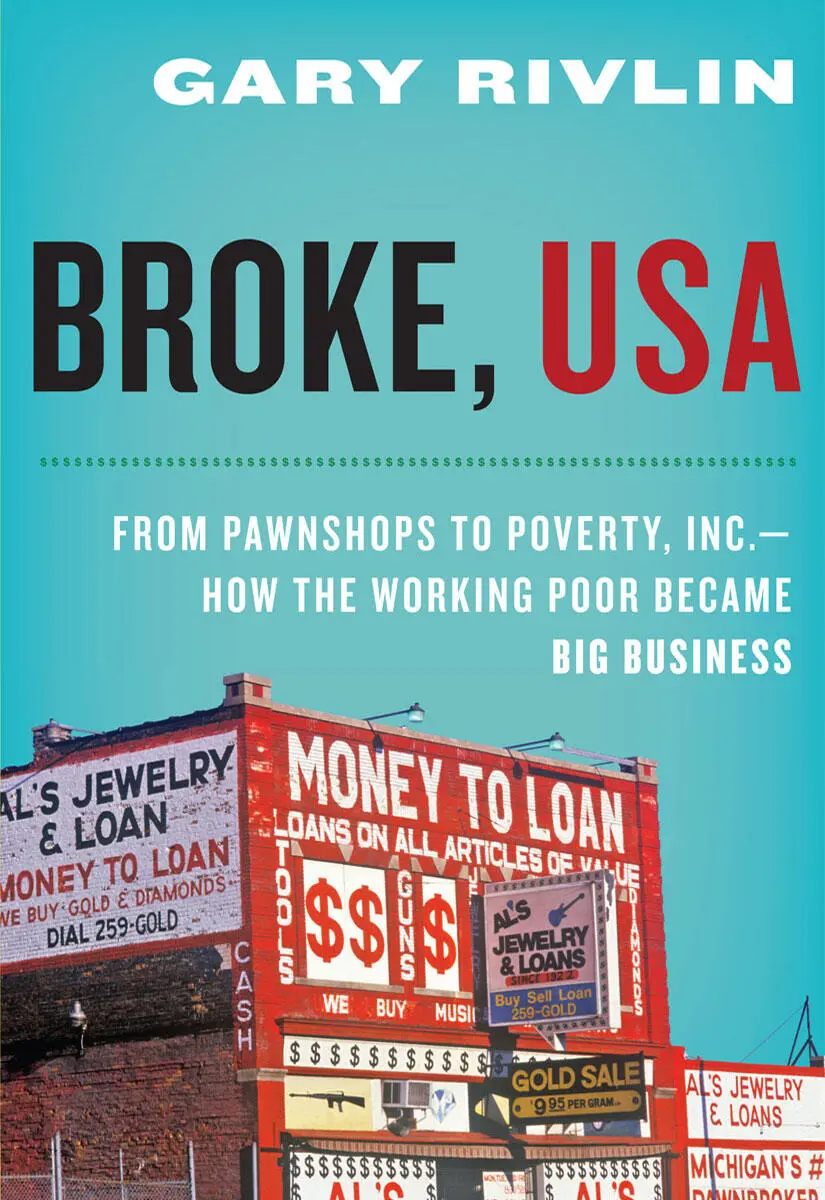
- Название:Broke, USA
- Автор:
- Издательство:HarperCollins Publishers Inc.
- Жанр:
- Год:2010
- Город:New York
- ISBN:978-0-06-199794-5
- Рейтинг книги:3 / 5. Голосов: 1
-
Избранное:Добавить в избранное
- Отзывы:
-
Ваша оценка:
Broke, USA: краткое содержание, описание и аннотация
Предлагаем к чтению аннотацию, описание, краткое содержание или предисловие (зависит от того, что написал сам автор книги «Broke, USA»). Если вы не нашли необходимую информацию о книге — напишите в комментариях, мы постараемся отыскать её.
Broke, USA — читать онлайн бесплатно полную книгу (весь текст) целиком
Ниже представлен текст книги, разбитый по страницам. Система сохранения места последней прочитанной страницы, позволяет с удобством читать онлайн бесплатно книгу «Broke, USA», без необходимости каждый раз заново искать на чём Вы остановились. Поставьте закладку, и сможете в любой момент перейти на страницу, на которой закончили чтение.
Интервал:
Закладка:
Then there were all those television pieces Brennan was able to orchestrate in the Atlanta area using his local contacts. Abusive and predatory loans weren’t necessarily illegal, and so when he was getting nowhere with a case, he would give a heads-up to a friendly TV reporter. In short order, a story would air about an elderly black woman living on meager means who had been ruined by Associates, or the short-order cook with diabetes who struggled to stand on his feet all day, or the hardworking couple with two young children, and there would be Brennan, eyes moist, bathing the viewer in sincerity, decrying the terrible injustice that had been done. With the heat turned up high, negotiations would commence and an accord would be reached contingent upon everyone’s future silence. Brennan’s friends dubbed it the “media-induced settlement.” Brennan copied several of these local broadcasts onto a video and, along with the Primetime Live piece and a few other choice offerings (including snippets of depositions with two former Associates employees, who spoke of the lengths they would go to lard deals with expensive extras), sent it along to Self-Help.
In the hands of most advocates, Brennan’s tape would have been a useful tool. In the hands of Martin Eakes it took on a life of its own. Inside Self-Help they made jokes about what they called Eakes’s “teletubby”—the stout combination TV-VCR that the boss brought with him everywhere during the months they were lobbying for an anti–predatory lending law in Raleigh. There were fifty state senators in North Carolina and 120 members of the state assembly and Eakes, intent on showing the tape to every last one of them, rolled his teletubby door-to-door in the manner of an old-fashioned vacuum cleaner salesman. If a receptionist or some other staffer was reluctant to allow him inside to see a legislator, he would show it to that person, hoping after viewing it he or she would feel compelled to pass the tape he left behind on to their boss. One news account had Self-Help distributing seven thousand copies of the videotape around the state. By that time, Eakes had testified no fewer than eight times in favor of an anti–predatory lending bill. “People say I work hard,” Mike Calhoun said, “but he put me to shame in that fight.” The initiative was supported by a group calling itself the Coalition for Responsible Lending. The coalition included such mainstream advocacy groups as the NAACP and AARP but the political establishment in Raleigh could be forgiven for thinking this legislative battle was brought to them and sponsored by Martin Eakes and the people of Self-Help.
Calhoun, whom Bill Brennan described as “the smartest lawyer I’ve ever worked with,” was the resident expert on consumer law within Self-Help, so it fell to him to type out a draft of the legislation. (“You’re not going to see a lot of clerical staff at Self-Help,” Calhoun sighed.) The aim of the bill was to impose limits on what a subprime lender could charge its customers. Roy Cooper, the senate majority leader and a Democrat, agreed to sponsor the bill. “We were beginning to see complaints filed by consumers and we began to hear concerns voiced by lawyers seeing these unfair terms at closings,” said Cooper, who had been elected to his second term as North Carolina attorney general by the time I visited him in the fall of 2008. “So we realized we needed to put some bright-line limits on the amount of charges associated with the loans.” Years later Cooper still remembered Freddie Rogers—not just his name but also his exact hourly wage and other details of his case.
Initially a long list of senators joined Cooper as co-sponsors, but after the lobbyists weighed in, Cooper ended up as its sole sponsor in the Senate. “North Carolina is the second-largest banking state in the country, so the banking industry is a significant economic engine here,” Cooper said. “They had a significant influence over the legislature and government process.” The key was to bring the banks around, or at least convince them to remain on the sidelines. That would be no easy task given the hundreds of millions in profits a local giant like NationsBank was booking selling subprime loans.
Ayear after the predatory lending fight was over, Eakes asked Keith Corbett, an executive at North Carolina Mutual, the nation’s oldest black-owned insurance company, to join them at Self-Help. “We don’t pay a lot in salary,” Eakes told Corbett. “But if we see someone who’s been mistreated, we’re willing to spend two to three million dollars to right that wrong.” Corbett was sold.
That’s exactly what happened in the case of Freddie Rogers. Mike Calhoun was among those working out an out-of-court settlement with Associates that allowed Rogers to refinance with Self-Help under terms he could afford. A few years later, a developer seeking to gentrify Rogers’s neighborhood paid him a substantial bounty for his home. By that time he had remarried.
Over the years Eakes had made his share of political enemies in Raleigh. “Imam” or “ayatollah” were among the less flattering nicknames given to him inside the state capitol by those resenting his sermonizing and righteousness, but there was also no denying his effectiveness. “He got along with a lot of my Republican colleagues, maybe better than I did,” Wib Gulley said. To his activist allies he might have been the accidental banker who was still one of their own, but for political purposes he was a subprime mortgage banker horrified by the lending practices of some of his more unscrupulous rivals. He was also a man on a first-name basis with the CEOs of some of the state’s largest lending institutions. He made the same pitch to each: The bad practices of the worst subprime lenders hurt the reputations of all in the mortgage business. Eventually even the North Carolina Bankers Association supported the reform bill. “That was Martin,” Roy Cooper said. “Working and working and working to bring the industry into the fold.”
The political fighting over the anti–predatory lending bill raged for the better part of a year. The bill was modified, for instance, to allow a lender to charge a borrower as much as 5 percent in up-front fees. “If your parents paid five points on a loan, you wouldn’t be very happy,” Calhoun said. But the legislation banned prepayment penalties on any mortgage less than $150,000 and made it illegal to roll into a loan the cost of credit insurance (credit insurance itself, with separate monthly payments, was still legal). Lenders could charge interest rates well above the rates enjoyed by prime customers but anyone wanting to sign a deal that would have them pay rates more than ten percentage points higher than a Treasury bill would be required to meet with a credit counselor. The bill was signed into law in July 1999.
Even with its limitations, consumer advocates hailed the law as a significant breakthrough. Inside Self-Help’s offices, the phone was now ringing with activists from places such as New Jersey, Chicago, and Dayton eager to pass something similar in their locale. “Initially we thought we passed this predatory lending bill, okay, good, we’re done, now we can go back to our day jobs,” said Mark Pearce. “But people wanted to know how we did it, especially as North Carolina wasn’t exactly seen as the most liberal, consumer-friendly state in the country.”
Six
The Great Payday Land Rush
Allan Jones parks in front of his old office building and a sly smile appears on his face, like someone anticipating the punch line of a favorite joke. He points his chin at a drab, low-slung cement bunker of a structure sitting in the corner of a shopping center parking lot. This is where he played host, he tells me, when all those investment bankers flew south to see him in the late 1990s to talk about taking Check Into Cash public. They would arrive dressed in Bill Blass and Brooks Brothers and Armani. He would be wearing an off-the-rack suit he bought at a discount place in town. He would then usher them into his “conference room”—maybe ten metal chairs around a banged-up, folding banquet table—where he would make his presentation. Check Into Cash’s revenues were on pace to more than double in 1998; its profit margins were well above 20 percent. At that point, Jones said, they could have cared less had he been naked and standing in a cave: “Them numbers are all they ever noticed,” he said.
Читать дальшеИнтервал:
Закладка:
Похожие книги на «Broke, USA»
Представляем Вашему вниманию похожие книги на «Broke, USA» списком для выбора. Мы отобрали схожую по названию и смыслу литературу в надежде предоставить читателям больше вариантов отыскать новые, интересные, ещё непрочитанные произведения.


Обсуждение, отзывы о книге «Broke, USA» и просто собственные мнения читателей. Оставьте ваши комментарии, напишите, что Вы думаете о произведении, его смысле или главных героях. Укажите что конкретно понравилось, а что нет, и почему Вы так считаете.