Gary Rivlin - Broke, USA
Здесь есть возможность читать онлайн «Gary Rivlin - Broke, USA» весь текст электронной книги совершенно бесплатно (целиком полную версию без сокращений). В некоторых случаях можно слушать аудио, скачать через торрент в формате fb2 и присутствует краткое содержание. Город: New York, Год выпуска: 2010, ISBN: 2010, Издательство: HarperCollins Publishers Inc., Жанр: Старинная литература, на английском языке. Описание произведения, (предисловие) а так же отзывы посетителей доступны на портале библиотеки ЛибКат.
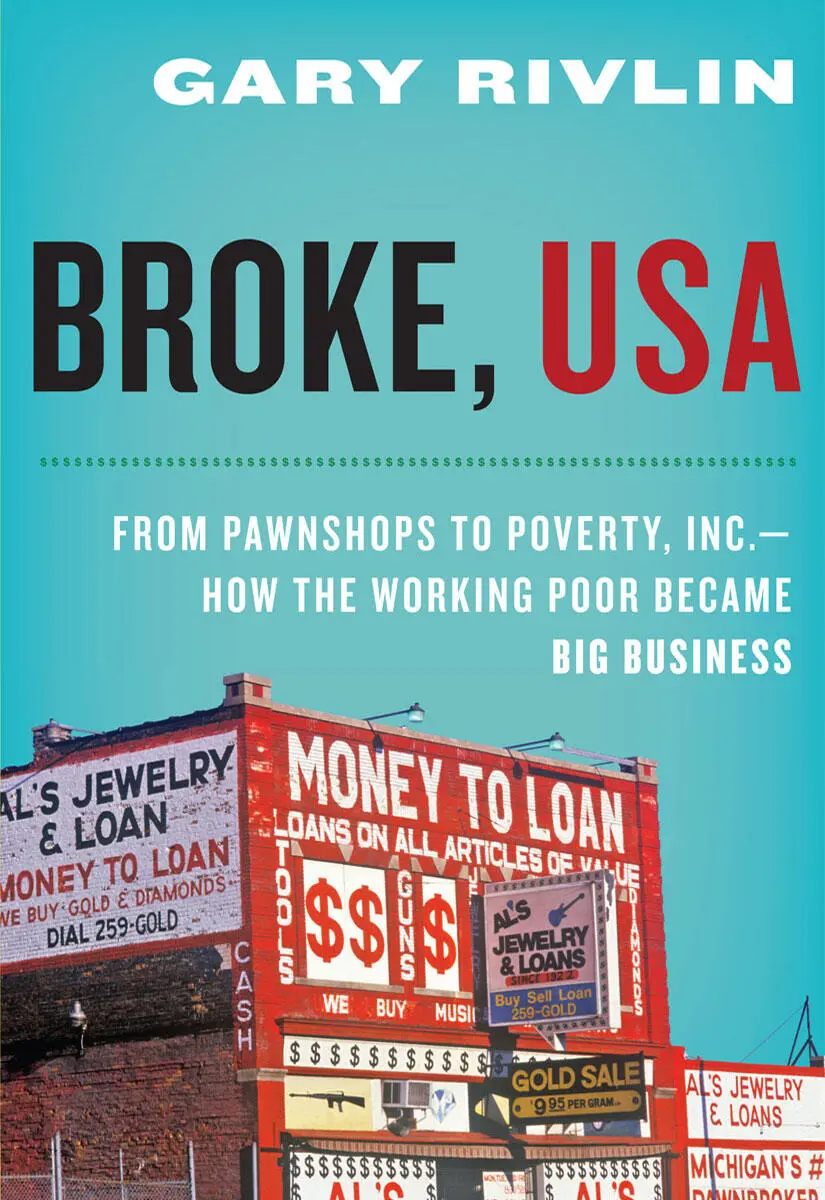
- Название:Broke, USA
- Автор:
- Издательство:HarperCollins Publishers Inc.
- Жанр:
- Год:2010
- Город:New York
- ISBN:978-0-06-199794-5
- Рейтинг книги:3 / 5. Голосов: 1
-
Избранное:Добавить в избранное
- Отзывы:
-
Ваша оценка:
Broke, USA: краткое содержание, описание и аннотация
Предлагаем к чтению аннотацию, описание, краткое содержание или предисловие (зависит от того, что написал сам автор книги «Broke, USA»). Если вы не нашли необходимую информацию о книге — напишите в комментариях, мы постараемся отыскать её.
Broke, USA — читать онлайн бесплатно полную книгу (весь текст) целиком
Ниже представлен текст книги, разбитый по страницам. Система сохранения места последней прочитанной страницы, позволяет с удобством читать онлайн бесплатно книгу «Broke, USA», без необходимости каждый раз заново искать на чём Вы остановились. Поставьте закладку, и сможете в любой момент перейти на страницу, на которой закончили чтение.
Интервал:
Закладка:
Pretty much any housing activist or consumer advocate who has heard Martin Eakes speak in public in recent years has heard the story of the phone call Eakes made to Texas on behalf of Freddie Rogers. The woman on the other end of the line accused Eakes of being a competitor out to steal a loan away from her company. She was evasive and dodged basic questions that a lender was legally obligated to answer. “I just snapped,” Eakes said. “I just started making a lot of threats.” We’re going to get this borrower out from under your thumb, he told the woman. We’re going to drive your company out of our state. “You’ve picked a fight with the wrong guy at the wrong time,” he told her. It was only after he hung up the phone that, with the help of his staff, Eakes realized he had threatened to boot from North Carolina one of the two or three largest consumer finance companies in the world.
Eakes is intense when he’s angry but he’s not the demonstrative kind. The signs that he is steeling for a fight are more subtle. His normally ruddy complexion turns a darker, more splotchy red. His jaw gets a fierce set to it and his jaw muscles start working. Those who have been at his side for a long time notice that his language changes as well. The more pragmatic Eakes, the physics major turned lawyer and banker, is replaced by the philosophy major who orates about right and wrong and the moral imperative everyone at Self-Help should feel to confront injustice when they see it. When Eakes is in that mode, Thad Moore, who has worked with Eakes for more than twenty-five years, hears a lapsed Baptist channeling the sermons of his youth. “He gets in this preaching mode about why we do what we do and why it’s important and how we’re taking on these pressing issues in our society that demand to be dealt with,” Moore said. “When I hear him power up and get going, I feel like I’m hearing the Baptist within.”
The Self-Help way is to meet, analyze, and dissect, and then meet some more. Every time Self-Help contemplated venturing into a new area, whether it was loaning money to charter schools and day-care centers or the move into the refinance business, their modus operandi was to gather in small groups and as an organization debate the new initiative. Eakes might have been hell-bent on action but they were a credit union, not a public interest advocacy organization. With everything else going on, were they going to devote the money and the energy that would be required to see them through a fight that would invariably land them in Raleigh, the state capital, if not Washington—all because the boss had lost his temper during a phone conversation with another lender? Mark Pearce, who had started at Self-Help in 1996, was among those arguing forcefully for them to take the fight to Associates. But Pearce, who would serve as the Center for Responsible Lending’s first president before leaving in 2006 to take a posting as North Carolina’s deputy commissioner of banks, also saw why some, especially those working in the business loan department, might disagree. “It was a real challenge to our mission,” Pearce said. “Self-Help was working so hard to get people into homes, and it’s not like we were anywhere near to meeting our goals on that front.”
In the end, though, the sheer size of Associates left the Self-Help executive team feeling they had no choice. Associates had started its life nearly a century earlier as an auto finance company aimed at helping people buy a Model T. Where Self-Help had a half dozen offices around the state and had made around five hundred home loans in North Carolina in 1998, Associates had eighty storefronts scattered around North Carolina making or buying thousands of home loans each year. Self-Help relied largely on word of mouth and a network of nonprofits; Associates had Terry Bradshaw, the former football great, pitching its loans on television and booming, “We make loans that make life better!” At Self-Help they felt like they were really something when in the late 1990s they were making more than $25 million in home loans each year. When, in 1998, Ford spun off Associates First Capital, as its subprime lending unit was called, through an initial public offering, it was generating nearly $1 billion a year in profits.
“It really hit us in the face,” Mike Calhoun said. “We recognized that if we don’t do something about predatory lending, we’re kidding ourselves that we’re really achieving something by putting people in homes.” This organization that had always viewed its core mission as helping families build wealth had come to the conclusion that it was equally as important to help families protect the wealth they had already attained. The solution, as they saw it, was for North Carolina to become the first state in the country to pass an anti–predatory lending bill aimed at reining in the most audacious practices of its subprime lenders.
In downtown Durham, an activist named Peter Skillern heard from Martin Eakes and told himself that it was about time. For years, Skillern, the executive director of the Community Reinvestment Association of North Carolina, or CRA-NC, had been organizing protests against subprime lenders at home and in Washington. He had even been known to don a rubber shark’s nose to underscore his point that these lenders were a dangerous breed to avoid. Skillern admired Eakes and all that he had accomplished but Self-Help had declined to take part in CRA-NC’s actions. “Martin is a remarkably effective leader,” Skillern told me when I visited with him in Durham—but that only made Eakes’s lack of engagement in the fight that much more maddening.
Skillern’s bête noire wasn’t Associates but a lender much closer to home, NationsBank, based in Charlotte. To him, NationsBank, one of the country’s largest, offered a stark example of what he saw as the country’s “parallel banking system.” “It’s like NationsBank has two doors, side by side,” Skillern told me. If you were white, middle class, and had good credit, you were ushered into one door. If you were low-income and had imperfect credit, you were shuffled into the door for either NationsCredit or EquiCredit, Nation’s two subprime subsidiaries. And if you were black your economic class or FICO score didn’t seem to matter; according to studies, you were far more likely to end up with one of the subprime lenders and one of their high-interest loans just by virtue of the color of your skin. The subprime lenders claimed they needed to charge higher interest rates and steeper fees to offset the increased risk they were taking with subprime borrowers but Skillern thought that was bunk. The big consumer finance companies, Forbes reported in 1997, were enjoying returns as much as six times greater than those of the best-managed banks. Neither NationsCredit nor EquiCredit was nearly as large as Associates, but by the late 1990s the two units were generating around $400 million in profits each year.
Skillern would prove to be one important Eakes ally against Associates, Bill Brennan in Atlanta another. Eakes could rely on Rogers to help put a human face on predatory lending and there were others from among the fifty people who had complained about Associates to the state authorities over the previous year. Brennan, however, provided video, much of it starring Bill Brennan and all of it powerful. Brennan had played a key role in the making of the Primetime Live episode, providing some of the piece’s rhetorical fire (he described Ford Motor as “the worst predatory lender in the country”) and also its heart. It was Brennan who pointed a producer to the couple who would give the exposé its emotional anchor, the Iveys of Atlanta, who almost lost their home of twenty-five years after a broker with Associates talked them into consolidating some credit card bills in a preposterously expensive home equity loan that included 24 percent in up-front charges and a payment schedule this couple of modest means couldn’t possibly afford.
Читать дальшеИнтервал:
Закладка:
Похожие книги на «Broke, USA»
Представляем Вашему вниманию похожие книги на «Broke, USA» списком для выбора. Мы отобрали схожую по названию и смыслу литературу в надежде предоставить читателям больше вариантов отыскать новые, интересные, ещё непрочитанные произведения.








Обсуждение, отзывы о книге «Broke, USA» и просто собственные мнения читателей. Оставьте ваши комментарии, напишите, что Вы думаете о произведении, его смысле или главных героях. Укажите что конкретно понравилось, а что нет, и почему Вы так считаете.