Gary Rivlin - Broke, USA
Здесь есть возможность читать онлайн «Gary Rivlin - Broke, USA» весь текст электронной книги совершенно бесплатно (целиком полную версию без сокращений). В некоторых случаях можно слушать аудио, скачать через торрент в формате fb2 и присутствует краткое содержание. Город: New York, Год выпуска: 2010, ISBN: 2010, Издательство: HarperCollins Publishers Inc., Жанр: Старинная литература, на английском языке. Описание произведения, (предисловие) а так же отзывы посетителей доступны на портале библиотеки ЛибКат.
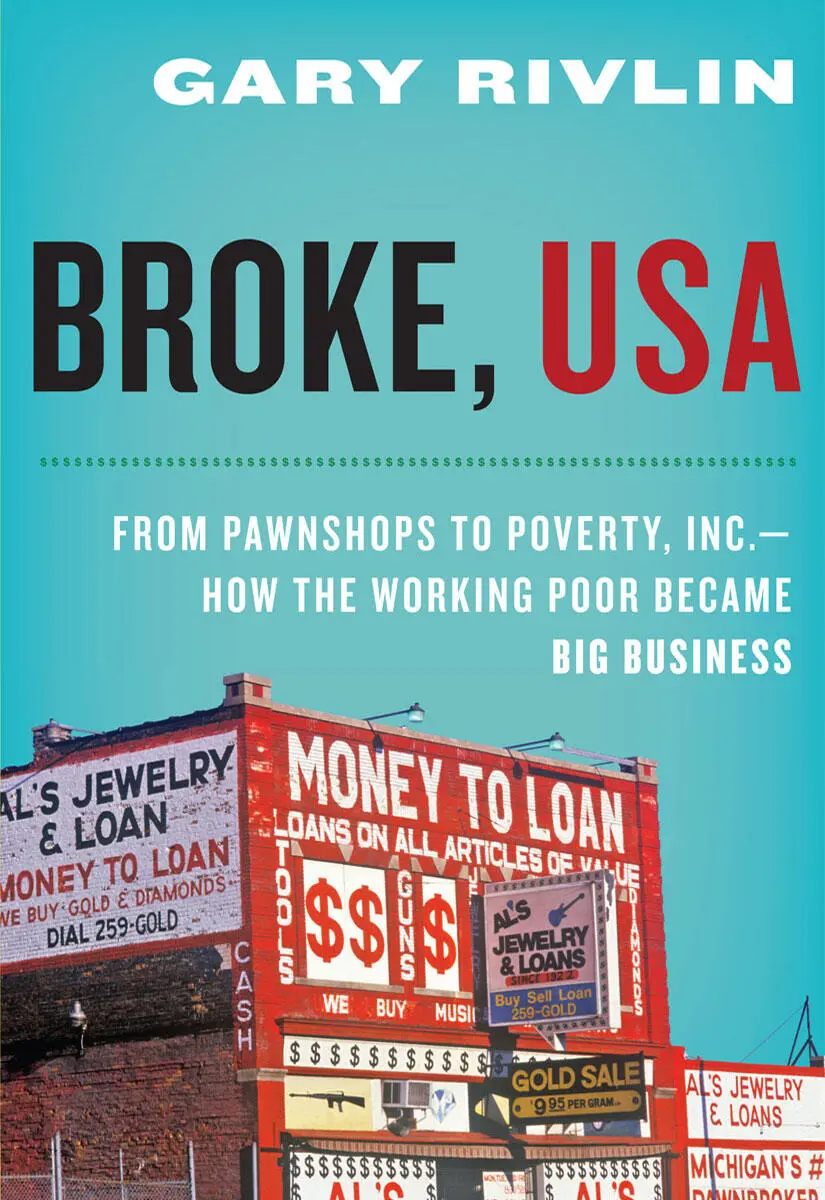
- Название:Broke, USA
- Автор:
- Издательство:HarperCollins Publishers Inc.
- Жанр:
- Год:2010
- Город:New York
- ISBN:978-0-06-199794-5
- Рейтинг книги:3 / 5. Голосов: 1
-
Избранное:Добавить в избранное
- Отзывы:
-
Ваша оценка:
Broke, USA: краткое содержание, описание и аннотация
Предлагаем к чтению аннотацию, описание, краткое содержание или предисловие (зависит от того, что написал сам автор книги «Broke, USA»). Если вы не нашли необходимую информацию о книге — напишите в комментариях, мы постараемся отыскать её.
Broke, USA — читать онлайн бесплатно полную книгу (весь текст) целиком
Ниже представлен текст книги, разбитый по страницам. Система сохранения места последней прочитанной страницы, позволяет с удобством читать онлайн бесплатно книгу «Broke, USA», без необходимости каждый раз заново искать на чём Вы остановились. Поставьте закладку, и сможете в любой момент перейти на страницу, на которой закончили чтение.
Интервал:
Закладка:
Then a man named Freddie Rogers, a widower in his fifties raising a daughter on his own, walked into Self-Help’s offices. “I think we’re basically self-honest about where we’re making a difference and where we’re not,” Eakes said. And Freddie Rogers, earning $8.24 an hour driving a bus for the Durham public schools, showed Self-Help “that just one predatory lender like Associates was doing more harm than all the good we were doing.”
Lanier Blum took an instant liking to the tall black man who showed up in her Self-Help office in the fall of 1998 interested in talking about a new home loan. Borrowers at Self-Help typically seem to arrive wearing whatever they happen to have on, but Freddie Rogers had dressed smartly in nice slacks, a button-down shirt, and a stylish hat worn jauntily on his head. “I had business to take care of,” he would later explain. He was outgoing, warm, and chatty, and he showed Blum pictures of his daughter and spoke lovingly about his wife, who had died some years earlier. “He was a very, very charming guy,” Blum said.
Self-Help had always focused on first-time homebuyers. But Blum had recently been put in charge of a new product Self-Help was experimenting with called the “fix-it loan.” Borrowers seeking a mortgage on a home that needed extensive repairs were eligible for a fix-it loan but so, too, were homeowners who needed money to make the basic repairs so a property holds its value. That was Rogers, who years earlier had bought a home with his wife in a semirural neighborhood on the southern outskirts of Durham. Drainage problems caused the basement to flood, and the flooding, along with a lack of proper ventilation, was causing mold to form on walls inside the house. Worse, there were no sewer or water lines in that part of the city and the septic tank they used for their waste had developed a leak, which was fouling the water of a well they relied on for their drinking water. It had gotten so bad, Rogers explained to Blum, that he and his daughter had been forced to move out until he could find the money to make the repairs.
Blum was familiar with the community where Rogers lived, an historically black section of town not far from a large regional mall that had recently opened near the interstate. Subdivisions were popping up all around that part of town, and, though Rogers still lived in a neighborhood with gravel roads and few amenities, his was a potentially hot property. Already there had been noise about rezoning the area to encourage outside investment. “I really wanted to help him stay where he was living,” Blum said. “He was obviously very attached to the house because he had bought it with his wife. But I also thought he could be in a position to do very well if the area was developed.”
Rogers had served in the army when he was young and then taken a job with the Durham schools, where he had worked since the early 1960s. “He seemed a real stable guy,” Blum said. “He had some credit issues but nothing too terrible. I thought, Let’s get a payoff quote and see what we’re dealing with.” She phoned Irving, Texas, where Associates had its headquarters—and then she phoned and phoned and phoned some more. “We absolutely harassed those people,” said Blum, whom Eakes has nicknamed “the Pest.”
At first the sticking point was the payoff figure. The person on the other end of the phone refused to give it to her, though refusing a payoff quote for a borrower is akin to a credit card company declining to tell a customer the total amount he or she owes in back charges. When finally someone provided Blum with the dollar figure, that only served to confuse the issue further. Rogers had records showing that while he was often late in paying his mortgage, he had never missed a payment, yet Associates was claiming he still owed the company nearly as much as he had borrowed ten years earlier. In all those years he had managed to pay down the principal by only a few thousand dollars. That must be a mistake, Blum told herself, so she asked someone to fax over a copy of his payment history. That seemed no more complicated than making a few taps on a keyboard but a company representative claimed that information wasn’t available. The Pest persevered until eventually somebody in Irving faxed over pages of records that Blum was convinced had been fabricated, and she handed the file off to Self-Help’s loan servicing department.
At that point, Blum wasn’t suspicious so much as curious. Sure, the people on the other end of the phone couldn’t respond in a straightforward manner to a routine request, but she figured they were some fly-by-night operator staffed by incompetents. “I had never seen a loan like this,” Blum said. “I really wanted to know what these other lenders knew that we didn’t know.” More borrowers came in seeking a fix-it loan and they too had loan terms similar to Rogers’s. At Self-Help, they required down payments of at least 5 to 10 percent, yet Associates and other lenders proved willing to write loans valued at 100 percent of the assessed worth of the property. “I was thinking, Why are we being so conservative? What have these banks figured out that we haven’t?” said Blum. These other lenders were charging interest rates four, five, or six percentage points higher than Self-Help’s, if not more. That struck Blum as a steep premium but she also had to ask herself if Self-Help was taking more risk than people inside the organization realized.
“We always saw ourselves as the high-risk lender of last resort,” said Blum, who had a degree in city planning, not finance. “We thought we were the ones out there providing loans to our customers where no one else was doing it. It came as a surprise that there were even these other players in the communities we were serving.”
The truth would emerge once Blum, with the help of others inside Self-Help, was able to piece together the details of Rogers’s loan. Years earlier, he and his wife had borrowed $29,000 through the Veterans Administration to buy their home, but then they had allowed themselves to be talked into refinancing with Associates. Under the new loan terms, they were paying 13.7 percent in interest and now owed $47,500, including thousands in fees and thousands more for a credit insurance policy. Associates hit Rogers with a penalty fee every time he was late with a payment, as any lender would, but the company would also tack on extra interest charges, treating his account as if it were perpetually in arrears. The bottom line was that Rogers was stuck. His home was not worth enough to justify the size of the loan Self-Help would need to pay off Associates and still have enough money left over for Rogers to make the necessary repairs on his property. And even if Self-Help were inclined to take the risk, Rogers, with a salary of around $17,000 a year, didn’t make enough to reliably cover the monthly payments.
“It took us some time,” Blum confessed, “but we eventually realized this wasn’t just an issue of one guy. This was a big company out there and they were lending a lot of money to a lot of people.”
Blum stopped by Eakes’s office one night when both were working late. She told him about Rogers’s predicament and Eakes pulled out his calculator. Had Rogers refinanced his loan through Self-Help and made the same monthly payments he had been making to Associates, Eakes found, he would have paid off his loan in full and even built up a modest-sized savings account. Instead he still owed Associates nearly as much as he had borrowed. Freddie Rogers’s only crime was that he, like much of the populace, wasn’t financially sophisticated. It had ended up costing him tens of thousands of dollars and it might well cost him his house. “This is scandalous,” he declared. He promised Blum he would call Irving, Texas, the next day.
Читать дальшеИнтервал:
Закладка:
Похожие книги на «Broke, USA»
Представляем Вашему вниманию похожие книги на «Broke, USA» списком для выбора. Мы отобрали схожую по названию и смыслу литературу в надежде предоставить читателям больше вариантов отыскать новые, интересные, ещё непрочитанные произведения.










Обсуждение, отзывы о книге «Broke, USA» и просто собственные мнения читателей. Оставьте ваши комментарии, напишите, что Вы думаете о произведении, его смысле или главных героях. Укажите что конкретно понравилось, а что нет, и почему Вы так считаете.