Gary Rivlin - Broke, USA
Здесь есть возможность читать онлайн «Gary Rivlin - Broke, USA» весь текст электронной книги совершенно бесплатно (целиком полную версию без сокращений). В некоторых случаях можно слушать аудио, скачать через торрент в формате fb2 и присутствует краткое содержание. Город: New York, Год выпуска: 2010, ISBN: 2010, Издательство: HarperCollins Publishers Inc., Жанр: Старинная литература, на английском языке. Описание произведения, (предисловие) а так же отзывы посетителей доступны на портале библиотеки ЛибКат.
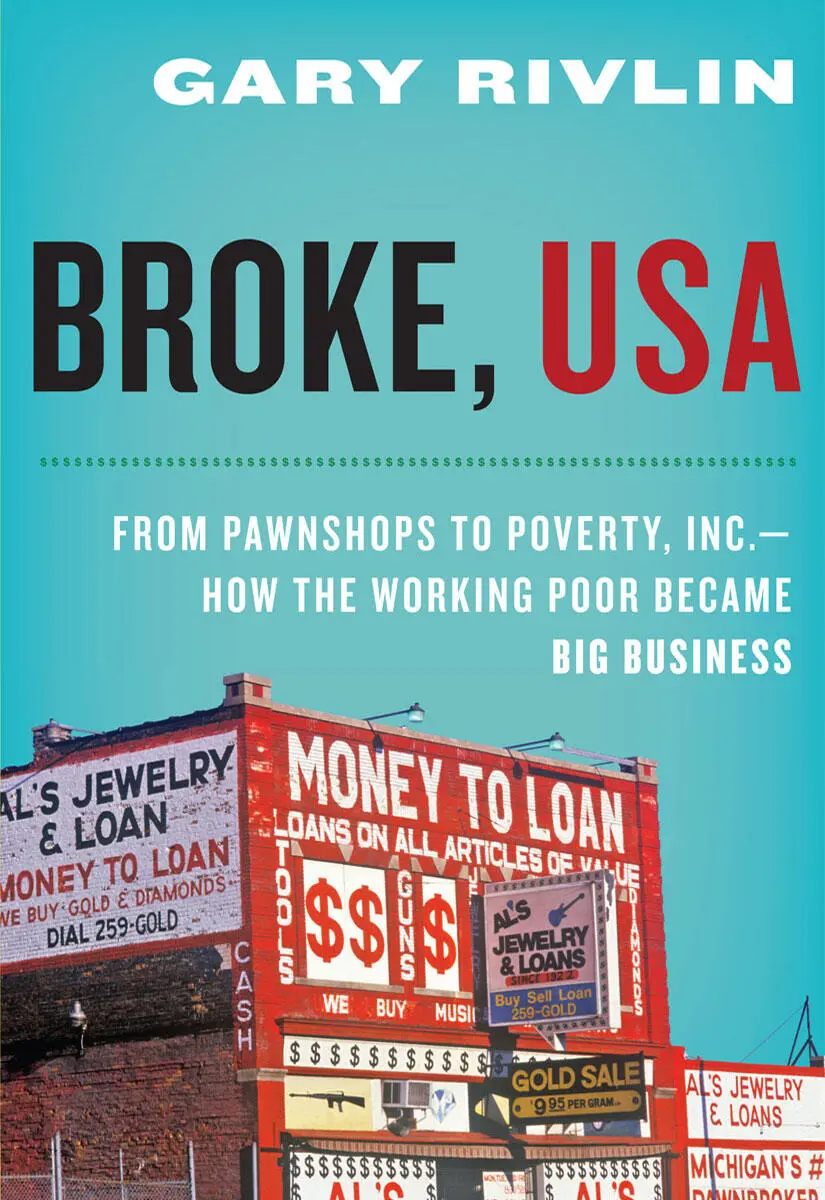
- Название:Broke, USA
- Автор:
- Издательство:HarperCollins Publishers Inc.
- Жанр:
- Год:2010
- Город:New York
- ISBN:978-0-06-199794-5
- Рейтинг книги:3 / 5. Голосов: 1
-
Избранное:Добавить в избранное
- Отзывы:
-
Ваша оценка:
Broke, USA: краткое содержание, описание и аннотация
Предлагаем к чтению аннотацию, описание, краткое содержание или предисловие (зависит от того, что написал сам автор книги «Broke, USA»). Если вы не нашли необходимую информацию о книге — напишите в комментариях, мы постараемся отыскать её.
Broke, USA — читать онлайн бесплатно полную книгу (весь текст) целиком
Ниже представлен текст книги, разбитый по страницам. Система сохранения места последней прочитанной страницы, позволяет с удобством читать онлайн бесплатно книгу «Broke, USA», без необходимости каждый раз заново искать на чём Вы остановились. Поставьте закладку, и сможете в любой момент перейти на страницу, на которой закончили чтение.
Интервал:
Закладка:
With the recognition and the acclaim, the deposits flowed in, and with more capital to work with, Eakes and Self-Help were able to get more ambitious still. A fund was established expressly to loan money to people wanting to get in the day-care business and the credit union got in the charter school financing business as well. Self-Help financed a homeless shelter in Durham and a large home that served as an early sanctuary for people with AIDS. Self-Help even acted in the role of a developer, buying landmark buildings in cities around North Carolina where it had a branch, rehabbing the properties, and then leasing offices to local nonprofits at a discount.
Self-Help’s boldest move began when Eakes started to think about the limits of what he had built. By the mid-1990s, Self-Help was up to seven branches around the state, but in ten years the organization had helped maybe one thousand families buy a first home. Some might have been impressed with Self-Help and its pace of growth but Eakes was struck with how slowly they were moving. That was what propelled him to make the drive to Winston-Salem, ninety minutes from Durham, to meet with Leslie “Bud” Baker, Jr., then the president of the Wachovia Corporation, one of North Carolina’s largest banks.
“We knew we were never going to be big enough to have the kind of impact we wanted to have,” Eakes said. “But Wachovia had branches all over the state. If we could get Wachovia to make loans to single African-American mothers, it would have a much bigger impact than we ever could.”
In Baker’s office, Eakes offered Self-Help’s clients as Exhibit A. His borrowers might not seem loan-worthy at first glance but they also realized this might be the only chance in their lives to own a home. They had less of a financial cushion than those in higher income brackets and were more likely to fall behind in their payments, Eakes conceded. But by that point, Eakes and Self-Help had been in the home loan business for nearly a decade. They had foreclosed on only three homes, and in all three cases the credit union had recouped its original investment. In almost ten years, they had yet to write off a single loss.
Eakes didn’t persuade Baker to start loaning Wachovia’s money to low-income families that first time they met. He failed to convince him a few months later when they met again or when he visited him for a third time several months after that. It might have been the right thing to do, and also judicious given the Community Reinvestment Act, but it also meant breaking with the established benchmarks of lending and Wachovia was a traditional, old-fashioned bank. When Baker finally relented, he told Eakes, “We’ll give it a try. We’ll make $10 million worth of these loans. I think we’ll lose half that money but it’s worth it to get you out of my office so I don’t have to hear you talking anymore.” As Eakes likes to tell the story, he walked out of Baker’s office without another word.
As Baker had promised, Wachovia wrote $10 million in home loans to those with solid work records but tarnished credit ratings, and Wachovia would write another $10 million in similar loans after that. But though people inside Wachovia assured Eakes the loans were performing well, they also told him that was more or less it. The bank didn’t feel comfortable carrying more than $20 million in nontraditional, subprime loans on its books.
That was when Self-Help decided to take the truly revolutionary step of creating a secondary market for subprime loans. As Eakes saw it, Self-Help could help so many more people if they had more than just a dozen or so loan officers scattered around a single midsize state. That was Eakes’s pitch to Bud Baker and the other bank presidents with whom he would meet. “I said to them, ‘Most people covet your money but I covet your delivery mechanism. You have branches all over the state. You have twenty thousand loan officers all over kingdom come. You can reach every little neighborhood we can’t.’” And if joining in his cause wasn’t reason enough to play in the secondary market he was creating, there were more concrete advantages as well. “I would tell them,” Eakes said, “‘We’ll pay you a fee, you’ll make your money, and you get to be the hero and get your CRA credits.’”
Again Eakes started with Wachovia, whom he approached with a unique offer. We’ll buy all the $20 million in loans you’ve made to low-income clients, he told Baker, if you promise to use the proceeds to make more loans to people of modest means. The catch was that Self-Help was going to borrow most of that $20 million from Wachovia itself. They’d put up $2 million as a down payment and the $20 million loan portfolio would serve as the collateral for the loan. “We were taking all the credit risk,” said Mike Calhoun. “If the mortgages went bad, we were out our reserves and the entire portfolio with a book value of $20 million reverted to them.” They would pay market rate on the loan to Wachovia but Calhoun and others had done the math: Self-Help would still come out ahead if all went as planned. Wachovia said yes and, Calhoun said, “We knew we were in business.”
Eakes was anxious to approach other banks with what he called his “godfather proposition”—a deal too good to refuse. Holding him back was a lack of cash. To make that first $20 million deal work, Self-Help needed to make a $2 million down payment, and it wasn’t as if the organization had that kind of money lying around to write more checks of that size. As luck would have it, one of Self-Help’s biggest financial backers, the Ford Foundation, which had aided Self-Help dating back to its worker-owned cooperative days, was confronting a unique challenge: the need to spend a lot of money and spend it fast.
By law, a foundation must pay out at least 5 percent of the total worth of its holdings each year, and in 1998, with dot-com fever fueling the stock market, the Ford Foundation’s portfolio ballooned. “I have a really big idea,” Eakes began when contacting his liaison at the foundation, and his timing couldn’t have been better. Ford gave Self-Help $50 million to help underwrite this new secondary market for subprime real estate loans, and with the commitment from Ford, Self-Help was able to convince Fannie Mae to guarantee the loans. Self-Help’s money would still be on the line—the company had to indemnify Fannie for 100 percent of any losses—but the mortgage giant’s imprimatur meant that this relatively anonymous, relatively small, Durham-based nonprofit could package and resell mortgages to Wall Street.
The process was called “mortgage securitization.”
Five
Freddie Rogers
The staff of Self-Help was so focused on their mission of expanding access to mortgage credit for the working poor that for a long time—despite some high-profile warnings—they didn’t notice they had competition. One of the most prominent was the investigative piece that ABC’s Primetime Live did on a company called Associates. It featured an interview with a former Associates loan officer who claimed he could barely live with himself while he worked there, given the gimmicks he was taught (talk fast, turn the pages fast) by higher-ups to trick people into signing for loans they couldn’t possibly afford. A second former employee told of the “tremendous pressure” every loan officer felt to pack loans with expensive extras, and both confessed to witnessing fellow agents forge signatures. The Wall Street Journal ran an equally unflattering piece about Associates focused on a single customer, a retired quarry worker named Bennie Roberts living in Virginia on $841 a month in Social Security and retirement benefits. The Journal found that Associates, a subsidiary of the Ford Motor Company, had refinanced, or flipped, Roberts’ loan ten times in four years, costing him $19,000 in fees on what had originally been a $1,250 home equity loan. Associates would even earn its own chapter in a book called Merchants of Misery , edited and largely written by a reporter named Mike Hudson. But who had time for books or the Wall Street Journal or TV when inside Self-Help they were busy saving the world? “It’s a tough act to run the business we do,” Mike Calhoun said.
Читать дальшеИнтервал:
Закладка:
Похожие книги на «Broke, USA»
Представляем Вашему вниманию похожие книги на «Broke, USA» списком для выбора. Мы отобрали схожую по названию и смыслу литературу в надежде предоставить читателям больше вариантов отыскать новые, интересные, ещё непрочитанные произведения.








Обсуждение, отзывы о книге «Broke, USA» и просто собственные мнения читателей. Оставьте ваши комментарии, напишите, что Вы думаете о произведении, его смысле или главных героях. Укажите что конкретно понравилось, а что нет, и почему Вы так считаете.