Gary Rivlin - Broke, USA
Здесь есть возможность читать онлайн «Gary Rivlin - Broke, USA» весь текст электронной книги совершенно бесплатно (целиком полную версию без сокращений). В некоторых случаях можно слушать аудио, скачать через торрент в формате fb2 и присутствует краткое содержание. Город: New York, Год выпуска: 2010, ISBN: 2010, Издательство: HarperCollins Publishers Inc., Жанр: Старинная литература, на английском языке. Описание произведения, (предисловие) а так же отзывы посетителей доступны на портале библиотеки ЛибКат.
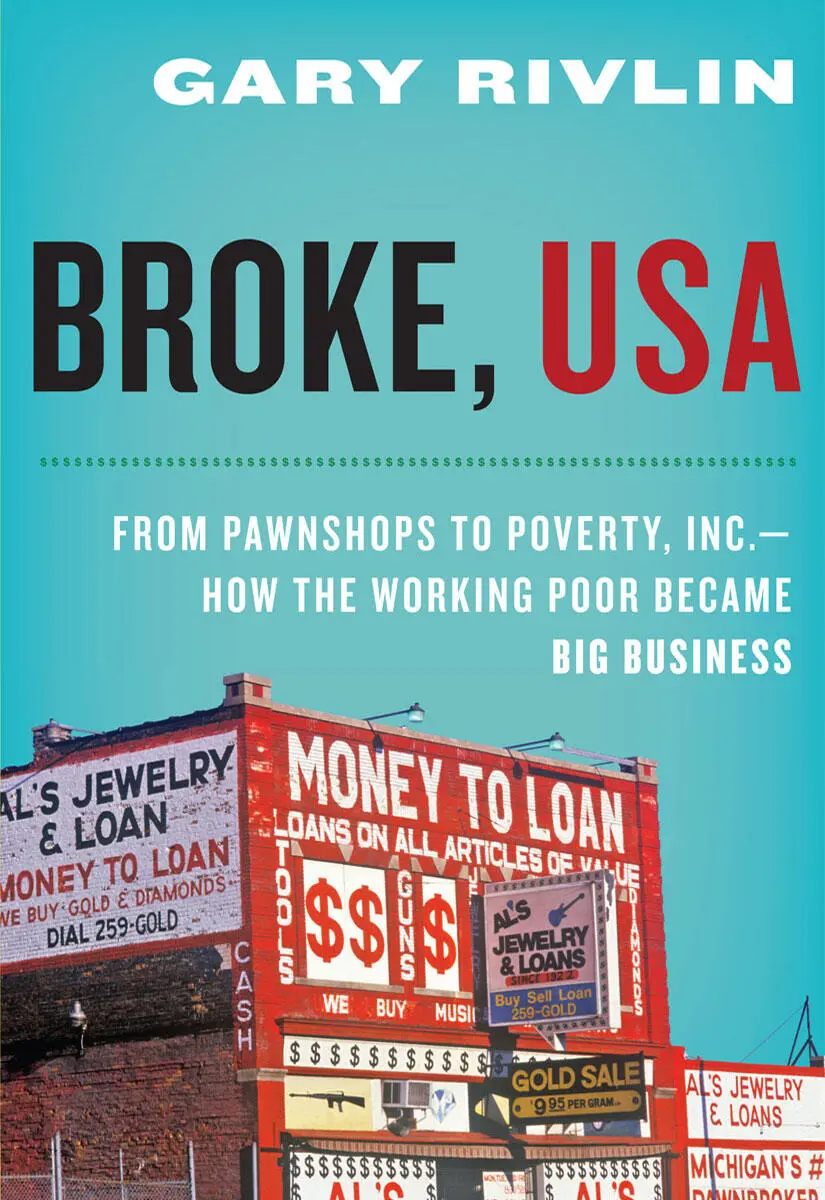
- Название:Broke, USA
- Автор:
- Издательство:HarperCollins Publishers Inc.
- Жанр:
- Год:2010
- Город:New York
- ISBN:978-0-06-199794-5
- Рейтинг книги:3 / 5. Голосов: 1
-
Избранное:Добавить в избранное
- Отзывы:
-
Ваша оценка:
Broke, USA: краткое содержание, описание и аннотация
Предлагаем к чтению аннотацию, описание, краткое содержание или предисловие (зависит от того, что написал сам автор книги «Broke, USA»). Если вы не нашли необходимую информацию о книге — напишите в комментариях, мы постараемся отыскать её.
Broke, USA — читать онлайн бесплатно полную книгу (весь текст) целиком
Ниже представлен текст книги, разбитый по страницам. Система сохранения места последней прочитанной страницы, позволяет с удобством читать онлайн бесплатно книгу «Broke, USA», без необходимости каждый раз заново искать на чём Вы остановились. Поставьте закладку, и сможете в любой момент перейти на страницу, на которой закончили чтение.
Интервал:
Закладка:
It was never easy. “If we had known what kinds of loans you intended to make,” Eakes quotes an early regulator as saying, “we’d have never let you get started.” Self-Help was deliberately seeking out those with the poorest credit rankings getting by on meager wages; its typical borrower in the early 1990s had a family income of $22,000. (A household wasn’t eligible for a Self-Help loan if its occupants earned more than the area’s median income.) But Self-Help’s borrowers were purchasing $30,000 or $50,000 homes and receiving loans almost as favorable as their prime counterparts. The key, Eakes said, was to find people who had proven themselves to be hard workers and then make sure they weren’t buying a home beyond their means. In a 1993 interview with a publication called Business/North Carolina , H. Allen Carver, who ran the Atlanta office for the National Credit Union Administration, declared himself a convert. His agency, he said, watched Self-Help “like a hawk” but Eakes’s organization had proven “they’ve got their act together.”
The local media seemed equally impressed. The editorial board at the Raleigh News & Observer dubbed Self-Help “heroes of high finance” and the Winston-Salem Journal heralded the organization as “the bank of last resort.” All around the state newspapers were running Self-Help profiles featuring single mothers and people who had known mostly bad luck and misfortune until Self-Help boosted them out of a trailer park or public housing and into a modest home of their own. President George H. W. Bush designated Self-Help one of his “thousand points of light,” and in 1993 President Clinton singled out Self-Help as a model when announcing a $382 million revolving loan fund to help bring economic opportunity to neglected communities. By that time, the Self-Help Credit Union had thirty-five full-time employees and $40 million under management. Over the next few years, the United Nations would honor Self-Help as one of the United States’ twenty most successful economic development projects and the MacArthur Foundation would bestow on Eakes a $260,000 “genius” grant for “helping the rural poor, women and minorities obtain $90 million in loans to start businesses and buy homes.”
His shoes were a pair of scuffed, dirt-smeared Reeboks that might raise an eyebrow at a backyard barbecue. They looked even more out of place given the rest of Martin Eakes’s ensemble. He wore a pair of pinstriped gray dress slacks that matched the suit jacket draped atop a box in the corner, and a wrinkled white dress shirt that was frayed at the cuffs and collar. Later that day, he explained after shaking my hand to welcome me to his office, he would be flying to New York. So he put on the pants this morning and wore the sport coat to the office so he wouldn’t have to carry a garment bag on the plane.
“Martin,” said Keith Corbett, who has worked with Eakes since 2000, “is not a man who wastes a lot of time thinking about things like fashion.” His old law partner’s manner of dress, Wib Gulley told me, caused bemused smirks even on the basketball court. He’s deceptively quick, said Gulley, who played in a regular pickup game with Eakes. He’s smart and tough on the court and he’s certainly not opposed to throwing the occasional elbow. But it was also like playing with Will Ferrell in the movie Semi-Pro , headband and tight shorts included. “He’d show up wearing these fat knee pads and thick Clark Kent glasses—all taped up, of course, because Martin isn’t going to buy new glasses when he can fix them with a little tape,” Gulley said.
He’s lean and fit, despite his age and what Gulley described as Eakes’s “very narrow approach” to food groups. “It’s a wonder he can operate as efficiently as he does,” Gulley said, “on a diet of chocolate chip cookies and ice cream.” For twenty-five years Eakes was a vegetarian but it was causing too many headaches in his family. “I decided I’d be the accommodating one,” Eakes said. He has hazel eyes, a ruddy complexion, and a proud, stubborn chin that he thrusts out and clenches, Bill Clinton–style, when conveying sincerity or defiance. With a razor tongue and reedy Southern accent, he is constantly cracking jokes, offering wiseguy asides, and making self-deprecating remarks. He tends to smirk a lot, as if constantly amusing himself with private jokes, and more often than not he seems to share those lines. For fun the former physics major reads science journals.
His office has a temporary look to it, as if he’s only just moved in. Picture frames and plaques lean against one wall; several cardboard cartons sit on the floor. The walls are practically bare. The first time I saw it, late in 2008, I asked if he’d recently switched offices. He cocked his head and looked at me confusedly. He has had the same office, he told me, for nearly a decade.
Since its inception, Self-Help’s bylaws have dictated that no employee can earn more than three times the pay of the lowest-paid person on the staff. At the end of 2008, some Self-Help workers made $23,000 a year, so that meant Eakes, despite the size of Self-Help and his fancy credentials, was earning a salary of $69,000. “He’s a guy who could have made a bazillion dollars on Wall Street if he didn’t have these social goals,” Calhoun said. “Martin is a hard-nosed businessperson. Make no mistake about it.”
Despite its inability to pay big salaries, Self-Help has never had trouble filling its headquarters with young graduates with advanced degrees from redoubts like Harvard and Prince ton. Its halls are filled with Eakes clones, nerdy and smart and over-degreed and seemingly indifferent to their clothes and their cars. Some years back, when the maximum salary at Self-Help was $32,000 a year, a potential funder came to visit. He took one look at the employee parking lot and shook his head. Never in his life, he said, had he seen such a collection of junkers in a single place. “Basically you could describe Self-Help as a bunch of misfits,” Eakes said. New initiatives seem to be born at night, when people find Eakes in his office and sit to spend an hour or two puzzling through a problem. Eakes describes himself as an introvert but friends and even subordinates scoff at that characterization. Being around other people seems to enliven him, and he certainly doesn’t seem an introvert during staff meetings when he’s acting like the class clown.
Yet Eakes seems to have mixed feelings about the limelight. I’ve seen him speak and he’s a natural, playful and chatty and entertaining, yet he says, and people around him confirm, that he genuinely would prefer to remain at the office and let others take the podium on Self-Help or CRL’s behalf. “He probably turns down ten requests to speak for every one he accepts,” said Mark Pearce, who worked as a top Self-Help executive between 1996 and 2006. “To Martin, testifying before Congress or a state legislature—any kind of public speaking—is a necessary evil that he’ll do only if he can convince himself he has no choice.”
That’s not to say Eakes lacks a robust ego. At times he can come off as supremely confident—even cocky. Within the first few minutes of our first meeting, he mentioned an email he had just written to the chief of staff of an important congressman and then dropped the names of two senators with whom he’d recently spoken. “We’re going to get the mortgage industry cleaned up over the next year,” he said over lunch, “and then we’ll be able to take care of these other issues like payday loans and credit card overdraft fees.” He said this matter-of-factly, as if these vexing national issues were just chores his wife had asked him to do on the way home from the office. Given Self-Help’s modest roots, I asked Eakes, was he astonished by its soaring success? “Not really,” he said with a shrug.
Читать дальшеИнтервал:
Закладка:
Похожие книги на «Broke, USA»
Представляем Вашему вниманию похожие книги на «Broke, USA» списком для выбора. Мы отобрали схожую по названию и смыслу литературу в надежде предоставить читателям больше вариантов отыскать новые, интересные, ещё непрочитанные произведения.








Обсуждение, отзывы о книге «Broke, USA» и просто собственные мнения читателей. Оставьте ваши комментарии, напишите, что Вы думаете о произведении, его смысле или главных героях. Укажите что конкретно понравилось, а что нет, и почему Вы так считаете.