Gary Rivlin - Broke, USA
Здесь есть возможность читать онлайн «Gary Rivlin - Broke, USA» весь текст электронной книги совершенно бесплатно (целиком полную версию без сокращений). В некоторых случаях можно слушать аудио, скачать через торрент в формате fb2 и присутствует краткое содержание. Город: New York, Год выпуска: 2010, ISBN: 2010, Издательство: HarperCollins Publishers Inc., Жанр: Старинная литература, на английском языке. Описание произведения, (предисловие) а так же отзывы посетителей доступны на портале библиотеки ЛибКат.
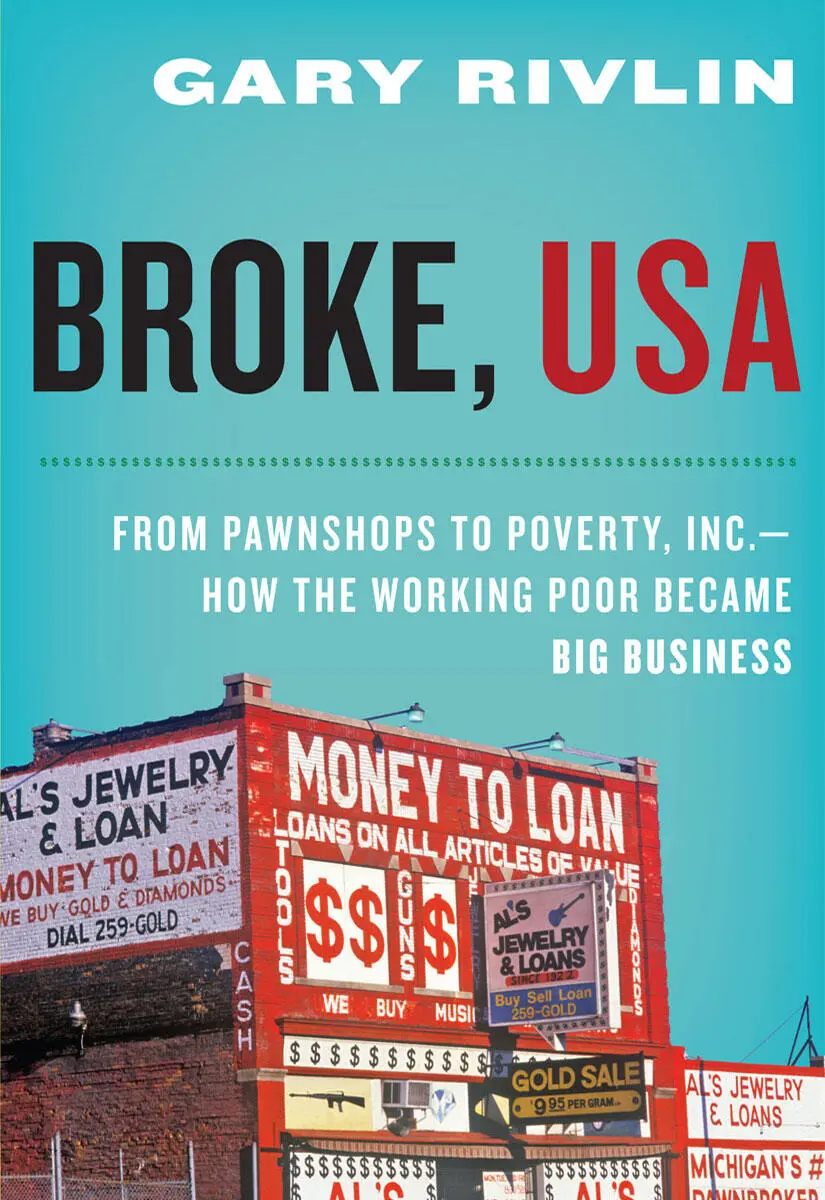
- Название:Broke, USA
- Автор:
- Издательство:HarperCollins Publishers Inc.
- Жанр:
- Год:2010
- Город:New York
- ISBN:978-0-06-199794-5
- Рейтинг книги:3 / 5. Голосов: 1
-
Избранное:Добавить в избранное
- Отзывы:
-
Ваша оценка:
Broke, USA: краткое содержание, описание и аннотация
Предлагаем к чтению аннотацию, описание, краткое содержание или предисловие (зависит от того, что написал сам автор книги «Broke, USA»). Если вы не нашли необходимую информацию о книге — напишите в комментариях, мы постараемся отыскать её.
Broke, USA — читать онлайн бесплатно полную книгу (весь текст) целиком
Ниже представлен текст книги, разбитый по страницам. Система сохранения места последней прочитанной страницы, позволяет с удобством читать онлайн бесплатно книгу «Broke, USA», без необходимости каждый раз заново искать на чём Вы остановились. Поставьте закладку, и сможете в любой момент перейти на страницу, на которой закончили чтение.
Интервал:
Закладка:
CIBC Oppenheimer agreed to serve as the lead underwriter on Check Into Cash’s IPO. CIBC wasn’t Goldman or Morgan but it was a large bank, respectable and legitimate. He even got to New York and rode the subway, where he saw a man with a hairdo he later learned was called a Mohawk. For months he entertained Doughball and the rest of the boys with stories about life up north. I must have arrived, he would say mockingly, because now I have me a real-life lawyer with a Park Avenue address.
Jones claims to have been relieved rather than disappointed when CIBC put the IPO on hold. They told him it was temporary, a short-term setback while the market recovered from a financial crisis everyone was calling the Asian flu, but the competition was heating up and he was anxious for his money. In Cleveland (Ohio), an old-time bank called National City was awakening to the profit potential of subprime and he convinced officials there to loan him the $50 million he had planned to raise through a public offering. The IPO would have meant $50 million in the bank while borrowing from NatCity meant paying back the loan with interest, but remaining private had its own rewards. He was not a man who liked answering to anyone but himself.
“We have board meetings at Check Into Cash,” Jones likes to joke, “but I win every vote one to nothing.” He mentioned a competitor named Billy Webster, whose company, Advance America, has traded shares on the New York Stock Exchange since 2004. “How much of his company does Billy own?” Jones asked. “How much of my company do I own? Go ask Billy and I’ll bet he’ll tell you: His shareholder meetings are a lot longer than mine.”
William M. Webster II lost everything during the Depression. His son, William M. Webster III, started from scratch, turning a single gas station in Greenville, South Carolina, into a modest-sized empire of twenty stations that he would sell to Marathon Oil in the 1970s at a handsome profit. Yet in the eyes of his son, William M. Webster IV, whom everyone called Billy, his father could have accomplished so much more. Billy Webster spent a good part of his teen years working for his old man, pumping gas and thinking how he would be different. His father had inherited his grandfather’s skittishness and worry about taking risks. He vowed that would never be him.
While he was still in college Billy Webster bought a laundry and charged other students a fee to wash their clothes. A Fulbright scholarship took him to Germany to spend a year studying Romantic poetry, but it was while he was studying law at the University of Virginia that his father started talking about the long lines of people queuing up at the Bojangles chicken shack near one of his old gas stations. That spelled the end of his legal career. “I graduated law school on a Saturday and Monday night I’m in the back of a Bojangles, learning how to fry chicken, being taught by a sixteen-year-old black guy from Frogmore, South Carolina,” Webster said. Ten years later, Webster and his father sold their holdings back to Bojangles; the pair were operating two dozen stores generating a combined $24 million in annual sales. By almost any standard, though not his own, Billy Webster was a rich man.
For a time Webster got into politics. Again his father proved the catalyst. He had grown up with Dick Riley, who would serve two terms as South Carolina’s governor (the elder Webster had served as chairman of Riley’s first political campaign). Riley introduced Billy Webster to Bill Clinton, and when the new president appointed Riley to serve as education secretary, Riley brought Webster to Washington to serve as his chief of staff. Webster resigned after two years, intent on returning to the private sector, but then Clinton invited him for a run around the Mall. My scheduling office is a mess, the president told him, and I think you’re the man to help me straighten it out. So Webster spent one more year in Washington before returning to South Carolina to figure out what he would do next.
“I’m not an engineer,” Webster told himself. “I’m not a software guy.” It was the mid-1990s but starting a technology company was out. This man who had made his money selling fried chicken and washing other people’s clothes reminded himself to keep it simple. He thought of his father’s friend, George Dean Johnson, Jr. He had gotten into the garbage collection business before selling it to Waste Management and then jumped into the video rentals market, opening more than two hundred Blockbuster stores before selling them back to the parent company for $156 million. The key was to find a field before it came under the control of its Blockbuster or Home Depot and then aggressively attack it with money, MBAs, and an all-or-nothing aggressiveness.
Webster went to visit Johnson, who by that time had moved back home to Spartanburg. Johnson, who had served three terms in the South Carolina legislature when he was younger (the first as a Democrat, the second as a Republican, the third as a declared Independent), was already on to his next business, Extended Stay Hotels, but he told Webster he would be happy to provide him with financial backing. You find a business that you think you can run, he told him, and I’ll take care of the money.
Webster mulled a return to the food business. He contemplated starting an automotive supplies company and thought about creating a competitor to the Sylvan Learning centers. Sometimes he would drive around town looking for businesses that had lines of people wanting to buy what they were selling. The idea for getting into the payday lending business came when George Johnson suggested Webster go talk to someone at Stephens, Inc., a boutique investment bank based in Little Rock, Arkansas, that had staked out the “specialty finance” sector as its own. There Webster spoke to a junior banker gung-ho about the moneymaking potential of the cash advance business. It was Jerry Robinson, who had moved to Tennessee to help Toby McKenzie take his rent-to-own company public but ended up helping him get into payday loans. We have a relationship with one of the industry’s top players, Robinson told Webster. He’d be happy to make the introductions.
Webster didn’t know what to think about payday when he first heard about the idea in 1996. He was intrigued, though, so he flew to Tennessee to spend the day parked outside one of McKenzie’s stores. He was struck by the sheer number of people visiting this one small outpost on the outskirts of Cleveland and asked Robinson to approach McKenzie about letting him see the operations from the inside. If that first trip to Tennessee left him eager to learn more, then the three weeks Webster worked the counter at a National Cash Advance storefront convinced him he had found what he was searching for. “I didn’t see an unhappy human being in my three weeks working there,” Webster said.
Back home Webster worked the phone. There were budding chains of 100 or 200 stores, he discovered, “but there was no dominant national player who could leverage efficiencies over hundreds and hundreds, if not thousands and thousands of operating units.” Those who had arrived before him in these low-rent credit fields hardly struck him as invincible. Jones and McKenzie, from what he could tell, were payday’s “Hatfields and McCoys,” two men with high school degrees building their businesses with one eye on the other and by the seats of their pants. In Cincinnati, the Davis brothers, with access to their father’s connections and his millions, could prove a more formidable team but already Webster was picking up reports of strife inside the family. “It didn’t take too much to figure out everyone was distracted,” said Webster, who then dryly added that “distracted” is “an understatement.” The opportunity seemed that much more bright given the sorry state of the typical payday outlet—“storefronts with a hole cut in the wall,” he said.
Читать дальшеИнтервал:
Закладка:
Похожие книги на «Broke, USA»
Представляем Вашему вниманию похожие книги на «Broke, USA» списком для выбора. Мы отобрали схожую по названию и смыслу литературу в надежде предоставить читателям больше вариантов отыскать новые, интересные, ещё непрочитанные произведения.








Обсуждение, отзывы о книге «Broke, USA» и просто собственные мнения читателей. Оставьте ваши комментарии, напишите, что Вы думаете о произведении, его смысле или главных героях. Укажите что конкретно понравилось, а что нет, и почему Вы так считаете.