Gary Rivlin - Broke, USA
Здесь есть возможность читать онлайн «Gary Rivlin - Broke, USA» весь текст электронной книги совершенно бесплатно (целиком полную версию без сокращений). В некоторых случаях можно слушать аудио, скачать через торрент в формате fb2 и присутствует краткое содержание. Город: New York, Год выпуска: 2010, ISBN: 2010, Издательство: HarperCollins Publishers Inc., Жанр: Старинная литература, на английском языке. Описание произведения, (предисловие) а так же отзывы посетителей доступны на портале библиотеки ЛибКат.
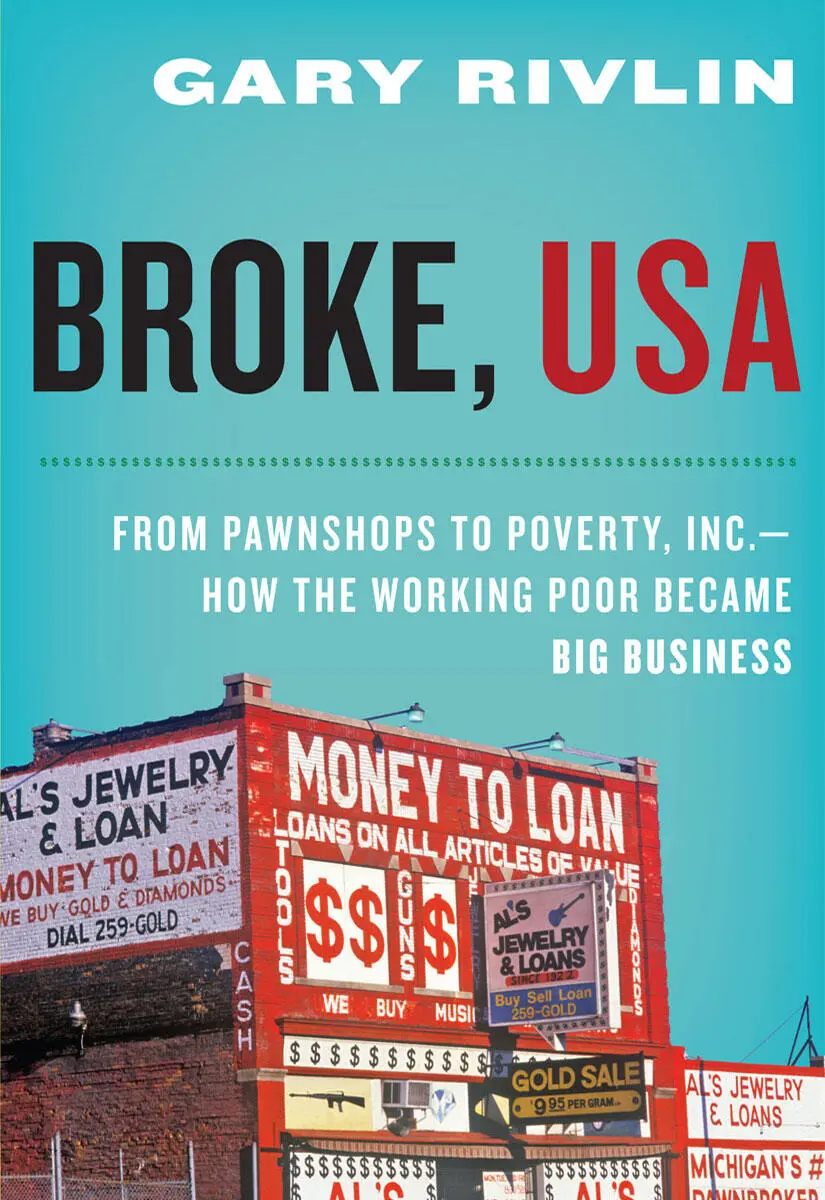
- Название:Broke, USA
- Автор:
- Издательство:HarperCollins Publishers Inc.
- Жанр:
- Год:2010
- Город:New York
- ISBN:978-0-06-199794-5
- Рейтинг книги:3 / 5. Голосов: 1
-
Избранное:Добавить в избранное
- Отзывы:
-
Ваша оценка:
Broke, USA: краткое содержание, описание и аннотация
Предлагаем к чтению аннотацию, описание, краткое содержание или предисловие (зависит от того, что написал сам автор книги «Broke, USA»). Если вы не нашли необходимую информацию о книге — напишите в комментариях, мы постараемся отыскать её.
Broke, USA — читать онлайн бесплатно полную книгу (весь текст) целиком
Ниже представлен текст книги, разбитый по страницам. Система сохранения места последней прочитанной страницы, позволяет с удобством читать онлайн бесплатно книгу «Broke, USA», без необходимости каждый раз заново искать на чём Вы остановились. Поставьте закладку, и сможете в любой момент перейти на страницу, на которой закончили чтение.
Интервал:
Закладка:
It didn’t take much effort for Webster to sell George Johnson on the idea, nothing more than two lines on a piece of paper. One line was the cost of a payday loan and the other depicted the rising costs of a bounced check or credit card late fee. “When those lines crossed,” Webster explained for Johnson, when the penalties a bank charged started costing more than these short-term quick loans, “the industry just grew and grew and grew.” Both put up money (Johnson invested the lion’s share) to start a company they called Advance America. Using their connections, the pair secured sizable lines of credit at Wells Fargo, Wachovia, and NationsBank. “We basically borrowed forty or fifty million dollars before we made anything,” Webster said. “We had an infrastructure for five hundred stores before we had even one.”
Advance America opened 300 stores in 1997 and then opened another 400 the next year. In 1999, Webster started calling competitors to see who might be interested in selling. Jones turned him down, LBJ-style, while soaking naked in a tub in a summer home he owned outside Cleveland, but McKenzie jumped at the chance, selling to Advance America for $150 million. Advance America opened 300 more stores in 1999 on top of the 450 or so they had bought from McKenzie. By the start of 2000, Advance America was operating more than 1,400 stores, including 250 in California, 150 in Florida, and another 120 in Ohio, each looking identical.
In the early days, payday could sometimes seem like something out of a Quentin Tarantino film rather than a burgeoning industry. Those touting the business had been excited when the Wall Street Journal sent a reporter to Tennessee to do one of the first big profiles of payday lending—and then Jones hooked up the guy with a store manager who, when asked if he was worried about people paying him back, pointed over his shoulder to the baseball bat he kept prominently displayed behind the counter and said, “I like to call that an attitude adjustor.” McKenzie could be even more of a loose cannon. When an Indiana legislator floated a bill that would have lowered the rates lenders could charge (back then, at least, Indiana allowed lenders to charge as much as $33 for every $100 they loaned out), McKenzie rushed north to lend a hand—and then handed his foes a fat gift when he was caught boasting in front of a meeting of his employees that “I’ve never seen a legislator I couldn’t buy.” The jobs of all those working to promote payday would be easier with George Johnson, a former state legislator, and Billy Webster, the friend of a sitting president, atop the industry’s largest company. “You would hear people say, ‘Payday can’t be too bad if Billy Webster is involved,’” Martin Eakes said.
“You don’t normally want competition,” Jared Davis said, “but in this case, we think Billy’s been a big help to the industry. From a lobbying perspective. From a legitimacy perspective.”
For a year or two it was enough for Advance America to build in states where others had gone before them but a company that ambitious could play fill-in for only so long. Before the end of that first year Webster was already staffing up a government affairs office. “There was always an overt business objective—to broaden the geography,” Webster said. In 1998, South Carolina legislators welcomed payday lenders into their state, as did elected officials in Mississippi, Nevada, and the District of Columbia. By the end of 2000, twenty-three states had legalized payday lending, and the likes of Advance America and Check Into Cash were operating in eight more because there was no law specifically forbidding them from doing so. Where a traditional lender was earning a return on investment of between 13 and 18 percent, Jerry Robinson, the investment banker who had worked for Toby McKenzie before taking a job with Stephens, Inc., told Business Week that the average payday lender was earning an average return of 23.8 percent.
At first reporters scratched their heads over this odd new business. “I don’t know how someone who just does payday advance is going to make it,” a local check casher told a reporter with the Sacramento Business Journal who was trying to figure out how a South Carolina–based company had opened twenty stores in the greater Sacramento area in a matter of months. Each would need to attract a “high volume” of customers, the check casher posited, just to cover the rent and labor costs; otherwise more than a few would be closing their doors as suddenly as they had opened them.
But quickly a new story line emerged: the payday client who had gotten him or herself into deep financial trouble availing themselves of a product pitched as requiring no credit check. Reporters never seemed to have much trouble finding unhappy customers. Readers of the New York Times would meet three when the paper turned its attention to the payday loan in 1999, including a thirty-nine-year-old woman named Shari Harris who earned $25,000 a year working computer security in Kokomo, Indiana. Harris had borrowed $150 from the Check Into Cash store near her home after the father of her two children stopped paying child support—six months later she owed $1,900. An Associated Press article that appeared around the same time featured a woman named Janet Delaney, a $16,000-a-year hospital food worker from Cleveland, Tennessee, who borrowed $200 from a Check Into Cash after falling behind on some bills. One year later, Delaney had paid nearly $1,000 in fees but had yet to pay back the original $200. “I’m just lucky,” that same AP article quoted Allan Jones as saying. “I hit on something that’s very popular with consumers.”
One theory offered to explain the immense and sudden popularity of payday loans was that ours is an instant-gratification society where almost anything we desire is only a few clicks away. Others pointed to a society at once comfortable with, and addicted to, debt; in a country where so many middle-class people were willing to mortgage the future for a new bathroom or a large flat-screen TV, was it any wonder that those of modest means might likewise avail themselves of these corner lenders? But there were deeper structural reasons for payday lending’s popularity, financial in nature rather than cultural, starting with the widening gap between the haves and have-nots. A full-time worker at Walmart, the country’s largest private employer, might make $15,000 or $16,000 her first year on the job, and polling showed that nearly one in two Americans was living paycheck to paycheck. The problem was particularly acute among the bottom 40 percent, whose income growth was flat in terms of real dollars throughout the 1990s while the cost of everything from health care, heating oil, and housing soared. For those living on the economic margins, payday offered a simple solution they could squeeze in after work, between the grocery shopping and making dinner for the kids. “Our motto is ‘quick, easy, and confidential,’” Jones had told the Wall Street Journal . “We can get people in and out in thirty seconds.”
Opposition was inevitable, of course. Before Martin Eakes there was Jean Ann Fox at the Consumer Federation of America. Fox’s first assault on what she originally called “delayed deposit check loans,” or “check advance loans,” was called “The Growth of Legal Loan Sharking.” This report, released in 1998, and subsequent ones provided an early chronicle of an industry largely getting its way in state legislatures around the United States. But Fox’s main contribution to the debate was adding an element of math. As she read it, the Truth in Lending Act, passed in 1968, required any business to express the cost of a loan not only in dollar terms but also as an annual percentage rate, or APR. The $15 per $100 that payday lenders could charge in stricter states like Ohio and Washington worked out to an APR of 391 percent. In Arkansas, where payday lenders could charge as much as $21 for every $100 borrowed, the APR was 546 percent, and in Colorado, where the going rate was $25 per $100, 650 percent. Borrowers in Indiana, with its $33 per $100 cap, were paying the equivalent of 858 percent on a two-week loan.
Читать дальшеИнтервал:
Закладка:
Похожие книги на «Broke, USA»
Представляем Вашему вниманию похожие книги на «Broke, USA» списком для выбора. Мы отобрали схожую по названию и смыслу литературу в надежде предоставить читателям больше вариантов отыскать новые, интересные, ещё непрочитанные произведения.








Обсуждение, отзывы о книге «Broke, USA» и просто собственные мнения читателей. Оставьте ваши комментарии, напишите, что Вы думаете о произведении, его смысле или главных героях. Укажите что конкретно понравилось, а что нет, и почему Вы так считаете.