Gary Rivlin - Broke, USA
Здесь есть возможность читать онлайн «Gary Rivlin - Broke, USA» весь текст электронной книги совершенно бесплатно (целиком полную версию без сокращений). В некоторых случаях можно слушать аудио, скачать через торрент в формате fb2 и присутствует краткое содержание. Город: New York, Год выпуска: 2010, ISBN: 2010, Издательство: HarperCollins Publishers Inc., Жанр: Старинная литература, на английском языке. Описание произведения, (предисловие) а так же отзывы посетителей доступны на портале библиотеки ЛибКат.
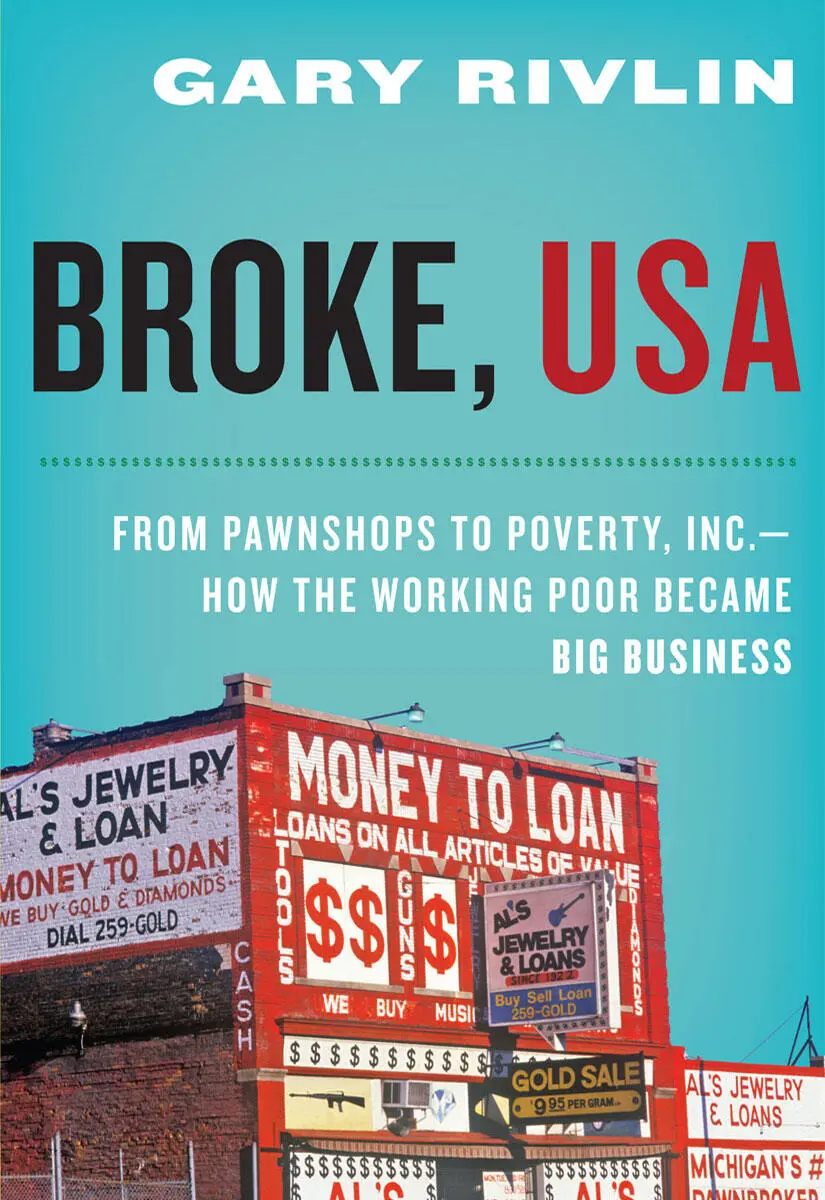
- Название:Broke, USA
- Автор:
- Издательство:HarperCollins Publishers Inc.
- Жанр:
- Год:2010
- Город:New York
- ISBN:978-0-06-199794-5
- Рейтинг книги:3 / 5. Голосов: 1
-
Избранное:Добавить в избранное
- Отзывы:
-
Ваша оценка:
Broke, USA: краткое содержание, описание и аннотация
Предлагаем к чтению аннотацию, описание, краткое содержание или предисловие (зависит от того, что написал сам автор книги «Broke, USA»). Если вы не нашли необходимую информацию о книге — напишите в комментариях, мы постараемся отыскать её.
Broke, USA — читать онлайн бесплатно полную книгу (весь текст) целиком
Ниже представлен текст книги, разбитый по страницам. Система сохранения места последней прочитанной страницы, позволяет с удобством читать онлайн бесплатно книгу «Broke, USA», без необходимости каждый раз заново искать на чём Вы остановились. Поставьте закладку, и сможете в любой момент перейти на страницу, на которой закончили чтение.
Интервал:
Закладка:
Lovelace gave me a funny look when I asked him how his modest-sized city came to occupy so prominent a position in the fight against some of the nation’s biggest financial institutions. He had constituents complaining, he said with a shrug, and advocates asking him for help. Anyone doubting that Dayton was experiencing a widespread problem only had to read the reports the Predatory Lending Project was submitting to the county. Its hotline was receiving so many calls that, despite having hired extra staffers to answer the phones, they simply stopped advertising the number. “It got to the point where there was such a backlog that people would have to wait six or eight weeks even to be seen,” McCarthy said. “We felt we were doing people a disservice.”
Lovelace introduced his bill at the start of 2001, sparking an immediate backlash. In the suburbs a firm called Ohio Mortgage Funding had just set up shop. What critics don’t understand, its branch manager told the Daily News, is that the people who will be harmed by this legislation are the very people whom subprime’s critics are seemingly trying to help. “They’re going after predatory lenders,” he said, “and all they’ll do is make low-income people unable to get loans.” The title companies came to the defense of their brethren in the lending business, and even the mainstream banks lined up against Lovelace. “That was one of the big surprises,” Lovelace said. As he saw it, the mortgage products the town’s established banks were selling were a world apart from the predatory lending he was aiming to stop. To win their support, he agreed to amend his bill so it exempted any bank scoring at least a “satisfactory” on the CRA test used to measure their level of lending in low- and moderate-income neighborhoods. The banking establishment continued to oppose him nonetheless. “We have seven big banks in Dayton,” Lovelace said. “I can’t say all seven came out against us but most of them did.” Only in time did he realize that the corporate parents of most of these banks had subprime affiliates and that their affiliates were the problem.
Lovelace made other compromises. He had originally proposed capping the fees a lender could charge at 3 percent of the loan total but he agreed to raise that to 5 percent. Similarly, he bumped the cap on the permissible interest rate from six percentage points above the going rate on a thirty-year Treasury bill to nine points. Some of its strongest provisions were left intact, though, like its prohibition against prepayment penalties and its ban on any loan with monthly payments that exceed 50 percent of a borrower’s income. The measure was unanimously passed into law in the summer of 2001.
Elected officials and others from around the country phoned Lovelace with their congratulations but their praise was premature. Lovelace might have stopped the worst excesses of the subprime mortgage business but his ordinance only applied to Dayton proper, not the suburbs. The poverty industry may have first taken root on the city’s west side but they had crossed the river and were spreading into the first-ring suburbs and even to the more rural communities along Interstate 75 on the fringes of the metro area. As its industrial lifeblood continued to drain, Dayton, it seemed, was becoming a subprime city.
Then the American Financial Services Association, a trade association representing the consumer finance companies and other lenders, challenged the bill’s legality in court. Instead of taking effect thirty days after its passage, as written, it would remain on hold pending a trial. That would give the industry time to turn its attention to the Ohio state legislature, which had the power to preempt Dayton’s ruling.
Eight
An Appetite for Subprime
Martin Eakes confesses he didn’t really know Sandy Weill’s name when a congressional staffer called his office asking if he could be in Washington the next day. Weill was a man editors put on the covers of their magazines, but apparently those weren’t magazines that Eakes read. Now Citigroup, the company Weill bought and transformed into the world’s largest financial titan, had announced it wanted to buy Associates—officially Associates First Capital—for $31 billion. They were holding a press conference the next day. Eakes was livid that a financial giant would lend its brand and its reputation to a company like Associates. Of course he would come.
His hosts the next day were Congressman John LaFalce of Buffalo, then the ranking Democrat on the House Banking Committee, and Senator Paul Sarbanes of Maryland, then the ranking Democrat on the corresponding Senate committee. LaFalce and Sarbanes spoke and then, at least the way Eakes likes to tell the story, the two exchanged alarmed glances as he took his turn at the podium. Eakes casts himself in high dudgeon that day, telling the story of Freddie Rogers, declaring Associates a moral cancer eating away at the body of American communities. “I was up there saying, ‘We can’t allow this to continue any longer, we must stop it and we must stop it now,’” Eakes remembers. “I went up there with my normal, all-guns-blazing style.”
A few weeks later, LaFalce, a fourteen-term member of Congress, sent a letter to Weill and also to Robert Rubin, the chairman of Citigroup’s executive committee and Bill Clinton’s former Treasury secretary, expressing his dismay that Citigroup intended to purchase a lender “that community advocates have for some time placed among the worst predatory lenders in the country.” Congress didn’t have the power to prevent the acquisition but a couple of committee chairs could make life miserable for a company; toward that end LaFalce named Eakes as his and Sarbanes’s emissary. To drive home the point, LaFalce and others sent a separate letter urging banking regulators to “closely scrutinize” the deal because of some “disturbing allegations.” Sanford I. Weill, tireless and driven, a man of relentless ambitions who had transformed Citigroup into what the New York Times Magazine dubbed “the world’s biggest money machine,” would have to deal with the likes of Martin Eakes.
“Sarbanes and LaFalce basically deputized me,” Eakes said. “They told Weill and Rubin that they had no choice but to deal with this young punk. They couldn’t ignore me even if they wanted to.” With characteristic bravado, Eakes announced at his first meeting with Citigroup’s representatives, “You will change these practices. Or we will bring you to your knees.”
Sandy Weill had attained great heights, but that only made his fall in the spring of 1985 seem that much more spectacular. He had arrived on Wall Street fresh out of Cornell, his finance degree in hand and ready to conquer the world, but instead he felt snubbed. A Jew from Brooklyn, born to Polish immigrants, he felt like an outsider in a world that favored the blue-bloods and WASPs. He started as a runner on Wall Street and was quickly promoted to broker, but after a few years he quit his job to help start a brokerage firm that eventually Weill and his partners sold to American Express for nearly $1 billion in stock. “The Jews are going to take over American Express and they’ll never know what hit them,” Weill boasted to a friend, according to one of his biographers. But American Express was run by men of lineage. Weill, by contrast, was brilliant and cunning but also plump and ill-mannered. He chewed his nails and wore rumpled suits and propped his scuffed shoes up on the furniture while smoking fat, pungent cigars. He ultimately attained the president’s post at American Express, but finding himself on non-native soil, he was out within four years of his arrival. At fifty-two and with a net worth north of $50 million, Weill leased a pricey set of offices in the Seagram Building on Park Avenue, hired a personal assistant, and waited for the phone to ring.
Читать дальшеИнтервал:
Закладка:
Похожие книги на «Broke, USA»
Представляем Вашему вниманию похожие книги на «Broke, USA» списком для выбора. Мы отобрали схожую по названию и смыслу литературу в надежде предоставить читателям больше вариантов отыскать новые, интересные, ещё непрочитанные произведения.








Обсуждение, отзывы о книге «Broke, USA» и просто собственные мнения читателей. Оставьте ваши комментарии, напишите, что Вы думаете о произведении, его смысле или главных героях. Укажите что конкретно понравилось, а что нет, и почему Вы так считаете.