Gary Rivlin - Broke, USA
Здесь есть возможность читать онлайн «Gary Rivlin - Broke, USA» весь текст электронной книги совершенно бесплатно (целиком полную версию без сокращений). В некоторых случаях можно слушать аудио, скачать через торрент в формате fb2 и присутствует краткое содержание. Город: New York, Год выпуска: 2010, ISBN: 2010, Издательство: HarperCollins Publishers Inc., Жанр: Старинная литература, на английском языке. Описание произведения, (предисловие) а так же отзывы посетителей доступны на портале библиотеки ЛибКат.
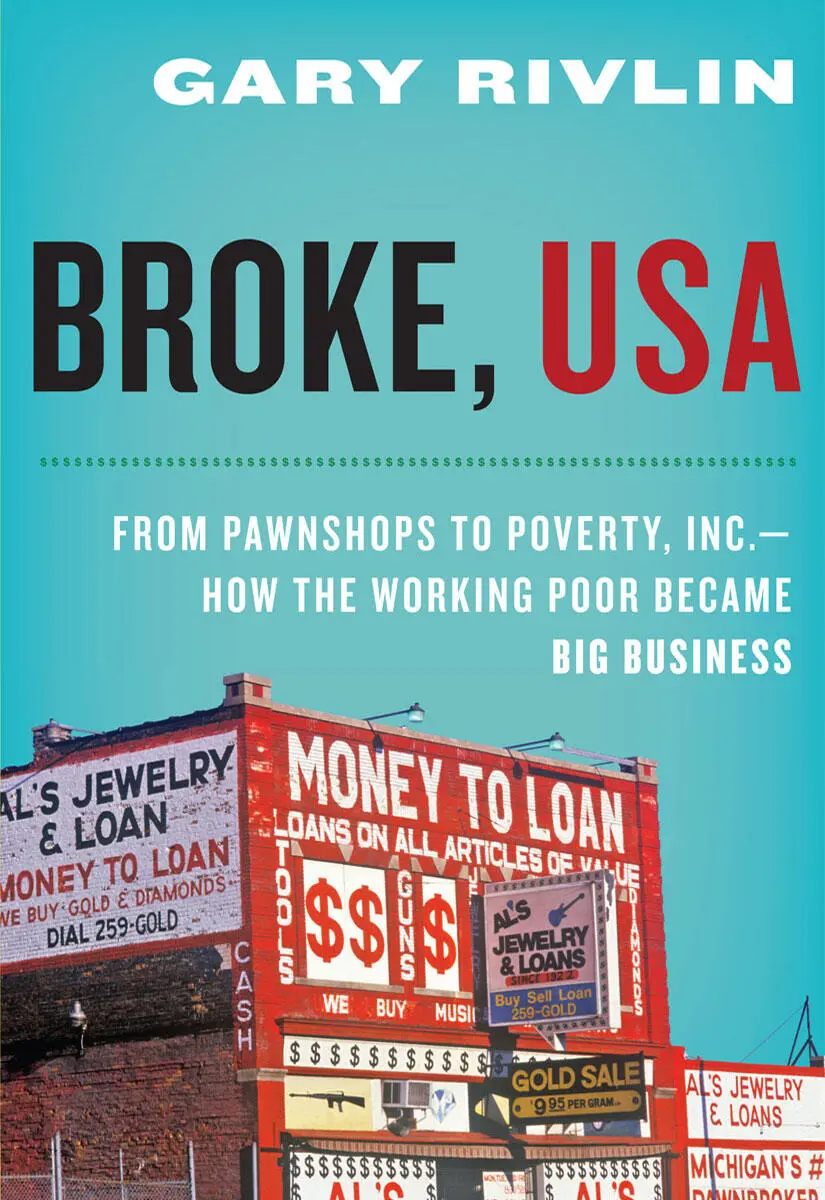
- Название:Broke, USA
- Автор:
- Издательство:HarperCollins Publishers Inc.
- Жанр:
- Год:2010
- Город:New York
- ISBN:978-0-06-199794-5
- Рейтинг книги:3 / 5. Голосов: 1
-
Избранное:Добавить в избранное
- Отзывы:
-
Ваша оценка:
Broke, USA: краткое содержание, описание и аннотация
Предлагаем к чтению аннотацию, описание, краткое содержание или предисловие (зависит от того, что написал сам автор книги «Broke, USA»). Если вы не нашли необходимую информацию о книге — напишите в комментариях, мы постараемся отыскать её.
Broke, USA — читать онлайн бесплатно полную книгу (весь текст) целиком
Ниже представлен текст книги, разбитый по страницам. Система сохранения места последней прочитанной страницы, позволяет с удобством читать онлайн бесплатно книгу «Broke, USA», без необходимости каждый раз заново искать на чём Вы остановились. Поставьте закладку, и сможете в любой момент перейти на страницу, на которой закончили чтение.
Интервал:
Закладка:
Their meeting lasted only an hour. It was decorous despite its contentious start but hardly satisfying for either side. The attorneys general asked for more latitude in cracking down on predatory lending; Hawke held forth on the doctrine of preemption and why it was critical that the federal government not relinquish any regulatory power. We’re not trying to intrude on the business of ensuring the safety and soundness of the nation’s banks, the attorneys general countered, but we have the right to protect our citizenry from the oppressive loans that some lenders under your charge are making. States have also always had the right to regulate real estate transactions within their borders, Cooper argued when it was his turn to speak, and they have the power to enforce consumer rights laws even if that abuse is at the hands of a nationally chartered bank (or a bank’s subprime subsidiary, for that matter). There were more practical considerations as well: The states were closer to the problem and could react more quickly than the federal government. Hawke, however, would not budge.
“He took fifty sheriffs off the job when the lending industry was becoming the Wild West,” Cooper, who was still angry with Hawke when I visited him in North Carolina, told me at the end of 2008. “What was going on was unrestrained and uncontrolled. You had these no-doc [no documentation] loans. You had lenders that weren’t even looking at the borrower’s ability to pay because they knew they would just be selling these loans on the secondary market.” If the federal government had chosen to remain neutral, Cooper said, “I believe the fight against these lenders would have spread like wildfire across the country because of just the basic unfairness.” Instead, Hawke and the OCC threatened lawsuits at every turn.
“I blame him for the meltdown,” Bill Brennan said of Hawke. “He knew exactly what was going on and didn’t do a thing about it.”
Hawke was fed up with that kind of statement by the time I reached him at the end of 2008. “Everyone’s looking around for a scapegoat,” he said. “So people point a finger at me.” It’s not as if he did nothing, he said. He asked the attorneys general to give his staff any evidence they had of reckless lending “but they just completely dropped the ball on that.” He suspected that’s because their main interest was in generating headlines. He pointed out that shortly after meeting with Cooper and his colleagues, he sent out rules clarifying the OCC’s position: Loans should be based not solely on the worth of a borrower’s collateral but also on his or her ability to pay. To him, if people are looking for someone to blame, look at the investment banks and their “unquenchable thirst” for more subprime loans they could package and sell.
Hawke is a heavyset man with thinning gray hair and dressed in suspenders and a bright blue-and-white striped dress shirt. After his term expired in 2004, he returned to Arnold & Porter, the Washington, D.C., powerhouse law firm where he had worked prior to his appointment. There he represents some of the same banks he had supervised as the chairman of the OCC, but to his mind there is no conflict of interest because his fight with the states had been over jurisdiction and never the behavior of the banks under his domain. “One of the benefits of being a national bank is you can operate under a single set of rules,” Hawke said. As he had done in his meeting with the attorneys general, Hawke gave me a short lecture about the Constitution and the primacy of delegated federal authority over states’ rights. “Preemption is not something for us to give up on because it might be convenient,” he said.
If ever he doubted himself, Hawke had the courts to provide him solace. The OCC filed suit against Spitzer after he opened an investigation of possible discrimination by banks under his charge. The federal district court ruled in favor of Hawke’s agency and the U.S. Court of Appeals upheld the lower court’s decision. “He challenged us,” Hawke said of Spitzer, “and we beat ’im every time.” Six months after my visit, though, Hawke was no doubt feeling less smug. The U.S. Supreme Court concluded that the OCC had been wrong and had had no right to block a state trying to enforce its own law. An unusual coalition had formed behind this ruling, with Antonin Scalia writing for the majority in an opinion that also had the consent of the Court’s four more liberal justices.
The alarms, meanwhile, continued to ring, even as most people in power chose to ignore them.
Twelve
Public Enemy Number One
The first thing Steven Schlein wants you to know about the ongoing, epic struggle between his clients—the payday lenders—and their critics is that it’s not a fair fight. Payday’s foes, and especially Martin Eakes, have too much money and too much power. “They’ve got more lobbyists than we do,” he complained when we sat down together in mid-2008. “They have more money. We’re completely outgunned!” I raised a skeptical eyebrow and Schlein, payday’s main spokesman, slowly shook his head in disappointment. He has a strained, Brooklyn-tinged voice that he raises an octave. He sounded as if he were pleading rather than making a rhetorical point. “Go take a look at the $25 million monument Eakes bought for himself,” he said. He pointed his chin toward the window and the multistory building the Center for Responsible Lending (CRL) bought a few years earlier to serve as its Washington, D.C., office. “Go there right now and then tell me they’re just this scrappy, underfunded public interest group up against this big, bad industry.”
We’re sitting two blocks from the CRL building in the offices of Dezenhall Resources. That’s how bad it had gotten for Allan Jones, Billy Webster, the Davis brothers, and the others. In 2004, they started paying for the high-priced services of a crisis management firm that specializes in the representation of unpopular industries such as the chemical manufacturers, pharmaceutical companies, and Big Oil. The firm’s founder and chief executive, Eric Dezenhall, laid out his approach to helping beleaguered industries in his 1999 book, Nail ’Em! Confronting High-Profile Attacks on Celebrities and Businesses . “Damage control used to be about soft, fuzzy concepts like image,” Dezenhall wrote. “Now it’s about survival, and this had made the battle bloodier.” THE PIT BULL OF PUBLIC RELATIONS—that was the headline BusinessWeek used above a 2006 profile of Dezenhall. The actual job of defending the payday lenders, however, fell mainly on Schlein and a younger woman named Lyndsey Medsker.
“They have people in Washington,” Schlein says of Eakes and the Center for Responsible Lending. “They have people in North Carolina. They have an office in Oakland. Here it’s just me and Lyndsey.” Schlein complains about the disparity in the size of their respective ground forces when the payday lenders gather for meetings of their trade organization. The opposition, he’ll tell them, is meeting with newspaper editorial boards; they’re organizing in this state or that. But invariably his calls for more help go unanswered. Perhaps the pooh-bahs know that each big chain has its own team of government affairs people and its own public relations staff on the payroll.
Schlein wonders if it would even make a difference if he had more people. Dezenhall has represented the likes of Exxon Mobil and a former Enron executive but payday lending seems to occupy a category all its own. “I’ve been in this business twenty-five years,” he said, “and I’ve never seen such closed-mindedness about an issue.” He hears the same from the lobbyists they hire whenever the Center for Responsible Lending or some similar-minded group is pushing a bill that would shut down the industry in some far-flung state. “They’ll all say it,” Schlein said. “Working for the gun lobby, or working for tobacco, is like working for Goodwill compared to the hostility they face working for the payday lenders.” Schlein tells of the time he phoned the Washington Post about meeting the newspaper’s editorial board. The District of Columbia City Council was considering a bill that would cap the rate payday lenders could charge (the bill passed by an eight-to-one margin, with only Marion Barry voting against it) and he thought the paper might be curious about what the industry might have to say. “This woman I spoke with at the Post , she basically ranted at me, ‘I’m not giving you slime-balls a minute of my time,’” he said. He shook his head and looked momentarily hurt. “She used terms you wouldn’t believe.”
Читать дальшеИнтервал:
Закладка:
Похожие книги на «Broke, USA»
Представляем Вашему вниманию похожие книги на «Broke, USA» списком для выбора. Мы отобрали схожую по названию и смыслу литературу в надежде предоставить читателям больше вариантов отыскать новые, интересные, ещё непрочитанные произведения.



Обсуждение, отзывы о книге «Broke, USA» и просто собственные мнения читателей. Оставьте ваши комментарии, напишите, что Вы думаете о произведении, его смысле или главных героях. Укажите что конкретно понравилось, а что нет, и почему Вы так считаете.