Gary Rivlin - Broke, USA
Здесь есть возможность читать онлайн «Gary Rivlin - Broke, USA» весь текст электронной книги совершенно бесплатно (целиком полную версию без сокращений). В некоторых случаях можно слушать аудио, скачать через торрент в формате fb2 и присутствует краткое содержание. Город: New York, Год выпуска: 2010, ISBN: 2010, Издательство: HarperCollins Publishers Inc., Жанр: Старинная литература, на английском языке. Описание произведения, (предисловие) а так же отзывы посетителей доступны на портале библиотеки ЛибКат.
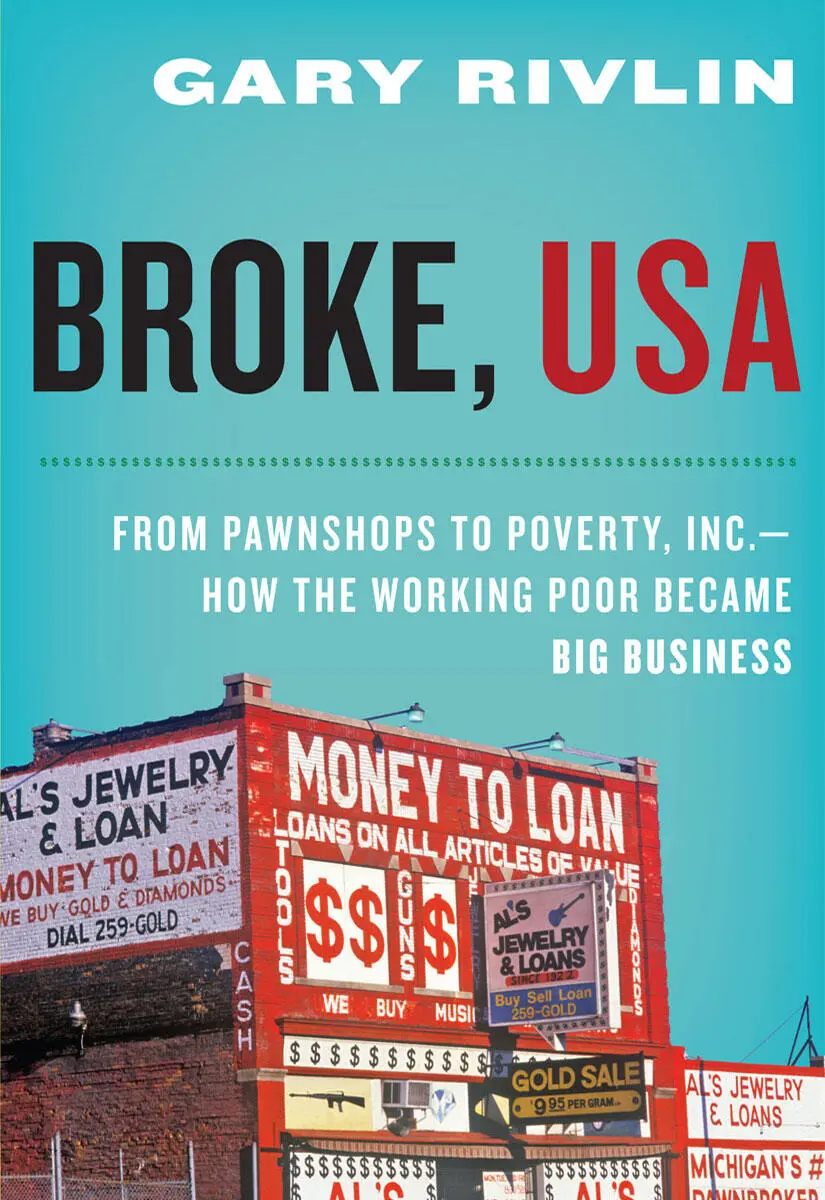
- Название:Broke, USA
- Автор:
- Издательство:HarperCollins Publishers Inc.
- Жанр:
- Год:2010
- Город:New York
- ISBN:978-0-06-199794-5
- Рейтинг книги:3 / 5. Голосов: 1
-
Избранное:Добавить в избранное
- Отзывы:
-
Ваша оценка:
Broke, USA: краткое содержание, описание и аннотация
Предлагаем к чтению аннотацию, описание, краткое содержание или предисловие (зависит от того, что написал сам автор книги «Broke, USA»). Если вы не нашли необходимую информацию о книге — напишите в комментариях, мы постараемся отыскать её.
Broke, USA — читать онлайн бесплатно полную книгу (весь текст) целиком
Ниже представлен текст книги, разбитый по страницам. Система сохранения места последней прочитанной страницы, позволяет с удобством читать онлайн бесплатно книгу «Broke, USA», без необходимости каждый раз заново искать на чём Вы остановились. Поставьте закладку, и сможете в любой момент перейти на страницу, на которой закончили чтение.
Интервал:
Закладка:
But payday hardly seemed an industry in need of outside help. As rapidly as payday had grown in its first seven years, it grew more rapidly still over the next few years; where there were 10,000 payday stores in 2000, that number exceeded 21,000 by 2004. Success inspired more success. As industry trailblazers such as Check Into Cash, Check ’n Go, and Advance America continued to thrive, large companies that had grown rich feasting in other corners of the poverty universe started offering payday loans. That included chains in the check cashing, pawn, and rent-to-own businesses. Regional powerhouses such as the MoneyTree in the Northwest helped to fuel the expansion, as did people like Mike Hodges. Hodges was twenty-four when he opened his first payday store in Nashville, in 1996. By 2008, Advance Financial was operating twenty stores within thirty miles of Tennessee’s state capital.
And there were those late to the poverty business who were no less eager to make their fortune. Just as Mike Hodges was poring over maps in search of gaps in the Nashville metro area, so too were people like Erich Simpson, a former DuPont factory worker who opened his first of three payday shops in a rural stretch of South Carolina in 2004. The industry would add two thousand more stores in 2005.
The big payday chains even started to spawn their own competition. Jones would grumble about the mid-level managers who gave notice “thinking that making it was as easy as figuring out what kind of plane they was gonna buy.” Billy Webster voiced the same complaint. Greg Fay served in the army for seven years right after high school, then went to work first in the rent-to-own business and then in payday finance. When Fay came into a little money, he opened his first payday store just outside Dayton in 2003 and was soon eyeing locales in and around Toledo, 150 miles up the highway. Ultimately he, his partner, and an outside pair of investors would open a half-dozen stores in western Ohio.
The issue of whether Wall Street could fully embrace payday lending was put to rest in 2004 when Advance America announced that it was going public and that Morgan Stanley, a top-tier investment bank, led the offering. The investment banking arms of Wells Fargo and Bank of America were among those lending their names and sales teams to the effort. If there was a taint to payday, the 23 percent profit margin Advance America was reporting in its prospectus made it all okay. Usually only the most successful technology companies consistently posted numbers that good.
The bankers had priced Advance America stock at between $13 and $15 a share. It opened at $15 and then soared above $21 before closing at $20.50—a 37 percent jump in one day of trading. Billy Webster had cashed out around $9 million worth of stock but still owned shares valued at more than $100 million. His partner and financier, George Johnson, cashed out $22 million in stock that day but still owned a $260 million stake in the company.
The numbers Advance America was posting naturally attracted even more wannabe moguls to the business. Every year at the annual meeting of the payday lenders, Steven Schlein rubs shoulders with some of the new arrivals, who give him hope for the industry. “You walk around and you think you’re seeing all of America in one room,” Schlein said. The crowd skews white, he acknowledged, but otherwise they strike him as a perfect cross-section of America, with people old and young and from all regions of the country. Schlein told me of a kid he had recently met who had gotten into payday lending while he was still in college but already owned five stores. “Think how rich he’s going to be when he already has five stores at twenty-two,” Schlein said.
But if Schlein was brightened by the native entrepreneurialism of a can-do country, Billy Webster was worried that he was witnessing his own doom. “One of the things I never dreamed would happen is we would have so many people in this business,” he told me when I visited him in Spartanburg. As a reference point, he harked back to his decade in the fried chicken business. “You’d never have seen a Popeyes and a KFC on the same corner as a Bojangles,” he said, “but that’s what you have now [with payday lending stores]. So you end up not just with saturation problems from a business perspective but also multiple loan problems.”
Inside the CRL they dubbed themselves the “road warriors.” These were the staffers so committed to defeating the payday lenders or their counterparts in the mortgage industry that they proved willing to turn their lives upside down and live in another state for weeks, if not months at a time. Martin Eakes described one of the warriors, Uriah King, as a “human vacuum cleaner sucking up everything he could about payday.” King, who read Clausewitz on war to gird himself for battle, could drive him batty, Eakes said, but what King lacked in experience he more than made up for in energy, enthusiasm, and native savvy. It fell to people like King and his colleague, Susan Lupton, to help fill in the narrative and demonstrate that the payday advance was, to borrow a vivid metaphor from Robert H. Frank, an economics professor at Cornell University, like “handing a suicidal person a noose.”
It helped that Advance America and a second payday company, QC Holdings, a chain of three hundred stores based in Kansas City, went public in 2004. The documents both companies are required by law to regularly file with the Securities and Exchange Commission have provided a treasure trove of information. So too have the quarterly conference calls that most publicly traded companies routinely record and post on the Internet as well as the detailed reports written by financial analysts who earn money selling stock advice to wealthy clients.
From the start, the payday lenders have said theirs is an occasional emergency product used by the rational consumer facing the prospect of a bounced check. Yet those in the business of following the industry seemed to come to precisely the opposite conclusion. “A note about rollovers,” an analyst named Elizabeth Pierce with Roth Capital Partners wrote in a research report about First Cash, a pawnshop chain that had gotten into payday. “We are convinced the business just doesn’t work without them.” That view was echoed by the accounting firm Ernst & Young: “The survival of payday loan operators depends on establishing and maintaining a substantial repeat customer business because that’s really where the profitability is.” Even Dan Feehan, the chief executive of Cash America, the country’s largest pawnshop chain and another major player in the payday industry, said much the same when explaining the business to potential shareholders at an investor’s conference. “The theory in the business,” Feehan said, “is you’ve got to get that customer, work to turn him into a repetitive customer, long-term customer, because that’s really where the profitability is.”
The CRL was convinced the payday cash advance was an inherently defective product, trapping people as if by design. The single mother with two kids might be avoiding a costly bounced-check fee that first time she borrows $400 but how is she ever going to cover that $460 check two weeks later when she brings home $1,100 a month? “They sucker you in with that first loan,” Eakes said, “and then they gotcha.” It became essential, then, to collect the tales of customers like Sandra Harris, an accounting technician in Wilmington, North Carolina, who borrowed $200 from a payday lender to pay her car insurance after her husband lost his job as a cook. Eight thousand dollars in fees later, the couple ended up losing the car and avoided eviction only because of a sympathetic landlord. John Kucan, a former Connecticut state trooper, had a less tragic story but one offering no less flattering a view of payday. He retired to North Carolina after being shot in the line of duty but then needed to borrow $850 from a payday lender because the state had overpaid some benefits and wanted its money back. Living on a fixed income, however, Kucan would need to renew the loan fifteen times, racking up $2,000 in fees before he was able to pay it off. When you’re desperate for quick cash, he told one interviewer, “what’s flashing in front of you is the dollars you’re looking for. The percentage rate isn’t something you’re even considering.”
Читать дальшеИнтервал:
Закладка:
Похожие книги на «Broke, USA»
Представляем Вашему вниманию похожие книги на «Broke, USA» списком для выбора. Мы отобрали схожую по названию и смыслу литературу в надежде предоставить читателям больше вариантов отыскать новые, интересные, ещё непрочитанные произведения.







Обсуждение, отзывы о книге «Broke, USA» и просто собственные мнения читателей. Оставьте ваши комментарии, напишите, что Вы думаете о произведении, его смысле или главных героях. Укажите что конкретно понравилось, а что нет, и почему Вы так считаете.