Gary Rivlin - Broke, USA
Здесь есть возможность читать онлайн «Gary Rivlin - Broke, USA» весь текст электронной книги совершенно бесплатно (целиком полную версию без сокращений). В некоторых случаях можно слушать аудио, скачать через торрент в формате fb2 и присутствует краткое содержание. Город: New York, Год выпуска: 2010, ISBN: 2010, Издательство: HarperCollins Publishers Inc., Жанр: Старинная литература, на английском языке. Описание произведения, (предисловие) а так же отзывы посетителей доступны на портале библиотеки ЛибКат.
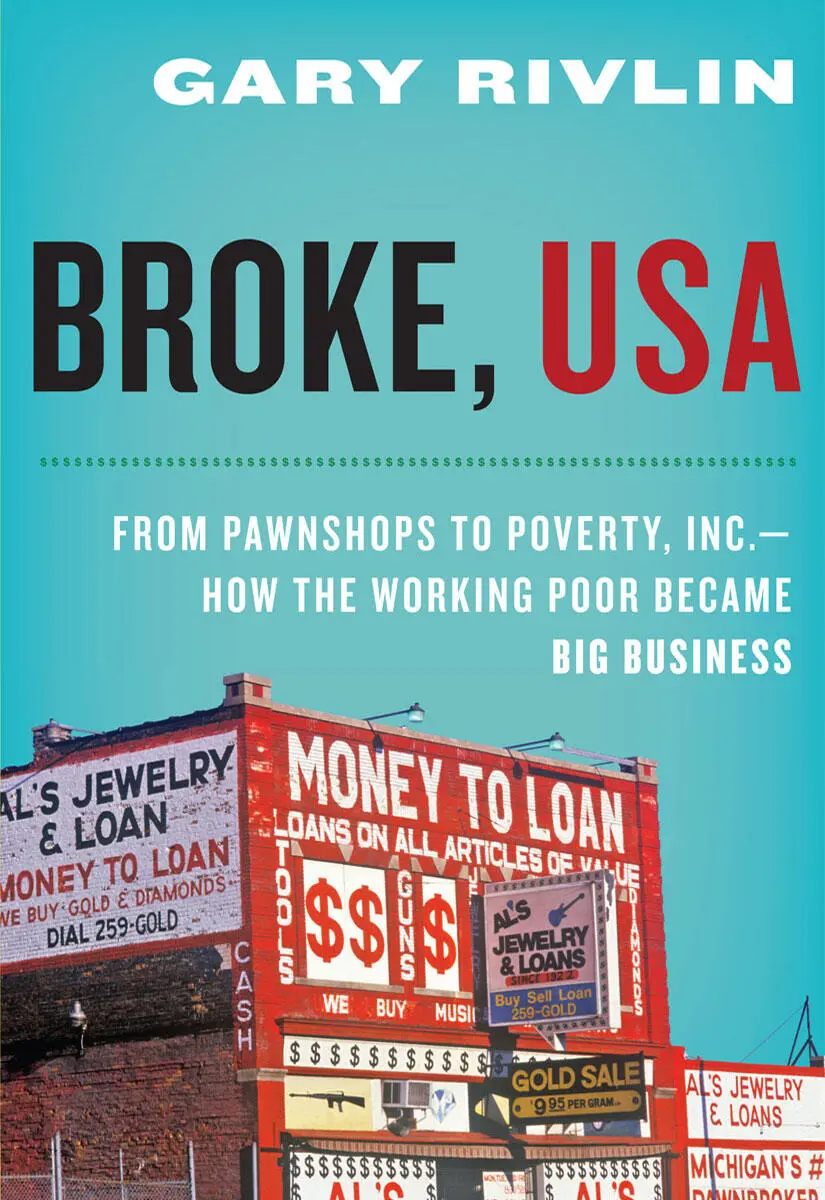
- Название:Broke, USA
- Автор:
- Издательство:HarperCollins Publishers Inc.
- Жанр:
- Год:2010
- Город:New York
- ISBN:978-0-06-199794-5
- Рейтинг книги:3 / 5. Голосов: 1
-
Избранное:Добавить в избранное
- Отзывы:
-
Ваша оценка:
Broke, USA: краткое содержание, описание и аннотация
Предлагаем к чтению аннотацию, описание, краткое содержание или предисловие (зависит от того, что написал сам автор книги «Broke, USA»). Если вы не нашли необходимую информацию о книге — напишите в комментариях, мы постараемся отыскать её.
Broke, USA — читать онлайн бесплатно полную книгу (весь текст) целиком
Ниже представлен текст книги, разбитый по страницам. Система сохранения места последней прочитанной страницы, позволяет с удобством читать онлайн бесплатно книгу «Broke, USA», без необходимости каждый раз заново искать на чём Вы остановились. Поставьте закладку, и сможете в любой момент перейти на страницу, на которой закончили чтение.
Интервал:
Закладка:
Lenders had threatened to stop making loans in North Carolina but studies showed that those were empty threats. A Morgan Stanley survey concluded that rather than reduce the availability of subprime loans there, the law had saved consumers in North Carolina at least $100 million in fees. But Georgia, of course, had implemented a more restrictive law. Countrywide and Option One announced they were greatly curtailing their activity in the state and Ameriquest announced it was pulling out of Georgia altogether. In time it would become clear that this should have been cause for celebration but at the time it had the intended effect of spooking more than a few legislators. Freddie Mac compounded the fear by announcing it would no longer buy any “high-cost” loans from Georgia lenders. One might have asked why a government-sponsored mortgage finance company like Freddie Mac was trafficking in these high-priced loans but the news further softened legislators to the industry’s argument that there were unintended consequences to the Barnes-Fort bill.
Still, the original legislation might have survived largely intact if it were not for the unexpected intervention of the nation’s largest credit rating agencies. Less than two weeks after Sonny Perdue took over as governor, Standard & Poor’s announced that it would no longer rate the creditworthiness of any mortgage-backed security that included even a single loan out of Georgia—even conventional mortgages. Since any party purchasing a predatory loan was potentially subject to a lawsuit in Georgia, the New York–based rating agency reasoned, and since the Georgia law placed no cap on potential damages, the legal exposure was incalculable. Moody’s Investors Service and Fitch Ratings soon followed suit.
If one were assembling a list of actors whose reputations were badly tarnished by the 2008 subprime meltdown, the big three credit rating agencies would likely be near the top. Far from being reliable third parties offering impartial financial judgments, together they were “a central culprit of the financial crisis,” Eric Dash of the New York Times would write in mid-2009. They stamped their highest ratings on junk. The problem was that the very people asking them to rate the integrity of these mortgage-backed securities were also the same people paying their fees. Dash likened the system to one in which Hollywood studios paid movie critics to judge their films. In 2003, however, the announcement caused panic inside the Georgia Capitol. The legislature was suddenly in a great rush to undo the damage.
Those who had authored the law had not done themselves any favors: It turned out that the law needed fixing as soon it had been passed. Fort described it as a matter of a few minor “tweaks,” but that meant opening the bill to reconsideration during the next legislative session, which played into the hands of the opposition. Fort and his colleagues proposed a cap on the financial liability of any single investor, but the legislature was intent on going much further. The amendment that Sonny Perdue signed into law in early March 2003, just five months after the original law had taken effect, limited liability to the original issuer of a loan while watering down a number of provisions in the Barnes-Fort bill. “It’s as bad as not having a bill at all,” a dispirited Fort told the Associated Press.
Not that their efforts were for naught. Like North Carolina, Georgia helped to inspire activists and legislators living in other locales. Soon after Georgia, New York State passed a tough anti–predatory lending law that also gave borrowers the right to sue whatever institution held their mortgage, even if it was owned by a third party. But that right was granted only if someone could prove that the third party had been complicit in committing fraud (or, in the event of foreclosure, a borrower could get out of his or her financial liabilities to a third party if the loan is deemed predatory under state law). The New York law went into effect in April 2003. Other states followed. Every state after Georgia was certain to put in place a cap on a mortgage holder’s potential liability. “That way the rating agencies like Standard & Poor’s could at least calculate the potential for damages,” said Patricia McCoy, a professor at the University of Connecticut School of Law, who has studied the issue.
But victories in New York and elsewhere would do little to help those communities in Georgia devastated by the subprime meltdown. By 2006 the state would rank third in the nation in foreclosures.
Predictably the problem was felt much more acutely in the state’s black precincts. Nearly half of all blacks buying a house in Atlanta in 2005 or 2006 ended up with a subprime mortgage, according to a 2007 analysis by the Atlanta Journal-Constitution , compared to 13 percent of white homebuyers. The difference was even more pronounced among those earning more than $100,000. Four in ten black homeowners earning in the six figures ended up in a high-interest subprime mortgage compared to less than one in ten whites in that income group. The rate of foreclosure among those blacks would be disproportionately high.
Bill Brennan continued to do what he could, one client at a time. If there was an upside to the 2002 fight, it was that now Brennan had an ally in Fort who could frighten banks into doing the right thing. In recent years, Fort has phoned top bank executives ranging from Countrywide’s Angelo Mozilo to Bank of America’s Ken Lewis to scare them into fixing the most egregious of Brennan’s cases. Fort depicted for me what happens after he leaves a message with one of their assistants. “They’ll google my name, they’ll figure out who I am, and then my phone rings an hour later,” he says. “They figure it’s better to work things out than face a picket line.”
“That’s how we settle a lot of cases nowadays,” Brennan told me. “Not all but well over half.”
Aman named John D. Hawke, Jr., played only a peripheral role in the legislative fight over predatory lending in Georgia. As head of the U.S. Office of the Comptroller of the Currency (OCC), Hawke regulated the country’s national banks. He blanched every time a state encroached on his turf, and even before the Barnes-Fort bill took effect, he had already granted a blanket exemption to the banks under his supervision. That didn’t help giant mortgage lenders like Countrywide or Ameriquest but it provided relief to big banks like Wells Fargo and Washington Mutual. But it was another judgment Hawke made in 2003, one month after Sonny Perdue broke the hearts of Fort, Brennan, and others in Georgia, that stands out as the other great what-if of the early 2000s. Bill Clinton had nominated Hawke to a five-year term as OCC chairman that began in 1999 and from the start he seemed intent on standing in the way of those trying to crack down on predatory lending.
It was more than just legislators in states like North Carolina, Georgia, and New York who were eager to do something about the more egregious forms of subprime mortgage lending. A number of state attorneys general were also intent on taking action, so much so that within their national association they had formed a predatory lending committee. Iowa Attorney General Tom Miller, whose investigation of Ameriquest led to that company paying a $325 million fine, served as co-chair of the committee. So too did North Carolina’s Roy Cooper, who had been displeased with Hawke ever since the latter exempted (as he would do in Georgia) national banks from the state law Cooper had championed while he was president of the North Carolina Senate. In April 2003, a small contingent of attorneys general converged on Washington hoping they could convince Hawke to work with them instead of against them.
Hawke agreed to a meeting but then asked himself why he had even bothered. He was annoyed with the lot of them even before they showed up at his offices. The day before they were scheduled to arrive, Eliot Spitzer, then the New York attorney general, had held a press conference blasting Hawke as a pinheaded bureaucrat for standing in the way of his efforts to crack down on unfair lending practices, especially in black and Latino neighborhoods. Spitzer wasn’t at the meeting with Hawke but his presence was felt just the same. “Are we here for a press event,” Hawke began when he took his seat, “or do you want to talk issues?” The attorneys general were no happier with their publicity-hungry colleague from New York but there was also nothing they could do. “We couldn’t control Spitzer but that didn’t change the fundamental issue that we were there to talk about,” Cooper said.
Читать дальшеИнтервал:
Закладка:
Похожие книги на «Broke, USA»
Представляем Вашему вниманию похожие книги на «Broke, USA» списком для выбора. Мы отобрали схожую по названию и смыслу литературу в надежде предоставить читателям больше вариантов отыскать новые, интересные, ещё непрочитанные произведения.



Обсуждение, отзывы о книге «Broke, USA» и просто собственные мнения читателей. Оставьте ваши комментарии, напишите, что Вы думаете о произведении, его смысле или главных героях. Укажите что конкретно понравилось, а что нет, и почему Вы так считаете.