Gary Rivlin - Broke, USA
Здесь есть возможность читать онлайн «Gary Rivlin - Broke, USA» весь текст электронной книги совершенно бесплатно (целиком полную версию без сокращений). В некоторых случаях можно слушать аудио, скачать через торрент в формате fb2 и присутствует краткое содержание. Город: New York, Год выпуска: 2010, ISBN: 2010, Издательство: HarperCollins Publishers Inc., Жанр: Старинная литература, на английском языке. Описание произведения, (предисловие) а так же отзывы посетителей доступны на портале библиотеки ЛибКат.
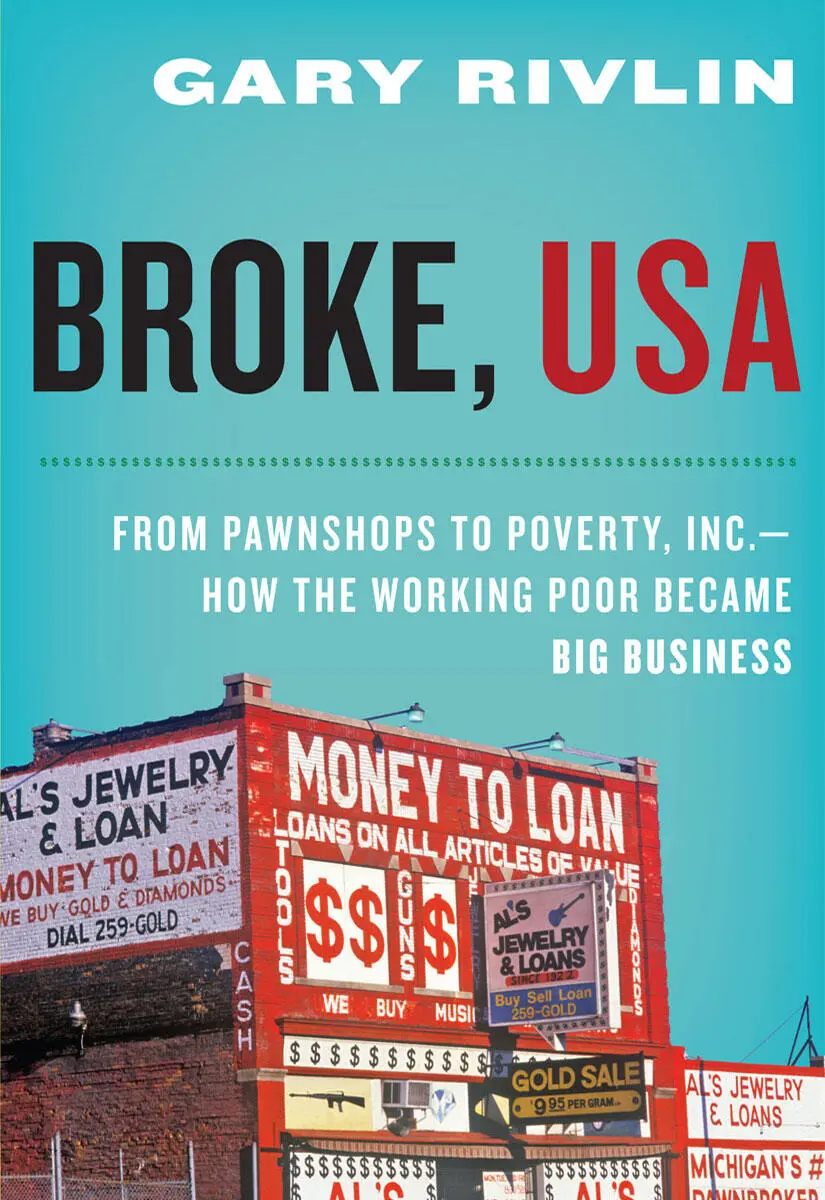
- Название:Broke, USA
- Автор:
- Издательство:HarperCollins Publishers Inc.
- Жанр:
- Год:2010
- Город:New York
- ISBN:978-0-06-199794-5
- Рейтинг книги:3 / 5. Голосов: 1
-
Избранное:Добавить в избранное
- Отзывы:
-
Ваша оценка:
Broke, USA: краткое содержание, описание и аннотация
Предлагаем к чтению аннотацию, описание, краткое содержание или предисловие (зависит от того, что написал сам автор книги «Broke, USA»). Если вы не нашли необходимую информацию о книге — напишите в комментариях, мы постараемся отыскать её.
Broke, USA — читать онлайн бесплатно полную книгу (весь текст) целиком
Ниже представлен текст книги, разбитый по страницам. Система сохранения места последней прочитанной страницы, позволяет с удобством читать онлайн бесплатно книгу «Broke, USA», без необходимости каждый раз заново искать на чём Вы остановились. Поставьте закладку, и сможете в любой момент перейти на страницу, на которой закончили чтение.
Интервал:
Закладка:
“There’s this subprime problem going on all over the state and what do our legislatures do?” Faith asked. “They pass a bill that says to the cities, ‘We’re going to preempt you from doing anything about predatory lending, that’s the state’s job, but, oh, by the way, we’re not going to do anything about the problem.” If there was the occasional tale of a borrower harmed by a particularly noxious subprime loan, legislators were told, that was the work of a rogue agent whose misdeeds had been exaggerated by a press corps on the hunt for the sensational. Politicians on both sides of the aisle, it seemed, were inclined to extend the benefit of the doubt to any lender willing to work with borrowers of modest means.
The bill, passed during the 2002 legislative session, did create a sixteen-person Predatory Lending Study Committee that would travel the state to assess the problem. When they hit Dayton, so many people wanted a turn at the microphone that, despite a strict five-minute limit on speeches, the meeting lasted three hours. The committee chairman Chuck Blasdel, a Republican state legislator who had been the primary sponsor of the preemption bill, told the Dayton Daily News that he was very moved by some of what he had heard that evening, but he warned against any new laws. Tighten regulations, he said, and watch credit dry up in those communities most in need. A year later, Blasdel’s task force made its recommendations but they quietly died in committee.
Among his fellow activists, Bill Faith, the executive director of the Columbus-based Coalition on Homelessness and Housing in Ohio, or COHHIO, is celebrated for his ability to get along with legislators on both sides of the aisle. Around the state capital, you’re as likely to spot Faith out with a Republican legislator as a Democrat, and over the years he would describe any number of conservative legislators as his friends. Ron Bridges, a lobbyist for AARP, only wishes he could be more like Faith. The AARP was a key ally in the fight against predatory lending and more than once Bridges joined Faith as he tried to work on Blasdel. “I was always two seconds away from wringing the guy’s neck because I see all the people getting hurt,” Bridges said. “But Bill sees the same thing, which is why he makes sure to get along with guys like Blasdel. He sees the bigger picture.” Apparently, though, that means sometimes missing the smaller details. A few years later, Faith and Bridges were on the verge of finally besting the mortgage industry and Bridges looked down to discover that his friend had just spent an hour meeting with the Ohio Senate leadership while wearing two mismatched shoes.
Bill is different than most activists,” Mike Toman, a partner in the lobbying firm The Success Group, is explaining to me at his office a block from the state capitol in Columbus. “He knows the inside game.” To Toman and his partner, Dan McCarthy, lobbying is best left to the professionals—but Faith is one of those rare social justice crusaders who not only understands how to sell a story to a member of the legislature but also has an innate sense of who to approach and when.
“Most activists want to be right,” McCarthy said. “But Bill wants to get things accomplished.”
“He’s still an activist,” Toman said. “He has that passion.”
“But he understands how to make a deal,” McCarthy said.
And then both more or less said in unison: Bill Faith likes to win.
Faith is a beefy man with a bearish physique and white gray hair that seems perpetually unkempt, as if he is suffering from an incurable case of bed-head. He wears a goatee and has a husky, heavy person’s voice that can sometimes makes him sound a bit like John Madden. He’s a talker, so much so that his friends joke that they don’t dare call him unless they know they will be in the car for at least an hour. He smokes, he swears, and he obviously drinks; when we met at the bar at Mitchell’s, a stylish steak house one block from the capitol, a Ketel One and cranberry cocktail appeared in front of him without him needing to ask for it. He wore a sport coat and tie that night, a common occurrence for someone who runs a statewide nonprofit with a multimillion-dollar budget, yet somehow the outfit seemed wrong on him. It might have been the quizzical, boyish way he examined the toast points and goat cheese that accompanied his beet salad (he may be a regular at the bar but he runs a housing advocacy group, and if he eats at Mitchell’s, it’s a rare treat because someone else is picking up the tab); it might have been the informal “How ya doin’?” greeting he gave most everyone, from the retired Senate president having a drink in the bar area to the hostess showing us to our seats.
His mother would drag him to civil rights protests as a kid. His father, a Presbyterian Republican raised in rural Indiana, was unhappy she was bringing their son to places where they were often the only whites in the room aside from the media. His mother was devastated when Martin Luther King, Jr., was assassinated. His father considered the civil rights leader a communist who had brought tragedy upon himself. Faith grew up in the People’s Republic of Youngstown, a staunchly pro-union town and firmly Democratic, but that’s only because his father was a farm implement salesman dispatched to eastern Ohio to grow the market there. “A lot of my relatives still live in rural Indiana and rural Illinois,” Faith said. “So I know those people. I can talk to them.”
Faith was never much of a student. He dropped out of college at the end of his freshman year, but a year back in Youngstown was all he needed to get serious about his studies. “I didn’t want to work in the mills,” he said, “but that’s exactly where my life was headed.” He was accepted into Ohio State in the mid-1970s, where his future started to take shape. He read about the Catholic Worker movement and imagined himself as a social worker. He liked the fit and even converted to Catholicism. “I was looking at this small sliver of the Catholic Church and ignoring the other ninety percent,” he said. “The first nun I met wore jeans.”
Faith’s first job after college was at an institution for the mentally ill called Orient, located about thirty miles from Columbus. Orient was a shock to his system. One resident there spent his days chewing his shirt; another, he said, the staff simply tied to a chair. The entire facility reeked from urine. “It’s a lot better than it used to be,” the facility’s superintendent assured him. After Faith discovered that his immediate boss was stealing money from patients, he began surreptitiously removing incriminating documents from work, and eventually a complaint he filed with the state attorney general’s office led to the man’s removal. Faith left Orient after two years to help open an alternative community for the mentally disabled that he and his fellow idealists called The Ark. Among the residents there was a man with Down syndrome named Richard Wilson, who had lived at Orient for four decades. “He lives in this godforsaken place for forty years but he loves life,” Faith said. “He had no reason to but he had this great attitude. He was a kind of life guru for me.”
Faith lived the life of a committed leftist coming of age during the first half of the 1980s. He got involved in the peace and sanctuary movements; he joined the Committee in Solidarity with the People of El Salvador (CISPES). Now on the other side of fifty, he sometimes wonders what his younger self might have been thinking. One time he traveled to Washington to join a group of Catholic workers who had chained themselves to the Pentagon to protest U.S. policy in Central America. It might have felt cathartic to speak truth to power, Faith said, but they had no real strategy other than voicing their collective outrage. On the other hand, he had good things to say about the two weeks he spent in the D.C. city jail on trespassing charges. “When does a guy like me ever get to see the inside of a place like that?” he asked.
Читать дальшеИнтервал:
Закладка:
Похожие книги на «Broke, USA»
Представляем Вашему вниманию похожие книги на «Broke, USA» списком для выбора. Мы отобрали схожую по названию и смыслу литературу в надежде предоставить читателям больше вариантов отыскать новые, интересные, ещё непрочитанные произведения.










Обсуждение, отзывы о книге «Broke, USA» и просто собственные мнения читателей. Оставьте ваши комментарии, напишите, что Вы думаете о произведении, его смысле или главных героях. Укажите что конкретно понравилось, а что нет, и почему Вы так считаете.