Gary Rivlin - Broke, USA
Здесь есть возможность читать онлайн «Gary Rivlin - Broke, USA» весь текст электронной книги совершенно бесплатно (целиком полную версию без сокращений). В некоторых случаях можно слушать аудио, скачать через торрент в формате fb2 и присутствует краткое содержание. Город: New York, Год выпуска: 2010, ISBN: 2010, Издательство: HarperCollins Publishers Inc., Жанр: Старинная литература, на английском языке. Описание произведения, (предисловие) а так же отзывы посетителей доступны на портале библиотеки ЛибКат.
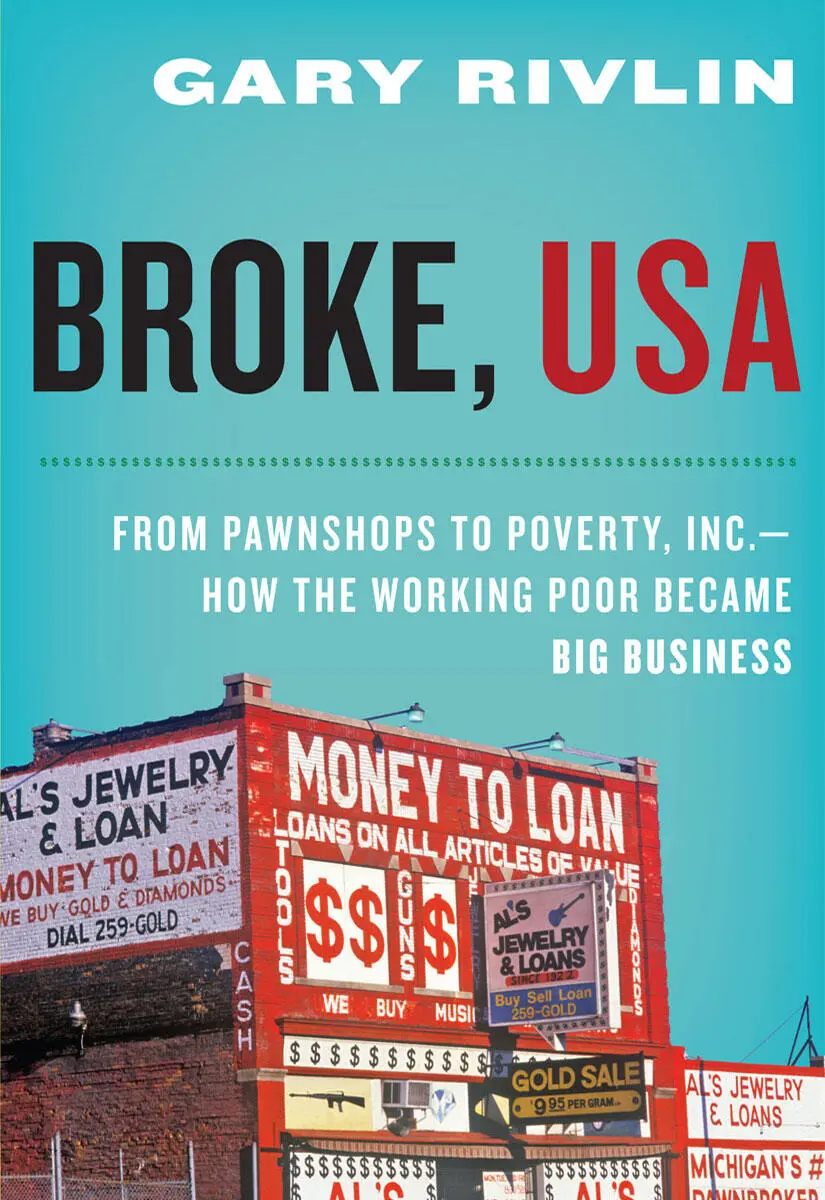
- Название:Broke, USA
- Автор:
- Издательство:HarperCollins Publishers Inc.
- Жанр:
- Год:2010
- Город:New York
- ISBN:978-0-06-199794-5
- Рейтинг книги:3 / 5. Голосов: 1
-
Избранное:Добавить в избранное
- Отзывы:
-
Ваша оценка:
Broke, USA: краткое содержание, описание и аннотация
Предлагаем к чтению аннотацию, описание, краткое содержание или предисловие (зависит от того, что написал сам автор книги «Broke, USA»). Если вы не нашли необходимую информацию о книге — напишите в комментариях, мы постараемся отыскать её.
Broke, USA — читать онлайн бесплатно полную книгу (весь текст) целиком
Ниже представлен текст книги, разбитый по страницам. Система сохранения места последней прочитанной страницы, позволяет с удобством читать онлайн бесплатно книгу «Broke, USA», без необходимости каждый раз заново искать на чём Вы остановились. Поставьте закладку, и сможете в любой момент перейти на страницу, на которой закончили чтение.
Интервал:
Закладка:
“I have this big win and my own mother, she’s on me about dealing with this other thing,” Faith says. “I’m all excited, ‘We did it,’ and she’s like, ‘That’s nice but what about payday lending?’” he said. He hacked out a throaty smoker’s laugh, shot me a glance, and asked, “Ya know?” With time, the payday lenders would grow to despise Faith with nearly the same intensity they normally reserved for Martin Eakes.
There’s something monomaniacal about Bill Faith. He burrows so deeply into an issue or a project that it’s as if the rest of the world ceases to exist. His wife of more than twenty years, Barb Poppe, describes it as “the zone.” It doesn’t make a difference if her husband is working at the computer or deep into a document or just playing cards. “When he gets in the zone, that’s what he totally focuses on,” Poppe said. But that also means Faith can miss a lot while he’s concentrating on something else. For the longest time this advocate for the poor was oblivious to all the payday stores opening in and around Columbus. To the extent he even understood what a payday loan was, he figured it was something people took out once in a blue moon. “I’m embarrassed to say that the cycle of debt and people getting sucked in was something that never even occurred to me,” Faith said.
Before his mother brought up the problem, Dan McCarthy, his lobbyist friend, and Tom Allio, a political ally running the social action arm of the Catholic Diocese of Cleveland, did. McCarthy had never taken out a payday loan, but he knew his sister had because she put him down as a reference and lenders started calling him at work whenever she was late on a payment. It got so bad, McCarthy told Faith, that he had written a big check just to make the phone calls stop. McCarthy, who had worked with Faith on the predatory lending bill, had even half joked with his friend on the night they finally won, “Now we go after the payday lenders.”
For Allio, payday had become his issue a couple of years earlier when he first learned about a woman named Peggy Daugherty. Daugherty, traveling back and forth from central Ohio to Cleveland to get medical attention for her daughter, had borrowed $300 to pay for work on her car. By the time a friend intervened, Daugherty, a middle-aged woman living on a monthly disability check of about $900 a month, owed money to five different stores and had already spent more than $1,000 in fees. To Allio, payday was nothing but an extension of the predatory subprime mortgage lending problem, and in fact he had irritated Faith no end by suggesting they add a payday rate cap to the predatory lending bill.
“We already were up against the entire mortgage industry,” Faith said. “At that point we didn’t need a whole new set of enemies lining up against us.”
Faith had promised Allio he would turn his attention to payday finance as soon as the mortgage fight was over, but months passed without Faith making any commitments. “I was still dragging my feet,” Faith said. “So now Tom is getting even more pissed.” It was no longer a question of what he thought of payday loans. A woman on his staff was getting calls at work because of a sibling who was past due on some loans and he heard from another friend whose sister had also gotten herself into a deep hole using them. “Once you start looking into this thing, you see it’s a really ugly world,” Faith said. But Faith, ever the pragmatist, wanted to see if they stood a chance before jumping into the fight. He checked in with a few friendly legislators and he set up a meeting with the governor-elect, a Democrat named Ted Strickland. Strickland, who would take office at the start of 2007, asked him to wait, but he also made it clear he would sign something if it reached his desk. Faith had similarly encouraging signs from the others, so he informed Allio he was on board.
The group called themselves the Ohio Coalition for Responsible Lending—a self-conscious nod to the Center for Responsible Lending. Jim McCarthy and Dean Lovelace were members, as were a long list of labor leaders, housing activists, community organizers, legal aid attorneys, and those representing faith-based organizations around the state. “To many of us this wasn’t just an economic issue but a moral one,” Allio said. “The high interest rates they charge is a modern-day form of usury. I don’t care what the text, whether it be Jewish or Catholic or mainline Protestant, there’s clear statements in each against usury and the need to offer fair interest rates.” The group decided that its aim would be to cap the interest rates that payday lenders could charge and limit the number of loans a person could take in a given year. “We had people calling the office every day who are like, ‘I’ve got five, six, ten payday loans, I’m trapped,’” said Nick DiNardo, a legal aid attorney in Cincinnati. “And there was nothing we could really do short of helping them if the collections got too aggressive.” It fell to Faith to find a lead sponsor for their bill.
The new governor was a Democrat but the Republicans still controlled both the Ohio House and Senate. So instead of starting with a good liberal, Faith surprised his allies by first approaching a conservative legislator named Bill Batchelder. With Leonid Brezhnev eyebrows, oversized Mars Blackmon glasses, and a tendency to quote Adam Smith, Batchelder hardly seemed to fit the bill of consumer champion. But if they could first muster Republican support, Faith reasoned, some of the bipartisanship good feeling they had nourished during the mortgage fight might carry over to payday. Besides, the two got along famously. Unlike most every other lobbyist traipsing through his office, Batchelder told me, he always found Faith a man of conviction “who was actually looking to engage you in a serious policy debate.” If some of Faith’s allies were inclined to describe Batchelder as one of the legislature’s “cavemen conservatives,” that was all right with Batchelder, who reacted to the characterization with a burst of delighted laughter.
Batchelder and Faith might disagree about most everything but he was an easy sell on payday lending. Batchelder told him he was happy to sponsor the Coalition for Responsible Lending’s bill, not despite Adam Smith, the first apostle of laissez-faire, but because of him. “The rates lenders charged were a moral question for Smith,” Batchelder said. “Smith pointed out that if you charge too much, you damage a society. And he’s right. You can’t charge people these kinds of interest rates without hurting their situation and society.” In October 2007, Batchelder and Robert Hagan, a liberal Democrat from Youngstown, introduced a bill that would impose a 36 percent rate cap on the interest rates payday lenders could charge.
In Washington, D.C., Steven Schlein reacted to the news with an indifferent shrug. After four years with the payday lenders, he had learned not to get too worked up over every dispatch from the hinterlands. “Every year a bunch of states put payday into play,” Schlein said. “But then in the end you have few actual fights.” They had lost legislative battles in Oregon and New Hampshire over the previous few years but mainly they ended up with a compromise that the big chains could live with. “Ohio didn’t seem one of the places we should worry about it,” Schlein said.
In Spartanburg, Billy Webster was similarly unconcerned. The market was too important and the industry too strong in Ohio to lose. Check ’n Go was based in Cincinnati and the Davis brothers several years earlier had had the foresight to spend the money necessary to lure away a top Ohio Senate staffer to run its governmental affairs office. There was also CheckSmart, based in Columbus, a chain of 175 payday and check-cashing stores that had just been sold to a large New York–based private equity fund for $268 million. After writing a check that big and with half of its stores in-state, CheckSmart’s investors weren’t going to sit idly by. “We were told time and time again,” Webster said. “With Check ’n Go and CheckSmart there, there was no way Ohio would be in play.”
Читать дальшеИнтервал:
Закладка:
Похожие книги на «Broke, USA»
Представляем Вашему вниманию похожие книги на «Broke, USA» списком для выбора. Мы отобрали схожую по названию и смыслу литературу в надежде предоставить читателям больше вариантов отыскать новые, интересные, ещё непрочитанные произведения.







Обсуждение, отзывы о книге «Broke, USA» и просто собственные мнения читателей. Оставьте ваши комментарии, напишите, что Вы думаете о произведении, его смысле или главных героях. Укажите что конкретно понравилось, а что нет, и почему Вы так считаете.