Gary Rivlin - Broke, USA
Здесь есть возможность читать онлайн «Gary Rivlin - Broke, USA» весь текст электронной книги совершенно бесплатно (целиком полную версию без сокращений). В некоторых случаях можно слушать аудио, скачать через торрент в формате fb2 и присутствует краткое содержание. Город: New York, Год выпуска: 2010, ISBN: 2010, Издательство: HarperCollins Publishers Inc., Жанр: Старинная литература, на английском языке. Описание произведения, (предисловие) а так же отзывы посетителей доступны на портале библиотеки ЛибКат.
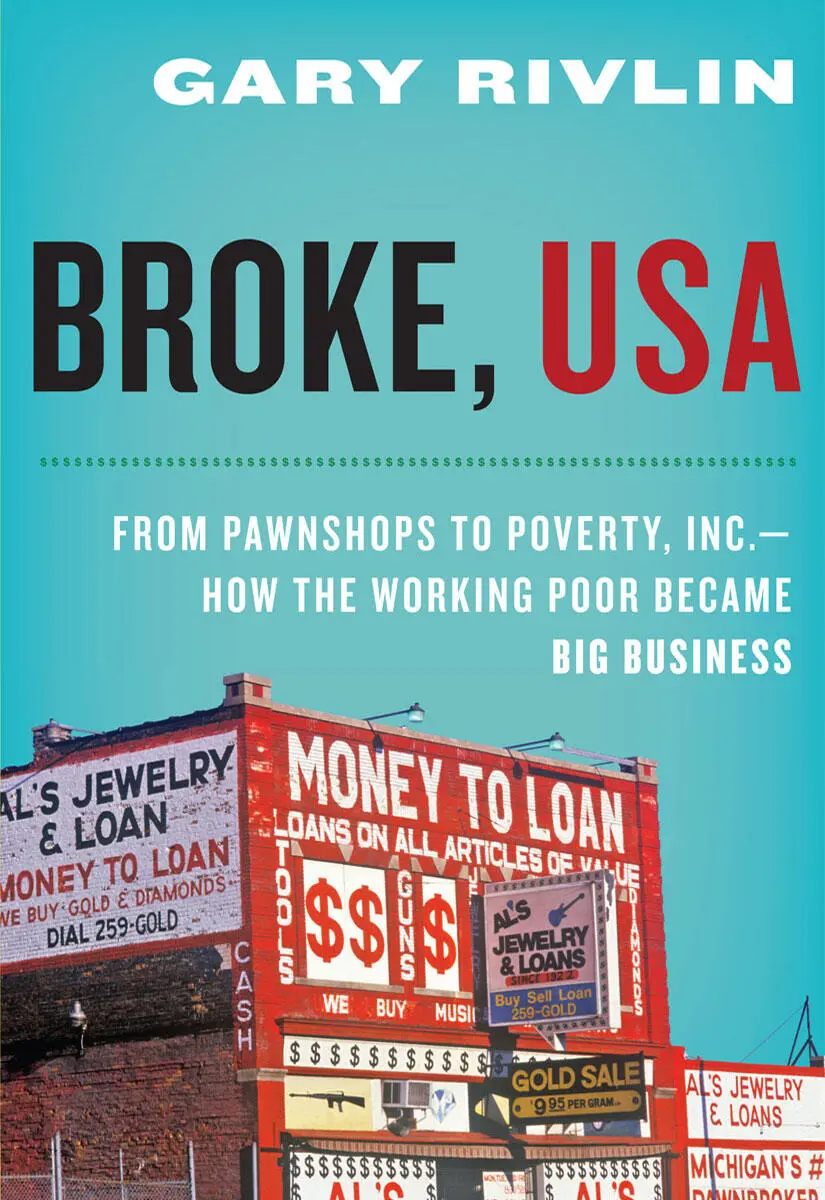
- Название:Broke, USA
- Автор:
- Издательство:HarperCollins Publishers Inc.
- Жанр:
- Год:2010
- Город:New York
- ISBN:978-0-06-199794-5
- Рейтинг книги:3 / 5. Голосов: 1
-
Избранное:Добавить в избранное
- Отзывы:
-
Ваша оценка:
Broke, USA: краткое содержание, описание и аннотация
Предлагаем к чтению аннотацию, описание, краткое содержание или предисловие (зависит от того, что написал сам автор книги «Broke, USA»). Если вы не нашли необходимую информацию о книге — напишите в комментариях, мы постараемся отыскать её.
Broke, USA — читать онлайн бесплатно полную книгу (весь текст) целиком
Ниже представлен текст книги, разбитый по страницам. Система сохранения места последней прочитанной страницы, позволяет с удобством читать онлайн бесплатно книгу «Broke, USA», без необходимости каждый раз заново искать на чём Вы остановились. Поставьте закладку, и сможете в любой момент перейти на страницу, на которой закончили чтение.
Интервал:
Закладка:
The Coalition for Responsible Lending held forums across the state and organized small delegations to meet with individual legislators and with the editorial boards of all the big daily newspapers. A local research group, Policy Matters Ohio, released a report demonstrating that payday had become widespread even in the state’s suburban and rural areas. When, in the autumn of 2007, Marc Dann, the state’s Democratic attorney general, announced he would be holding hearings investigating the lending practices of the state’s 1,600 payday stores, the search was on for customers and employees, or at least former employees, willing to talk about their experiences.
The first of three hearings was held in a large Baptist church on Cleveland’s east side. The industry might have been confident about a victory but they were hardly complacent. Its supporters showed up in full force, wearing yellow “I Support Payday Lending” buttons and made sure their perspective was voiced. They pointed to the list of “best practices” their trade association had developed, including a twenty-four-hour rescission policy and a once-a-year extended payment plan for customers who get themselves into financial trouble with a payday loan. Payday’s critics, many of whom sported buttons showing a shark’s snout biting into a large stash of cash, dismissed these voluntary policies as not worth the paper they were printed on. One of the more moving speakers in Cleveland was a man named Charles Mormino, who told the crowd about a family member with psychiatric problems (he was no more specific than that) who had gotten into trouble with a trio of payday stores. He settled up her debts at all three and then sent a certified letter to each alerting them to the family member’s problem. But all three—Advance America, CheckSmart, and ACE Cash Express—continued to do business with her.
A former payday manager named Tom Kirk spoke at the attorney general’s hearing in Columbus. On paper, Kirk said, the payday lenders were generally responsible citizens. There were in fact rules at the company where he worked against lending to a customer carrying loans at multiple stores, and there were policies to protect borrowers from overzealous collections. The rub was that employee bonuses were based largely on volume. “The policy manual of the company I worked for was good,” Kirk said. “The problem is that the district manager and the store managers and the store personnel don’t always follow it.”
Those who supported the Batchelder bill might have felt encouraged by their organizing efforts if not for one failing: They seemed to be getting nowhere in their hunt for legislators willing to join their crusade. Particularly baffling was the reluctance of House Democrats to commit to their cause. “Several of the legislators were not friendly, verging on hostile,” said Jeff Modzelewski, an organizer for BREAD, a church-based group in the Columbus area, who met with all twelve legislators representing the capital and its suburbs in the statehouse. Even Joyce Beatty, the House minority leader, a black woman representing central Columbus, proved frosty. “We figured she would be strongly enthusiastic,” Modzelewski said. “She represents a black, poor urban district with inner-city problems. But meeting with her—she was among the worst. I’m there with twenty church members and she’s talking to us like we don’t know what we’re talking about.”
There are people in the black community, of course, with a favorable view of the poverty industry. In South Carolina, I spent an evening with Willie Green, the former pro football player who had proven brave or foolish enough to appear on 60 Minutes Wednesday . Green, who by this time had gone to work for Advance America, spoke rhapsodically about the critical role these fringe financial institutions played in the life of the black community. “Check-cashing stores and pawnshops and payday lending stores, those are the poor man’s institutions,” Green said. “You go to any poor black person, and I guarantee you, they’ve borrowed money from a payday person, a title loan person, or a pawnshop. That’s what you do if you don’t have the luxury of going into a bank and borrowing money.” Green’s father, a janitor at a movie theater in Athens, Georgia, had raised nine kids on $85 a week. “He used to play golf on Saturdays and Sundays and then go to the pawnshop,” Green said. “He’d pawn his clubs and he’d pay for my school, or whatever I needed to succeed in life. And then he’d go get his clubs at the end of the week when he got paid.
“He made that sacrifice for us. If my dad had not had the ability to use a pawnshop, I wouldn’t be where I am. I wouldn’t have been able to go to college. I wouldn’t have been able to play professional sports.”
But Joyce Beatty was another story. The Cleveland Plain Dealer revealed that CheckSmart, the company that had just been sold for more than a quarter of a billion dollars, put Beatty’s husband, himself a former legislator (she had taken his seat in the legislature), on the CheckSmart payroll. Even the whiff of controversy was all the motivation many in Beatty’s caucus needed to make up their minds about the evils of payday lending. “A lot of wavering Democrats suddenly had very strong opinions,” said Jim Siegel, who covers the state legislature for the Dispatch . Even Beatty came out in support of meaningful payday reform, as if to show that she was not in bed (so to speak) with the industry. Now all they had to do was convince enough Republicans that there was a compelling reason to add to the state’s job loss and shutter an industry that employed several thousand people across Ohio.
In the eight years he served in the Ohio House of Representatives, Chris Widener remembers a gavel being used during a committee hearing only a few times—and all of them were in the winter and spring of 2008, when his committee, Financial Institutions, was debating payday lending. Widener is an architect by profession, thorough and precise, a thin man with blue eyes, metal-framed glasses, and a receding hairline. He believed that any person wanting a chance to speak should be given one and so he held four hearings on the issue, one of which lasted nearly seven hours.
The crowds were large and often raucous. What Chris Browning remembers about her time in front of Widener’s committee was the hissing and the jeering that accompanied her testimony. She told the committee about the GM pensioner who had borrowed money from her store for 115 consecutive months—and people wearing yellow “I Support Payday Lending” buttons and yellow shirts booed and yelled out things like “liar” and “bullshit.” She declared that “repeat borrowers are the payday loan institution’s bread and butter,” which prompted more catcalls and cries. “Widener’s banging that gavel of his and telling people they’ll be quiet or he’ll remove them but it’s not making much difference,” Browning recalled.
An unhappy Allan Jones took his turn at the witness table. He had better things to do than try to explain his business to people who didn’t understand it, yet suddenly he had been told that he needed to worry about shutting down all his stores in one of his best markets. “It’s like overnight we’re hearing we might lose Ohio,” he recalled. With foreclosures starting to spike across the country and the economy starting to teeter, he was worried that payday would end up collateral damage. “Payday didn’t cause any of this but I realized we were being used as an easy scapegoat,” he said. You might not like how I make my money, he told the committee, but the people you’d be hurting if you imposed this cap “were the ones who without us couldn’t pay the electric company or the repair shop if their car breaks down.”
Читать дальшеИнтервал:
Закладка:
Похожие книги на «Broke, USA»
Представляем Вашему вниманию похожие книги на «Broke, USA» списком для выбора. Мы отобрали схожую по названию и смыслу литературу в надежде предоставить читателям больше вариантов отыскать новые, интересные, ещё непрочитанные произведения.







Обсуждение, отзывы о книге «Broke, USA» и просто собственные мнения читателей. Оставьте ваши комментарии, напишите, что Вы думаете о произведении, его смысле или главных героях. Укажите что конкретно понравилось, а что нет, и почему Вы так считаете.