Gary Rivlin - Broke, USA
Здесь есть возможность читать онлайн «Gary Rivlin - Broke, USA» весь текст электронной книги совершенно бесплатно (целиком полную версию без сокращений). В некоторых случаях можно слушать аудио, скачать через торрент в формате fb2 и присутствует краткое содержание. Город: New York, Год выпуска: 2010, ISBN: 2010, Издательство: HarperCollins Publishers Inc., Жанр: Старинная литература, на английском языке. Описание произведения, (предисловие) а так же отзывы посетителей доступны на портале библиотеки ЛибКат.
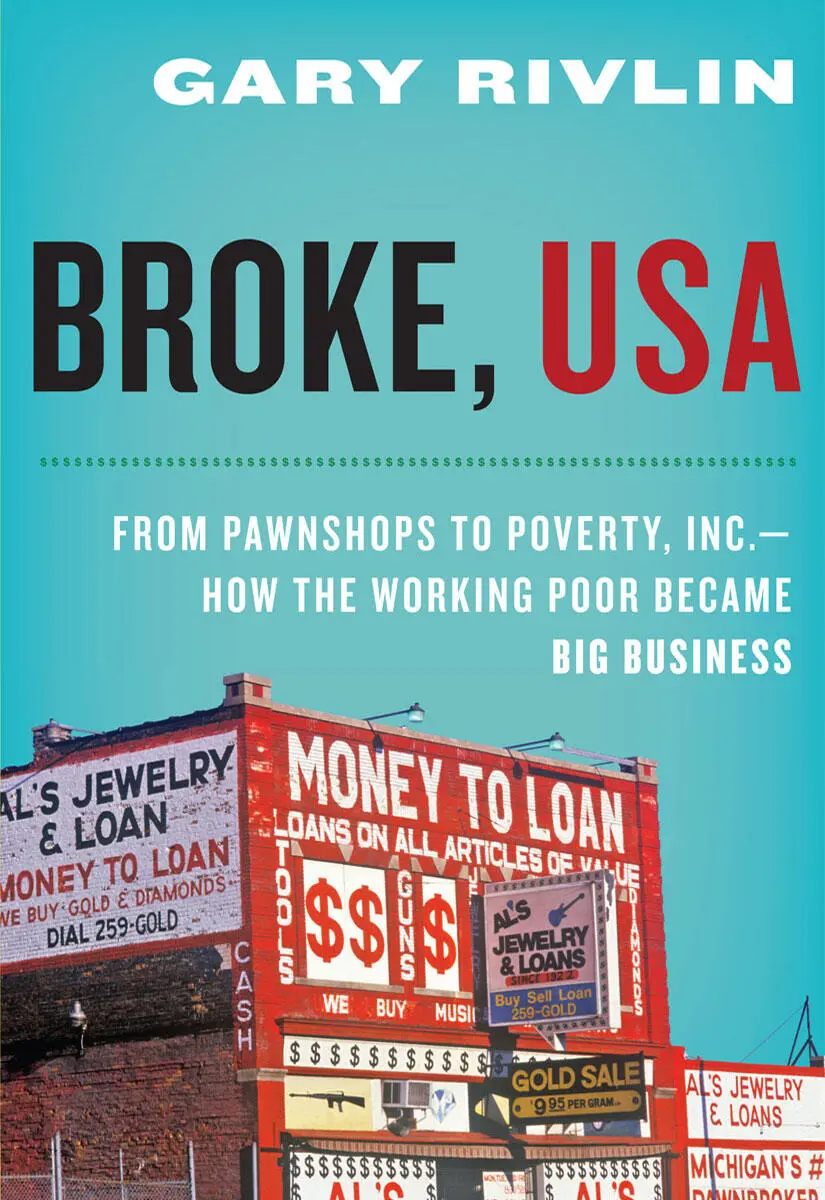
- Название:Broke, USA
- Автор:
- Издательство:HarperCollins Publishers Inc.
- Жанр:
- Год:2010
- Город:New York
- ISBN:978-0-06-199794-5
- Рейтинг книги:3 / 5. Голосов: 1
-
Избранное:Добавить в избранное
- Отзывы:
-
Ваша оценка:
Broke, USA: краткое содержание, описание и аннотация
Предлагаем к чтению аннотацию, описание, краткое содержание или предисловие (зависит от того, что написал сам автор книги «Broke, USA»). Если вы не нашли необходимую информацию о книге — напишите в комментариях, мы постараемся отыскать её.
Broke, USA — читать онлайн бесплатно полную книгу (весь текст) целиком
Ниже представлен текст книги, разбитый по страницам. Система сохранения места последней прочитанной страницы, позволяет с удобством читать онлайн бесплатно книгу «Broke, USA», без необходимости каждый раз заново искать на чём Вы остановились. Поставьте закладку, и сможете в любой момент перейти на страницу, на которой закончили чтение.
Интервал:
Закладка:
Back in Columbus, Faith got involved with a group trying to feed and house the homeless. While he was working behind the steam table at one of the soup kitchens, a man pulled out a shiv and slashed Faith’s face from ear to lip. What most amazed the people who worked with Faith is that, despite the hundred-plus stitches it required to close the wound, he took his regular turn serving just days later. Faith said he was fine with it (“Maybe he just wasn’t on his medications that day,” Faith had told the Cleveland Plain Dealer when that paper profiled him as its man of the year in 2003) until the guy tracked him down years later to offer an apology. “I kinda had a fantasy vision of shooting him between the eyes,” Faith said.
When Greg Haas thinks of his friend back then, he imagines him wearing denim—a denim jacket, a denim shirt, and of course jeans. Faith favored sandals and wore his hair in a fierce bush of curls. The two met when Faith was helping to organize a series of protests at city hall aimed at establishing shelters for the homeless around Columbus and Haas was running the mayoral campaign of an old-school social services Democrat. Faith might have looked like every other protester, Haas said, but even then he stood out from the crowd. “Rather than humiliate people, or just hit them in the face with an issue, Bill seemed to be someone searching for a solution,” he said. It was Faith, Haas said, who hammered out a compromise with the city’s social services director—find a community willing to take a shelter, the agency head said, and we’ll provide the funding—and Faith, after calling what seemed like every landlord and bureaucrat in town, made it happen.
That fight was winding down when Faith was offered a job running the Coalition on Homelessness and Housing in Ohio. He moved out of the Ark and started wearing a tie to meetings, and eventually added a sport coat to his wardrobe. He focused on affordable housing and the homeless through most of the 1990s but by the end of the decade he started talking about predatory lending as well. He thought he had a simple and elegant solution to the problem: Simply apply the state’s existing consumer protection laws to the mortgage business. How could it be, he asked, that Ohio protects its citizens from getting ripped off when they plunk down $25 for a toaster but not when they sign papers committing themselves to an $80,000 loan?
Faith shifted strategy after the 2002 legislative session. If the legislature refused to intervene, Faith said, he would “pound the issue in the court of public opinion” until elected officials relented. He began contacting reporters he knew, hoping to get them interested in the issue. He offered the same message to each: The poverty industry is far more pervasive than you think. “I kept telling them, ‘Don’t talk about black folks,’” Faith said. “There are these loan sharks in the suburbs. There are loan sharks in the town squares of rural areas.”
While he was working the phone, he learned that two reporters at the Columbus Dispatch , Jill Riepenhoff and Geoff Dutton, were already starting to look at the dramatic spike in foreclosures in the Columbus area. He might have made a pest of himself during the nine months he worked with the pair on their series but it seemed well worth it. The resulting series, “Brokered Dreams,” published in September 2005, seemed to have exactly the kind of impact Faith was hoping for. “All of Columbus read it,” AARP lobbyist Ron Bridges said of the Dispatch series. “Or at least all of political Columbus read it.” Bridges, who is black, grumbled that it wasn’t until a series of articles showed that the problem had spread to the white suburbs and rural areas that the legislature felt it needed to act, but when I visited him in his office several years later he still had a small stack of reprints right behind his desk.
The two reporters didn’t completely ignore the center of town, of course. Dutton’s “Flipping Frenzy” piece revealed how wealthy investors with money in a New York–based hedge fund called Stillwater Capital Partners profited from subprime in Columbus, and that kept him running around some of Columbus’s poorer neighborhoods in search of vacant properties and the “straw buyers” whose names and signatures were needed to bid up the prices of these boarded-up messes. But the shock in the series was its finding that foreclosure filings had risen faster in the state’s suburban and rural counties than in urban ones. “Foreclosures were predictably concentrated in poor, inner-city neighborhoods,” Dutton wrote. “But, surprisingly, clusters of dots circled the outskirts of the city, in the newest subdivisions of suburbia.” Even a small Amish community in the northeastern corner of the state felt so under siege that the county posted public service billboards on the more popular horse-and-buggy routes. “You can be robbed when you are away from home,” the signs read, “or you can be robbed over pie and coffee. Be skeptical of door-to-door mortgage salesmen.”
In her reporting, Riepenhoff focused on a single subdivision on the city’s far western suburbs, called Galloway Ridge. It had been developed by Dominion Homes, a publicly traded real estate development company that built subdivisions in central Ohio and Kentucky. Galloway Ridge was a relatively new development but one in six homes were already in foreclosure or part of a bankruptcy proceeding. When Riepenhoff asked the executives at Dominion for an explanation, they blamed it on the irresponsibility of their buyers. “These people are not of the same credit quality, the same earnings level, the same understanding of credit as people in other parts of town,” company CEO Douglas G. Borror told the Dispatch.
However, the credit counselors, bankers, appraisers, and others in the real estate industry appearing in Riepenhoff’s article offered an alternative explanation for the high rate of foreclosures: a lack of checks and balances in the company’s sales transactions. Five years earlier, Dominion had created a new division, Dominion Homes Financial Services, to act as a mortgage broker for those looking to buy any of the properties they built. That meant a single company was constructing the homes, setting the prices, and playing a large role in establishing the loan terms. Dominion even went one step further by helping those without any money raise a down payment—or, as Riepenhoff wrote, the home builder “found a way around a federal law barring sellers from giving money directly to buyers for a down payment.”
A California-based nonprofit called the Nehemiah Corporation of America was the key. Dominion would send a prospective buyer to Nehemiah, which would send Dominion borrowers the 3 percent down payment required to qualify for a loan through the Federal Housing Administration (FHA). Then, within a few days, Dominion would donate that amount of money to Nehemiah, plus a service fee. (For years HUD, which oversees the FHA, has tried to block this practice but the agency had never prevailed in the courts.)
What was the harm if a sizable corporation wanted to devote a portion of its profits to helping people of modest means raise a down payment for a house? For one thing, it wasn’t a gift; Dominion officials admitted to Riepenhoff that they simply passed along the cost of the down payment to the buyer, just as it would the cost of a specially ordered stove. Moreover, there were risk-management studies that led the government to impose the 3 percent requirement in the first place. A 2002 HUD study of Nehemiah-assisted loans in four cities found default rates higher than 19 percent. At 11.5 percent, the Dominion default rate was much lower but it was still twice as high as the Ohio average and more than two and a half times the national average.
Читать дальшеИнтервал:
Закладка:
Похожие книги на «Broke, USA»
Представляем Вашему вниманию похожие книги на «Broke, USA» списком для выбора. Мы отобрали схожую по названию и смыслу литературу в надежде предоставить читателям больше вариантов отыскать новые, интересные, ещё непрочитанные произведения.








Обсуждение, отзывы о книге «Broke, USA» и просто собственные мнения читателей. Оставьте ваши комментарии, напишите, что Вы думаете о произведении, его смысле или главных героях. Укажите что конкретно понравилось, а что нет, и почему Вы так считаете.