Marcos Giralt Torrente - Paris
Здесь есть возможность читать онлайн «Marcos Giralt Torrente - Paris» весь текст электронной книги совершенно бесплатно (целиком полную версию без сокращений). В некоторых случаях можно слушать аудио, скачать через торрент в формате fb2 и присутствует краткое содержание. Год выпуска: 2014, ISBN: 2014, Издательство: Hispabooks, Жанр: Современная проза, на английском языке. Описание произведения, (предисловие) а так же отзывы посетителей доступны на портале библиотеки ЛибКат.
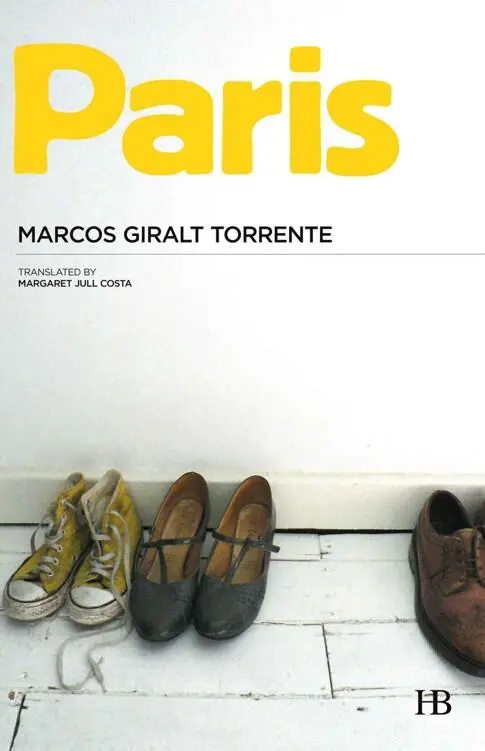
- Название:Paris
- Автор:
- Издательство:Hispabooks
- Жанр:
- Год:2014
- ISBN:9788494228452
- Рейтинг книги:5 / 5. Голосов: 1
-
Избранное:Добавить в избранное
- Отзывы:
-
Ваша оценка:
Paris: краткое содержание, описание и аннотация
Предлагаем к чтению аннотацию, описание, краткое содержание или предисловие (зависит от того, что написал сам автор книги «Paris»). Если вы не нашли необходимую информацию о книге — напишите в комментариях, мы постараемся отыскать её.
Paris — читать онлайн бесплатно полную книгу (весь текст) целиком
Ниже представлен текст книги, разбитый по страницам. Система сохранения места последней прочитанной страницы, позволяет с удобством читать онлайн бесплатно книгу «Paris», без необходимости каждый раз заново искать на чём Вы остановились. Поставьте закладку, и сможете в любой момент перейти на страницу, на которой закончили чтение.
Интервал:
Закладка:
Something similar happened, although for very different reasons, with my maternal grandfather, who died when I was four years old, and about whom I knew almost nothing because I’d hardly ever seen him and because, once he was dead, my mother never mentioned him unless I specifically asked about him. I attributed her silence to the family rift caused by my grandfather’s remarriage, which I did know about, and so I was surprised when my aunt, who must also have been affected by this, was far more forthcoming and not only talked often to me about him but enjoyed saying how much I resembled him. It’s true that many of the anecdotes she told me hinted at the same resentment evident in my mother’s silence and that often during those conversations, her eyes would darken just as my mother’s face would darken on the few occasions she spoke of him, but the contrast between their very different attitudes was still not enough to arouse my interest. I was aware of that contrast and felt intrigued by the figure of my grandfather for the first time, although, as with the silence that my aunt and uncle wove around my father, I never thought about it or did anything more than notice it.
During the months I lived in La Coruña, I did not have the mirror of my mother there on a daily basis, but she continued to be the person I thought about most often, the person whose opinion mattered most to me and who was there in my mind whenever I did something that merited approval or censure. The distance between us made no difference, nor did the fact that any communication between us relied not on unspoken words but on the clumsy or hasty ones babbled into the telephone or set down on paper.
XIX
During the months she spent in Paris, my mother phoned me every week, but never on any particular day or at any set time. She would sometimes phone in the afternoon and sometimes in the evening. She might not phone for five or six days, or leave no space at all between calls, sometimes even phoning twice in one day. Perhaps that’s why I still have the feeling that she was always acting on the impulse of the moment and not according to some predetermined plan. As if she were not entirely sure she was going to call until she picked up the phone to dial the number, as if she were calling for no reason, spontaneously, because the opportunity had suddenly arisen and she didn’t want to waste it, or she were taking a break from some other task, on her way from one place to another. They were hurried calls, rushed conversations that usually followed the same concentric pattern: first, my mother would ask me how I was and listen with great attention to what I said, and then, after talking briefly about herself, she would bring the conversation back to me, as if she couldn’t quite believe the news I had given her just moments before or as if enough time had passed for me to have undergone some radical change. And this cycle was repeated in ever shorter and more insistent segments as we reached the imminent end of the call, until the dropping of her last coin into the pay phone or a decision she herself made brought the conversation to a close. Perhaps that’s also why I still have the feeling there were always things left unsaid and that at the end of each phone call, I knew almost nothing or very little of what was new about her. The calls were too unexpected, too brief or emotional. It isn’t that they were disappointing, but I can’t deny that after the sudden joy of receiving the calls, they left a bigger void than had existed beforehand. They did nothing to dissipate the fog imposed by distance. For a few minutes, my mother’s voice was alive and audible, but there was never time for that artificially created closeness to take on the appearance of reality, to lose the sense that it was all a mirage. This contributed to the difficulty I had imagining her in a particular place, creating an enduring backdrop where I could imagine her sitting or lying down while she was talking to me. During the months that her stay in Paris lasted, my mother changed lodgings often. After a brief spell in the house of an acquaintance, she spent most of the time staying in small hotels she never found entirely satisfactory and never stayed in for very long. She used to call from public telephones, and the background noise that usually surrounded her voice was not the submarine echo of furnished rooms but the cold, metallic, pressurized sound of call shops or phone booths encountered by chance. As far as I remember, or according to what she herself told me, she never had her own phone, and since we could not call her, all responsibility for getting in touch fell on her. We had an emergency number, one belonging to someone she often saw who, in case of anything urgent, could go around to wherever she was living and give her a message. We also had the phone numbers of her neighbors, when she had them, and sometimes, that of the hotel or boarding house where she was staying temporarily, but apart from on special occasions, letters were the most usual and reliable method of reaching her, the only one, moreover, that allowed us to take the initiative. Since she had no permanent address, a few days after moving to Paris, she got a P.O. box number, and that was where we sent nearly all our correspondence.
Time has left no trace of the letters I wrote to her on my own or the ones I wrote together with my aunt; I have no idea how frequent they were or what I wrote about. I know they existed, but memory plays no part in that certainty; it’s like a sediment, a remnant that persists long after the more complex substance of which it was made up or formed a part has disappeared. What I know, now that time has passed and I can recall no detail of their various characteristics, is that those letters are not so very different from all those other childhood truths we never question and always assume to be true, when in reality, not only did we not experience them ourselves, we don’t even know when or how we found out about them. I know that I wrote quite a lot of letters, but that’s as far as I can go. I can’t remember any dates or what the letters contained. The color of the paper and envelopes I used has vanished, too, along with any memory of which mailbox I used, what stamps I put on them, or what my handwriting looked like at the time.
I have a slightly clearer memory of the letters my mother sent to me. I haven’t kept any of them, and there isn’t one that I remember in particular, but my memory is of some use here. There are images and details I can base my certainty on. It isn’t a truth without evidence. I can still see myself picking them up from the table where my aunt would leave the mail, or receiving them directly from her hand, and then putting them in my pocket so that I could read them later, when I was alone. I can see the box where I kept them, and I can especially see my mother’s narrow, sloping hand, the little crosses she added at the end, like English people do, to represent the kisses she had already sent me in words. I remember waiting for what seemed like ages when she owed us a letter, and my almost incredulous surprise when I received one unexpectedly, because apart from postcards — brief, casual messages written and sent from a curbside — my mother rarely wrote on her own initiative. She only wrote in reply to the letters we sent her, and even then not at any great length. She used to linger over the essential details of the letter to which she was replying, and when the moment came to speak about herself and thus furnish material for our response, she always ran out of words, as if she had lost the desire to write or as if some urgent task beckoned. “I woke up today feeling happy”; “I have a really busy day tomorrow”; “I don’t know what I’ll do this weekend.” Her sentences became short, telegraphic. She almost never talked about her work, she didn’t mention the people she mixed with or what kind of life she was leading. Just as when we spoke on the phone, she asked a lot of questions, probing for news of myself and my aunt; she was fond and affectionate, but always very vague about her own affairs. Just as when we spoke on the phone, I imagined her alone, coming from one place or going to another, but, again, this was never something that worried me.
Читать дальшеИнтервал:
Закладка:
Похожие книги на «Paris»
Представляем Вашему вниманию похожие книги на «Paris» списком для выбора. Мы отобрали схожую по названию и смыслу литературу в надежде предоставить читателям больше вариантов отыскать новые, интересные, ещё непрочитанные произведения.







Обсуждение, отзывы о книге «Paris» и просто собственные мнения читателей. Оставьте ваши комментарии, напишите, что Вы думаете о произведении, его смысле или главных героях. Укажите что конкретно понравилось, а что нет, и почему Вы так считаете.