Marcos Giralt Torrente - Paris
Здесь есть возможность читать онлайн «Marcos Giralt Torrente - Paris» весь текст электронной книги совершенно бесплатно (целиком полную версию без сокращений). В некоторых случаях можно слушать аудио, скачать через торрент в формате fb2 и присутствует краткое содержание. Год выпуска: 2014, ISBN: 2014, Издательство: Hispabooks, Жанр: Современная проза, на английском языке. Описание произведения, (предисловие) а так же отзывы посетителей доступны на портале библиотеки ЛибКат.
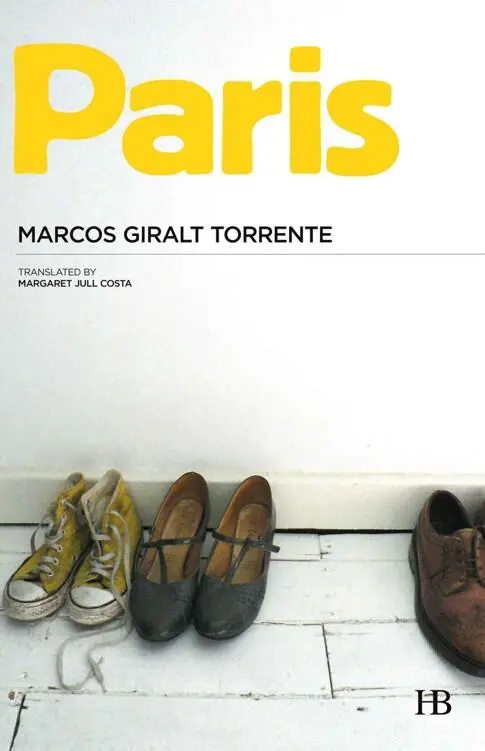
- Название:Paris
- Автор:
- Издательство:Hispabooks
- Жанр:
- Год:2014
- ISBN:9788494228452
- Рейтинг книги:5 / 5. Голосов: 1
-
Избранное:Добавить в избранное
- Отзывы:
-
Ваша оценка:
Paris: краткое содержание, описание и аннотация
Предлагаем к чтению аннотацию, описание, краткое содержание или предисловие (зависит от того, что написал сам автор книги «Paris»). Если вы не нашли необходимую информацию о книге — напишите в комментариях, мы постараемся отыскать её.
Paris — читать онлайн бесплатно полную книгу (весь текст) целиком
Ниже представлен текст книги, разбитый по страницам. Система сохранения места последней прочитанной страницы, позволяет с удобством читать онлайн бесплатно книгу «Paris», без необходимости каждый раз заново искать на чём Вы остановились. Поставьте закладку, и сможете в любой момент перейти на страницу, на которой закончили чтение.
Интервал:
Закладка:
Nothing about the journey to La Coruña ruffles that untroubled atmosphere, it neither modifies anything nor introduces any novelty, there are no anomalies to threaten the flat calm of my memory. We made the journey by car, as we had on other occasions, leaving Madrid in the early morning and, after a leisurely lunch in a restaurant on the way, arriving at our destination eleven hours later, but I have no memory of the preparations made on the preceding days and can’t even remember what happened on the night before we set off. I think my mother gave me a quarter of a sleeping pill so that I would go to sleep earlier than usual, but I may be wrong and that could be a memory from other journeys. I obviously wasn’t overly preoccupied or alert, since otherwise, I would surely remember something, which just goes to show that my mother gave me no reason to be worried, that nothing out of the ordinary happened. It would have taken very little to arouse my disquiet, but my impressions in the car, despite my father’s still recent departure and the suddenness of the journey, were clearly not very different from my impressions on other such journeys. I had no sense that anything was about to end, nor was I in the least worried about my mother. It must have been a very quiet journey, with a lot of looking out the window and long silences interspersed with games or my questions about the landscapes we were driving through. She must have been utterly imperturbable, or was pretending to be, she must have behaved as she felt she should, or as she could not help behaving.
With our arrival in La Coruña, my memory grows very slightly brighter. There are a few signs and a few warning lights, but all very faint. There are two images, two interrelated glimmers of light. One has to do with the very moment we arrived at my aunt’s apartment and the other, with a moment on the following day or possibly one or two days later. In the first, I see my Aunt Delfina welcoming us at the door. She has stood to one side to make way for us, she has picked up the suitcase my mother was carrying, and after asking if we’ve left any other bags in the car, she follows us along the path my mother and I have forged ahead on as if we, not she, were the hosts. I could see she was rather agitated. After leaving our luggage in the room assigned to my mother, and once we were able to say our hellos properly, she barely took any notice of me at all, she didn’t, as one tends to do with children and as she herself always did, devote more attention to me at the start, getting the usual questions and jokes out of the way so as to make up for subsequently relegating me to the background because what she really wanted to do was to talk to her sister without any interruptions or abrupt changes of subject. On that occasion, my aunt did exactly the opposite. I could tell at once that she was impatient to get me out of the way. She walked past me, enquired briefly about my exams, affectionately pinched my cheek, and then, from that moment on, devoted all her attention to my mother, asking over and over, “How are you?”; “Are you all right?”; “How did everything go?”—as if the continual repetition of the same question, framed in different ways, concealed a real concern about something she did not dare to name directly. After that image, there is nothing, the final flicker of the candle snuffed out in the cold wax of my memory. I don’t know how we spent the rest of the afternoon or if my aunt made any attempt to be alone with my mother. I find myself faced by a void that is impossible to fill. I can’t remember, however dimly or confusedly, a single incident or conversation. That faint flame is only lit again when the three of us are in the kitchen having breakfast. On that occasion, the image is rather blurred, and unlike the previous one, it isn’t my aunt but my mother who takes center stage. It must have been very shortly after our arrival, because my mother joined us in the kitchen, bringing me a pair of pants from our shared suitcase. She left them folded up on the back of a chair, then sat down without offering to help my aunt, who was feeding slices of bread into the toaster. She waited a few seconds, as if she were angry or bothered by something, then said to my aunt, “I’m sure this is the best way.” Her words, spoken in the middle of a long silence, sounded brusque, even though they weren’t, and my aunt, who had her back to us, turned to look at her. Then she looked at me, as if to check that I was still there, and said, “It’s OK, you’re absolutely right, I just find it a bit strange.” She said this in a conciliatory but slightly weary tone, like that of someone who concedes a point in the middle of a heated debate, not out of real conviction but in order to avoid an insuperable difference of opinion. For a while, no one said anything, my aunt continuing to watch over the toast. Then suddenly, without saying a word, my mother downed her cup of coffee in one gulp, got up, and went off to take a shower.
That is the last glimmer, the last scene after the sudden disappearance of my father that remains shrouded in darkness and uncertainty. There are no further memories until light finally dawns. A few days later, my mother finally told me her plans, and I discovered that this summer would be different from any other and that after our stay in La Coruña, we would not be moving, as we usually did, to some rented house on the Mediterranean coast. I learned that we would stay in Galicia for the whole of July and August, until the first of September, when my mother would go back to Madrid alone, and that afterward, I would not rejoin her — she would send me my winter clothes and my most important possessions and I would remain with my aunt in La Coruña. I learned that my mother would close up our apartment in Madrid and that, with the possible exception of vacations or the occasional weekend, for ten long months we would live in different cities, me in La Coruña, studying at a school my aunt had found for me, and my mother in Paris, working as a teacher of Spanish, although she had yet to find a post; and this sudden revelation was not in the least traumatic. In a way, I knew the step my mother was taking was not an easy one, and even more importantly, I was convinced that she was taking the step not because it was inevitable but because she had chosen to. No one told me my father was the reason for this, but that’s how I interpreted it. In some way, I preferred to feel that, after the great disappointment of my father’s departure, she was imposing a radical change on us, and moving to another country seemed to me a convincing way of doing this. My mother would take refuge in another city, would be unavailable, and was simply leaving me with her sister, the only person she could leave me with, her only family. At the time, I had no doubts; I didn’t feel abandoned or for one moment cease to believe her promise that this was a provisional arrangement, just while she got used to living in Paris and found a suitable apartment for the two of us.
XVIII
I don’t think I found anything strange or disquieting about what I’ve been calling my mother’s Paris period, not until right at the end, at least, when it was almost the past and no longer the present. While it was happening, I didn’t feel that anything significant would come of it. I even remember that on the day of her departure, I put on the phony indifference that children or simpletons or people unsure of their own emotions tend to adopt in highly charged situations. If my memory of that crucial moment serves me right, what frightened me, more than separation from my mother, was having to deal with the unknown quantity of life with my aunt in a city that, up until then, I’d only known in summer, and having to go to a school where, for a long time, I would be the new boy , the focus of attention and possibly the butt of jokes or jealousy, that kid from Madrid . I don’t mean that her departure left me unmoved, as had been the case with my father’s disappearance, which only affected me insofar as it might have distressed my mother. I would, of course, have preferred to continue our life in Madrid — it would be ridiculous to say otherwise — but just as I felt no malice toward her as the instigator of that move, neither did the move itself arouse in me an exaggerated sense of loss. I felt neither hurt nor sidelined by it. I suppose it was as much a natural desire not to betray my mother’s confidence in me as a more personal and perhaps artificial desire to feel that I was part of the challenge she was taking on — our union preserved despite the distance separating us.
Читать дальшеИнтервал:
Закладка:
Похожие книги на «Paris»
Представляем Вашему вниманию похожие книги на «Paris» списком для выбора. Мы отобрали схожую по названию и смыслу литературу в надежде предоставить читателям больше вариантов отыскать новые, интересные, ещё непрочитанные произведения.







Обсуждение, отзывы о книге «Paris» и просто собственные мнения читателей. Оставьте ваши комментарии, напишите, что Вы думаете о произведении, его смысле или главных героях. Укажите что конкретно понравилось, а что нет, и почему Вы так считаете.