Marcos Giralt Torrente - Paris
Здесь есть возможность читать онлайн «Marcos Giralt Torrente - Paris» весь текст электронной книги совершенно бесплатно (целиком полную версию без сокращений). В некоторых случаях можно слушать аудио, скачать через торрент в формате fb2 и присутствует краткое содержание. Год выпуска: 2014, ISBN: 2014, Издательство: Hispabooks, Жанр: Современная проза, на английском языке. Описание произведения, (предисловие) а так же отзывы посетителей доступны на портале библиотеки ЛибКат.
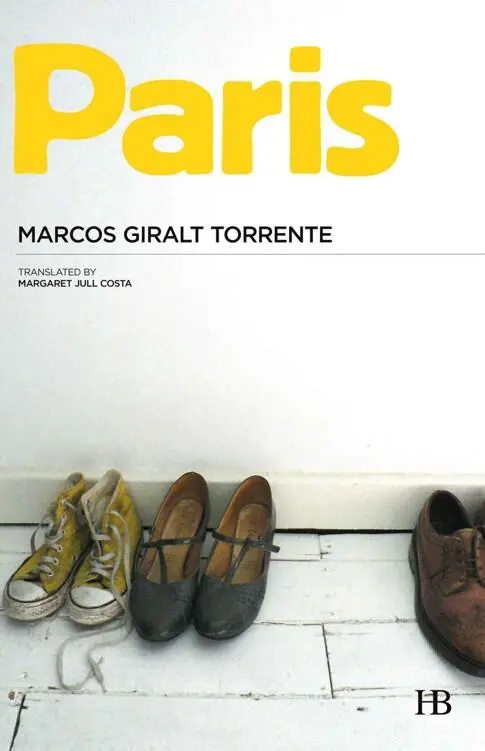
- Название:Paris
- Автор:
- Издательство:Hispabooks
- Жанр:
- Год:2014
- ISBN:9788494228452
- Рейтинг книги:5 / 5. Голосов: 1
-
Избранное:Добавить в избранное
- Отзывы:
-
Ваша оценка:
Paris: краткое содержание, описание и аннотация
Предлагаем к чтению аннотацию, описание, краткое содержание или предисловие (зависит от того, что написал сам автор книги «Paris»). Если вы не нашли необходимую информацию о книге — напишите в комментариях, мы постараемся отыскать её.
Paris — читать онлайн бесплатно полную книгу (весь текст) целиком
Ниже представлен текст книги, разбитый по страницам. Система сохранения места последней прочитанной страницы, позволяет с удобством читать онлайн бесплатно книгу «Paris», без необходимости каждый раз заново искать на чём Вы остановились. Поставьте закладку, и сможете в любой момент перейти на страницу, на которой закончили чтение.
Интервал:
Закладка:
There’s no real point in looking for causes, there’s nothing so very odd about it. It’s likely that the most important things that happen to us are things we would never have predicted. We live our lives thinking we know who we are and how we’ll react in any given situation, but we just have to dig around a little in our memories to find significant examples of when we reacted quite differently from how we should have reacted. There is no model for how we behave. We can’t trust how we think we’ll respond to a particular stimulus. There are no constants. The variables that govern our responses, like the variables of memory, are entirely unforeseeable. What do we remember, and why? What is it that affects or moves us, and why? We can’t even be sure about our most automatic responses, those that shape our character and allow us to define ourselves and others, to say things like “That’s how I am” or “This person is like that.” For every reflex reaction, every habit or obsession that forms part of our way of being, how often have we also been moved to tears by things that have nothing to do with us, things we are even ashamed to be seeing? Likewise, how often have we accepted, without a flicker of emotion, other situations that do have to do with us and should touch us, that cry out either for our repudiation or our support? As soon as we explore our memory more deeply, it comes up with a multitude of occasions when we experienced incidents or situations that should have upset us but, despite everything, passed and left no trace, or left a very different trace from the one we might have expected. There are times when we think we couldn’t possibly laugh at or be offended by something, and yet we can’t help ourselves and duly end up laughing at or being offended by that very thing. Deep down, we know very little about ourselves, very little of what might affect us. Even our reactions or responses to the same stimulus are not always the same.
I’m thinking and saying all this as a way of trying to understand my behavior then. But I’m thinking, too, about how things developed after my father’s disappearance, the changes it wrought in my life, the transformation, in part definitive, brought about by the subsequent separation from my mother, and the undramatic way in which I accepted those changes never fails to surprise me. It seems unnatural. My father disappeared toward the end of May, by mid-June my mother and I were in La Coruña, and just over two months later, she went off to Paris, leaving me with my aunt and uncle, but in my memory, this sequence of events is not accompanied by any pain or sadness. For what seemed like a very long time, my mother and I stopped living in the same place, our centers of gravity moved apart, but I can detect no hint of resignation, distrust, or resentment in myself. There is, rather, acceptance, a predisposition to understand the reasons I sensed lay behind her decision. Of course, it’s impossible to say what would have happened if I hadn’t found those business cards, if I hadn’t felt guilty about concealing it from my mother, and if my father’s departure hadn’t confirmed all the foreboding that my discovery had awoken in me. I don’t know if my attitude or my feelings would have been any different. Yet I can’t help thinking that, albeit unconsciously, the bad taste it left in my mouth somehow influenced my acceptance of that new phase. I’m not saying this was a conscious calculation on my part, an attempt to compensate for my guilt. I’m just saying that one thing followed the other, and it seems highly likely that the former had some effect, however tenuous, on the latter, even if I myself didn’t notice it and had possibly forgotten all about my earlier deceit.
On the other hand, there were no such attenuating circumstances with my mother, and I can’t imagine what she would have done if, instead of me being an only child, she’d had three children, because in that case it would have been impossible to leave us all with my Aunt Delfina. I can’t imagine what would have become of her if she hadn’t been able to temporarily shed her responsibilities, how her life would have changed if she hadn’t been able to escape to Paris, if she’d had to stay in Madrid even though doing so meant deepening the wound. What is certain is that, even though I was her only child, even though it was her choice, even though she was the one who decided to take that step, it could not have been easy for her. She must have thought long and hard about it.
XVII
What I observed in my mother after my father ran away was not insubstantial, but it was all very contradictory and would be of little help in getting even a vague idea of her true state of mind if I hadn’t had the example of previous occasions when I was able to glimpse how deeply she was affected by what had now become a reality — her possibly definitive failure. We need not go very far back. For example, in comparison with her joy on that weekend trip to Toledo, when my father told her that he had found a job, or with that more recent example when he went off unexpectedly and she feared she would never see him again, her reaction this time was moderate, one might even say cool, but perhaps that’s not so very strange. In a way, it could be considered an indication of the magnitude of her despair: the greater her despair, the greater the effort required to mitigate it.
Firstly, there are the days immediately following my father’s disappearance, when it was still too early to give up all hope. After the first night spent waiting for a phone call that never came or for him to come home, the light in my mother seemed to go out. She stayed at home and made no attempt to excuse my father’s absence, saying only that he had gone. Her bewilderment was obvious, as was the fact that she had no way of justifying it and was in no mood to come up with a justification. My father hadn’t said goodbye, he had simply left with a small suitcase filled with his best clothes, and it wasn’t hard to infer from this that he had no plans to return. It nevertheless took two days for my mother to grasp this. For two days, she was caught between two impulses, the more urgent one that drove her to stay in her bedroom, and the perennial one that told her not to lower her guard with me for an instant. One minute she would be absorbed in thought or invisible, the next she would be trying to compensate for this by checking up on me all the time, coming into my room or the living room to ask how I was feeling or if I needed anything. Not until the third day — like a watch that has gotten wet and suddenly starts going again just when we thought it had stopped for good — only then did her customary determination reappear. In an ambiguous gesture in which I sensed both a desire to conceal nothing from me and an equal desire not to have to explain too much, she phoned the police, even though I was there with her. She didn’t tell them my father had disappeared, she merely asked about his situation, if he’d been arrested or was wanted and on the run. When she hung up and turned to look at me, her attitude was quite different. I noticed a sudden look of relief on her face and in the way she spoke to me. What she said has remained engraved on my memory: “There’s no need to worry.” I don’t remember what happened after that. I don’t know if she stayed by my side or if we just went on with our separate tasks. I have a feeling, although I can’t be sure, that she began removing all trace of him from the apartment that very afternoon, putting his clothes and belongings into boxes.
It’s as difficult to interpret the days that followed my father’s departure as it is the intervening time between then and our move to La Coruña. Two weeks in which the only revealing thing my mother did was to schedule our trip for the middle of June, when normally, we wouldn’t go until July. Two weeks during which, if it hadn’t been such a short time and I hadn’t been in the middle of taking my final exams, it would have been almost as if we had gone back to our old, pre-Burgos routine. My mother waking me up each morning, my mother telling me to hurry up so as not to miss the school bus, my mother out at work, my mother there to greet me at six o’clock when I came home, where she had been waiting for me since midday. There was nothing in our daily life to remind us of our recent loss, there were no startling outbursts, no melancholy looks or unusual behavior. My mother talked and moved about the house just as she had before, as if with the simple act of packing up and putting away my father’s things, she had freed herself — if not for ever, at least quite determinedly — from any excessive feelings of grief on his account. She didn’t tell me what was beginning to take shape in her head, but now that I think about it, there was one day when she almost did. At the time, I didn’t give it much importance, because I had no idea what was about to happen and her question caught me unawares. It was one Sunday morning, after the gymnastics showcase my school always put on at the end of the year. I’d taken part along with my classmates, and my mother had watched from the stands in the gymnasium. When the performance was over and we were in the cafeteria — where, every year, parents had the chance to chat with the teachers for the last time that term — in what was perhaps a chance remark or something she said after she’d done the rounds of the teachers, and while I was enjoying a cold drink and she was on her second cup of coffee, she asked if I was happy at the school or if I felt like a change. Perhaps that isn’t exactly what she said or she put it in a slightly different way. What I do know is that I didn’t interpret her question as having any hidden meaning, and I replied noncommittally, saying something along the lines that all schools were pretty much the same. My mother didn’t press the matter, and we didn’t touch on the subject again until after we arrived in La Coruña, when she presented me with a fait accompli . I have no idea what would have happened if I’d said I didn’t want to lose the friends I had or didn’t want to have to get used to new faces and new rules. I suppose, though, that it wouldn’t have been very different. My mother could be very persuasive and was always very good at arguing her case, and I suspect, moreover, that she knew better than I did that there was nothing very important binding me to that particular school, nothing I couldn’t do without, like those annual gymnastics recitals.
Читать дальшеИнтервал:
Закладка:
Похожие книги на «Paris»
Представляем Вашему вниманию похожие книги на «Paris» списком для выбора. Мы отобрали схожую по названию и смыслу литературу в надежде предоставить читателям больше вариантов отыскать новые, интересные, ещё непрочитанные произведения.










Обсуждение, отзывы о книге «Paris» и просто собственные мнения читателей. Оставьте ваши комментарии, напишите, что Вы думаете о произведении, его смысле или главных героях. Укажите что конкретно понравилось, а что нет, и почему Вы так считаете.