Marcos Giralt Torrente - Paris
Здесь есть возможность читать онлайн «Marcos Giralt Torrente - Paris» весь текст электронной книги совершенно бесплатно (целиком полную версию без сокращений). В некоторых случаях можно слушать аудио, скачать через торрент в формате fb2 и присутствует краткое содержание. Год выпуска: 2014, ISBN: 2014, Издательство: Hispabooks, Жанр: Современная проза, на английском языке. Описание произведения, (предисловие) а так же отзывы посетителей доступны на портале библиотеки ЛибКат.
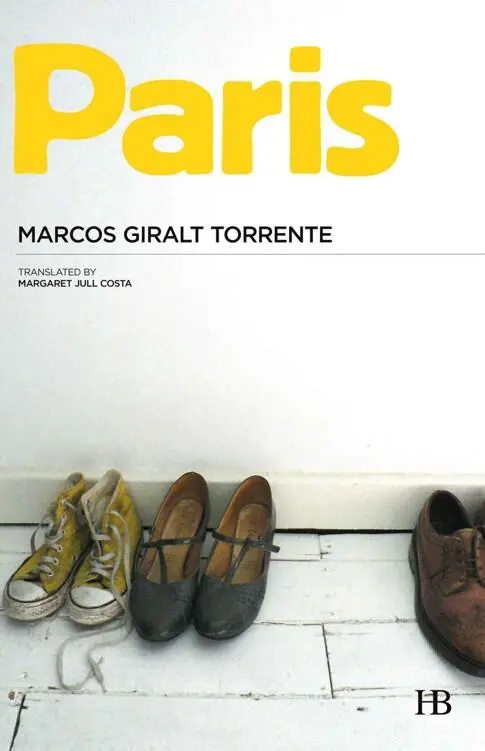
- Название:Paris
- Автор:
- Издательство:Hispabooks
- Жанр:
- Год:2014
- ISBN:9788494228452
- Рейтинг книги:5 / 5. Голосов: 1
-
Избранное:Добавить в избранное
- Отзывы:
-
Ваша оценка:
Paris: краткое содержание, описание и аннотация
Предлагаем к чтению аннотацию, описание, краткое содержание или предисловие (зависит от того, что написал сам автор книги «Paris»). Если вы не нашли необходимую информацию о книге — напишите в комментариях, мы постараемся отыскать её.
Paris — читать онлайн бесплатно полную книгу (весь текст) целиком
Ниже представлен текст книги, разбитый по страницам. Система сохранения места последней прочитанной страницы, позволяет с удобством читать онлайн бесплатно книгу «Paris», без необходимости каждый раз заново искать на чём Вы остановились. Поставьте закладку, и сможете в любой момент перейти на страницу, на которой закончили чтение.
Интервал:
Закладка:
XV
I didn’t tell my mother about my discovery. I wanted to for days, but didn’t. That would have meant making it more real than it already was, and, initially, I just couldn’t do it, fearful of how she might react. Later, when I was ready to tell her, my father preempted my decision, and it was no longer necessary and would have solved nothing. Maybe my silence was no more than an innocent and slightly clumsy way of refusing to see the beginning of an end whose approach I had started to feel the moment I found the package. That night, however, while I was crawling around under the table, as well as during the days and weeks that followed, everything was much vaguer. I didn’t think about it. I could feel the danger, sense its worrying proximity, but that was all. I couldn’t come up with any satisfactory explanation as to what the contents of that package might mean or how they could be translated into something concrete. I could see how carefully it had been hidden away, and I had understood at once, with no need for further thought, the fear felt by the person who had hidden it — fear of me, but, above all, fear of my mother. Anyway, she was the person I thought of, not myself.
I kept trying to ward off the threat, turning my back on it, refusing to think about it, as if it would be less likely to materialize if I didn’t name it. I didn’t tell my mother about my discovery, and yet the memory of my failure to do so lives on in me. It’s more real than many other things that were perhaps more important but my memory has nevertheless failed to retain. It’s true that for many years, that scene remained forgotten and not until much later did it come back to me, but it’s also true that afterward, that moment or that decision — which I made almost without thinking or even considering the possible consequences — has become one of the cornerstones by which I judge my relationship with my mother, far more than many other things I did consciously, after having carefully pondered the consequences. What troubles me, basically, is the age-old dilemma of whether not telling someone something is the same as lying: Does real lying have to be deliberate? Are we lying from the moment we choose to conceal something from someone because it seems inopportune or inappropriate? Or, on the contrary, if deceit — to call it by another name — arises in such cases by accident, with the passing of time, when after waiting for the right moment to tell someone — a moment that never arrives — it becomes ever more difficult to speak out, does that mean that not telling and lying are one and the same? And this brings me inevitably to another question. However close we feel to those around us, can we ever be sure that what we know about them is true, if what they tell us is the whole truth or just part of the truth, and does knowing or not knowing change anything in our lives?
Would anything have changed if I had told my mother about my discovery? Would the ensuing years have been any different? Would my image of her be any different from the one I have now? Would I be different?
If these questions still preoccupy me now, when so much time has passed, it isn’t because of the remorse I can’t help but feel whenever I think about that period of my life. I’m not even sure I regret my silence, or that I wouldn’t do the same again, or that I wouldn’t have continued to remain silent even if my father had not preempted my decision. Nor is it my fear of having at some point been a victim myself of the very thing I inflicted on my mother. If these questions still trouble me, it’s because the answer is related to something that affects me most directly — my own relationship with my mother.
When you’re an only child, when you don’t have the mirror of siblings, your insecurity about who you are seems greater than if you had grown up with someone else who shared the same influences, the same parents, and who is nonetheless clearly different from them, and, of course, from you. But when there are no brothers and sisters on whom to offload responsibility, parents are all you have, they become your sole reference, your sole viewpoint. Everything begins and ends in you, and phenomena like betrayal, love, admiration, and duty are felt with greater intensity. The bonds are stronger, or leave a deeper mark, and it’s often hard to distinguish what’s yours and what’s inherited. You have no one with whom to compare yourself, your solitude is suffocating. Who do you share with or offload onto? Who do you ask, who do you answer to, who do you blame? How do you get any kind of perspective? How can you use your memories to construct a balanced history when you have only one way of looking and that way of looking is filtered and influenced by your own solitary self? When you have no brothers and sisters, everything seems specially tailored for you. The danger is that you tend to magnify things, tend to draw infinite conclusions from every word spoken, every look or rebuff, every event seen or sensed, or that you’re told about, or that never even happened. That’s why you get into more of a muddle and make more mistakes, too. It may be that you overestimate your parents, that it’s harder to break away, and it may be that you don’t always value them as you should. Everything has the potential to hurt you more, but nothing so much as your own solitary self, your utter onliness.
I didn’t realize what this meant until long after the time I’m talking about now, when I began to wonder if I hadn’t taken too much for granted, and when the weight of what I knew and didn’t know about my mother on the one hand and what the two of us together represented on the other first began to intrigue me. But occasionally, albeit only vaguely, I had already felt the unnamed, unimagined void of the absent sibling. The first occasion I can remember was the one I’ve just described. Kneeling under the table — not immediately after I had discovered the package, but once I had opened it and sealed it up again and restored it to its original place, where I could still see the marks left by the insulating tape, and especially in the days that followed, when the temptation to share the discovery with my mother was greatest, as was the caution that prevented me from doing so— that was when I began to feel, as I never had before, the loneliness, and the fear that loneliness creates. My disloyalty, and the wall it erected between us, really hurt me. My mother was my only ally, my only security, and the idea that I might be harming her in some way made me suddenly aware of the precariousness of my position. I realized that without her, I was lost, and that if she failed me or I failed her, if she were to disappear or we were to become separated, there was nothing else. The empty, unknown void of a future in which, unless I myself ever had a child, there would be no such unconditional love.
I didn’t ask myself anything at the time. It was a feeling that assailed me suddenly, without provoking or bringing with it questions of any importance, but it was enough, nonetheless, to fill me with renewed unease and disquiet. For two weeks, the time it took for what both of us feared would happen to happen, I felt that a gulf opened up between my mother and myself, that we were not the close-knit unit we had been (she and I alone or she and I vis-à-vis my father), but that, for the first time, there were three of us, including my father, each one the vertex of an imaginary triangle, each one (or at least two of us) with a secret to keep.
XVI
Apart from the parallels with other occasions when I felt that same sense of separation — through no fault of my own this time — the reason I mention the new experience of those two weeks is because I think they influenced the ease with which I accepted what happened afterward: my father’s departure, our move to La Coruña, and, in particular, the beginning of what I’ve described elsewhere as my mother’s Paris period, her decision to set off for the first time along a path that would temporarily separate her from me.
Читать дальшеИнтервал:
Закладка:
Похожие книги на «Paris»
Представляем Вашему вниманию похожие книги на «Paris» списком для выбора. Мы отобрали схожую по названию и смыслу литературу в надежде предоставить читателям больше вариантов отыскать новые, интересные, ещё непрочитанные произведения.







Обсуждение, отзывы о книге «Paris» и просто собственные мнения читателей. Оставьте ваши комментарии, напишите, что Вы думаете о произведении, его смысле или главных героях. Укажите что конкретно понравилось, а что нет, и почему Вы так считаете.