Marcos Giralt Torrente - Paris
Здесь есть возможность читать онлайн «Marcos Giralt Torrente - Paris» весь текст электронной книги совершенно бесплатно (целиком полную версию без сокращений). В некоторых случаях можно слушать аудио, скачать через торрент в формате fb2 и присутствует краткое содержание. Год выпуска: 2014, ISBN: 2014, Издательство: Hispabooks, Жанр: Современная проза, на английском языке. Описание произведения, (предисловие) а так же отзывы посетителей доступны на портале библиотеки ЛибКат.
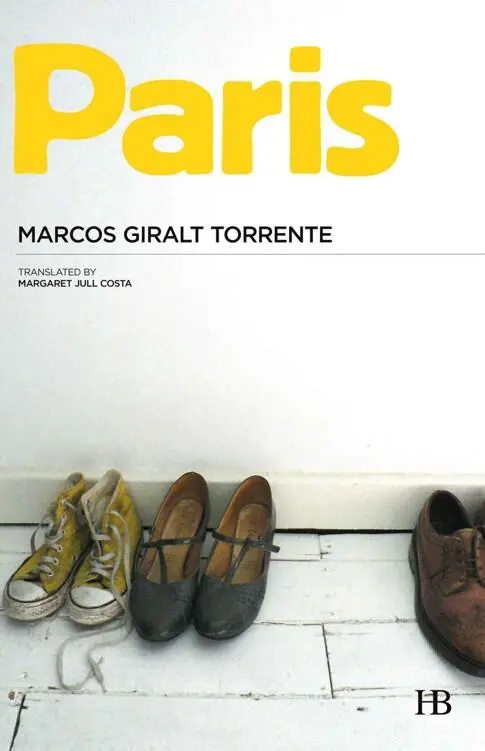
- Название:Paris
- Автор:
- Издательство:Hispabooks
- Жанр:
- Год:2014
- ISBN:9788494228452
- Рейтинг книги:5 / 5. Голосов: 1
-
Избранное:Добавить в избранное
- Отзывы:
-
Ваша оценка:
Paris: краткое содержание, описание и аннотация
Предлагаем к чтению аннотацию, описание, краткое содержание или предисловие (зависит от того, что написал сам автор книги «Paris»). Если вы не нашли необходимую информацию о книге — напишите в комментариях, мы постараемся отыскать её.
Paris — читать онлайн бесплатно полную книгу (весь текст) целиком
Ниже представлен текст книги, разбитый по страницам. Система сохранения места последней прочитанной страницы, позволяет с удобством читать онлайн бесплатно книгу «Paris», без необходимости каждый раз заново искать на чём Вы остановились. Поставьте закладку, и сможете в любой момент перейти на страницу, на которой закончили чтение.
Интервал:
Закладка:
One not insignificant factor in my almost blithe acceptance of my mother’s absence was that during the time I stayed in La Coruña, there were no disagreements between me and my aunt and her husband. It seems strange to me now, but during the months I spent with them, there were never any unpleasant surprises, no outlandish impositions or deprivations; as far as I can remember, we never experienced any of the little domestic misunderstandings that, however minor, can be extremely troubling and cause great tension, especially between people unaccustomed to living together. No doubt this was largely because my Aunt Delfina had decided that there would be no unnecessary conflicts. Yet I find it hard to believe that her decision was the sole determining factor. On the one hand, it would have been difficult to maintain a fiction over that many months, and on the other, had it been purely my aunt’s decision, it would probably have been accompanied by an excess of zeal, which was certainly not the case — childless couples who find themselves forced to play the role of adoptive parents often try to be so perfect and scrupulous in their inherited role that they turn out to be more rigid and intolerant than the real parents. More important and influential than any single decision was my aunt’s personality and the already familiar way in which she ran her household.
My aunt was an extremely restless, energetic person, one of those people who cannot imagine lingering quietly over anything or giving in for any length of time to a single feeling or emotion apart from the one that impels them into the labyrinth of some activity so diverse and so obsessive that it has no end and no beginning. She was extremely thin and prematurely lined, and she spent all her time bustling about, busily doing things that turned out to be nothing at all. She gave the impression that if she’d ever had an ambition, she had either long ago fulfilled it or given it up. She was abuzz with frenetic energy, but just as my mother checked her own natural tendency to introversion with a strong sense of duty that often transmuted into overanxiety, so my aunt never allowed her accelerated pace of life, her lack of any real focus, to come between her and what she considered important. Apart from the times they were together, when my mother would take the subordinate role and delegate some of her power to my aunt, they were very similar in temperament. As I said before, my aunt was considerably more conventional, or less flexible, in her views, but, as far as I could see and as far as I can recall, this stance was more imagined than real and could be put down to the very different world she inhabited, and it in no way influenced her relationship with me. In that respect, she was almost a carbon copy of my mother: the same or a similar sense of loyalty, the same or a similar sense of family and sacrifice, the same or a similar mix of tolerance and rigor. Living with her was very comfortable, since it did not require me to adapt to any new order. It was, if I can put it like this, as if she expected of me what I, quite naturally, was prepared to give her. Her husband’s influence, if he had any, was barely noticeable. Tall and gangly, with narrow, sloping shoulders and an almost nonexistent neck, on which sat a ridiculously large head, he was both the complement and the opposite of my aunt. A man of few words, with a permanent frown, as if he were constantly preoccupied or overwhelmed by problems, he gave the impression of being someone who leaves nothing to chance, is never plagued by doubt, and is in firm control of everything around him. His every measured, precise gesture oozed confidence, and he had a high opinion of himself, which he applied to every aspect of his life. When you saw him, especially when he was in uniform, you would assume that these attributes were all part and parcel of his military profession. However, the proof that this was very much an inner quality was that he never imposed himself on others and rarely demanded of them what he demanded of himself. He was a friendly fellow, though, and had a kindly, accommodating nature that made him a very pleasant person to deal with. Whenever we discussed matters that did not affect him personally, he would respond in the same neutral tones, never angry or bossy. Despite the marked differences between him and my aunt and the fact that they seemed to talk very rarely to each other, he clearly had total confidence in his wife, or so it seemed, and he was one of those men who, though very much an old-fashioned male — or perhaps precisely because he was incapable of shedding a particular masculine mode of behavior learned and transmitted over generations — happily did as he was told as soon as he crossed the threshold of his house. I never heard him question any decision made by my aunt. He accepted everything, including her sometimes troubling restlessness. With me, he was affable and even affectionate, in his somewhat gruff, embarrassed way, but he went no further than that and would never advise or criticize me. I fell under the jurisdiction of his wife. I was part of a domestic world in which it would never have occurred to him to interfere, not because he despised it, but because he did not feel he had the right to, it wasn’t his job, his field of expertise. My aunt reciprocated by showing the utmost respect for everything that formed part of his professional life, going to the frequent ceremonial or social events that his high rank required him to attend or where his presence was expected, and maintaining a scrupulous silence about everything else. That rigid separation of duties, that mutual consideration, did not affect their relationship. Seeing the two of them together, so cool with each other, so repetitive in their daily routine, with its daily dearth of incident, the impression they made on me (or the impression they make on me now) was one of sadness, of a lack of spontaneity and passion, one of those couples who, perhaps rather arrogantly, one tends to think are held together only by habit or by the material or emotional impossibility of even considering divorce. It seems to me, though, that in their brusque, infrequent displays of affection, in the impassivity with which he accepted my aunt’s excesses and in her bland, innocuous response to the consequences of leading a life that I can’t help thinking was a long way from any hopes she might have nurtured in her distant youth as to what her life might turn out to be, they nonetheless came very close to the image I had of a perfection I had never known at home with my own parents.
That is what occurs to me now, in the light of subsequent events, but such an idea never entered my head during the months I lived with them. As far as I was concerned, my time spent in La Coruña was merely a rather longer than usual vacation, and it never for a moment interrupted a line I thought of as infinite, the line drawn by my mother and myself with our silent understandings and our almost never mentioned and possibly never perceived differences. Nothing unusual happened until the last week; I never thought of my aunt and uncle as something enviable, and I never compared them with my parents. Even then, separated from my mother for reasons I didn’t understand but did accept, there was still nothing lacking in my life. Those months could have been the right moment to start asking a few questions, to come up with a few objections, or find grounds for disagreement with all those things I normally never questioned. The distance and separation from my mother could have constituted the right moment, the initiation or apprenticeship that would suddenly allow me to find my own place, rather than the one I had inherited from or owed to my mother. I had plenty of excuses. It’s clear, for example, that my uncle must have found it distressing to have someone like my father in his family, even though he was not a blood relative and had nothing to do with him directly. But if that were true (and I can’t help but suspect that it was in those days, when one’s personal life was an open book and could have proved problematic for someone of his rank), I didn’t think about it until long afterward. Just as, in one way or another, my mother, though absent, was a constant presence, my father was never spoken about, did not exist, no one mentioned his name. I myself only thought about him from time to time. I would occasionally wonder where he was living or what he was doing, but the lack of any answer did not trouble me unduly; it was a bit like when we wonder what happened to someone we used to know but with whom we feel no real connection once we’ve lost all contact, partly because we can’t even be sure he remembers us. I noticed the silence that surrounded his name in my aunt and uncle’s home, but I assumed, and still do in the case of my aunt, that it was out of delicacy on her part, so as not to remind me of something she thought would bring back painful memories. Not until two or three years later did I realize how alone my mother was in what she was trying to do, how little support she had.
Читать дальшеИнтервал:
Закладка:
Похожие книги на «Paris»
Представляем Вашему вниманию похожие книги на «Paris» списком для выбора. Мы отобрали схожую по названию и смыслу литературу в надежде предоставить читателям больше вариантов отыскать новые, интересные, ещё непрочитанные произведения.









Обсуждение, отзывы о книге «Paris» и просто собственные мнения читателей. Оставьте ваши комментарии, напишите, что Вы думаете о произведении, его смысле или главных героях. Укажите что конкретно понравилось, а что нет, и почему Вы так считаете.