Marcos Giralt Torrente - Paris
Здесь есть возможность читать онлайн «Marcos Giralt Torrente - Paris» весь текст электронной книги совершенно бесплатно (целиком полную версию без сокращений). В некоторых случаях можно слушать аудио, скачать через торрент в формате fb2 и присутствует краткое содержание. Год выпуска: 2014, ISBN: 2014, Издательство: Hispabooks, Жанр: Современная проза, на английском языке. Описание произведения, (предисловие) а так же отзывы посетителей доступны на портале библиотеки ЛибКат.
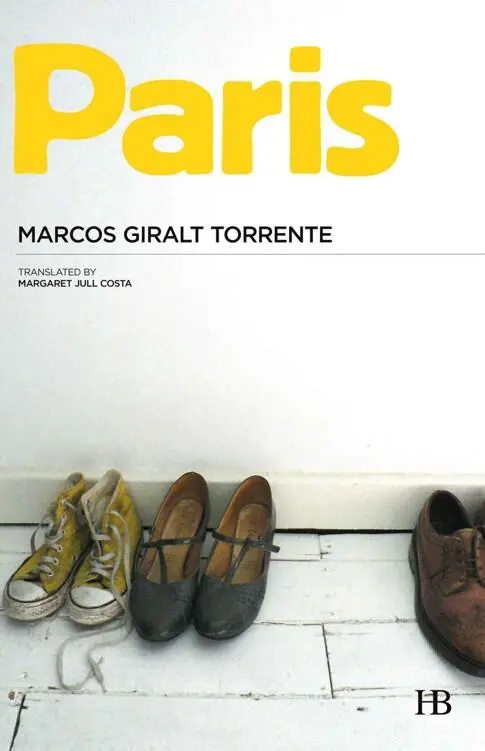
- Название:Paris
- Автор:
- Издательство:Hispabooks
- Жанр:
- Год:2014
- ISBN:9788494228452
- Рейтинг книги:5 / 5. Голосов: 1
-
Избранное:Добавить в избранное
- Отзывы:
-
Ваша оценка:
Paris: краткое содержание, описание и аннотация
Предлагаем к чтению аннотацию, описание, краткое содержание или предисловие (зависит от того, что написал сам автор книги «Paris»). Если вы не нашли необходимую информацию о книге — напишите в комментариях, мы постараемся отыскать её.
Paris — читать онлайн бесплатно полную книгу (весь текст) целиком
Ниже представлен текст книги, разбитый по страницам. Система сохранения места последней прочитанной страницы, позволяет с удобством читать онлайн бесплатно книгу «Paris», без необходимости каждый раз заново искать на чём Вы остановились. Поставьте закладку, и сможете в любой момент перейти на страницу, на которой закончили чтение.
Интервал:
Закладка:
XXI
When we think about the past, it’s hard to resist both dividing it up into blocks in accordance with the pattern of events that have made most impression on us and attributing powers to it that it does not have, allowing ourselves to believe that the arrival of a particular date had the ability to work some radical transformation on us. Until the death of my father, we say, I was like this or like that, when we should really say that on such and such a date, something that already existed inside us began to make itself manifest or visible. Such nonsense is merely the reflection of a still greater error of thinking, the belief that we change suddenly rather than gradually, as if we could not possibly be influenced by opposing but simultaneous impulses.
As it appears in my memory now, the impression I have when I look back at the era that began with the return of my mother, the recommencement of our life together, is one of change and permanence; as if when travelling along an old provincial road relegated to premature neglect by the creation of a highway or by steady depopulation, we suddenly emerged, after a bridge or a turn or a particularly tight bend, onto a stretch rather different from all the previous ones, different enough to be noticeable, but in such a vague, indefinite way that we could easily be mistaken — it’s no wider, the surface is no better, and yet, nevertheless, there’s something different about the quality of the tarmac and the paint used on the road markings. Throughout those years, right up until now, really, the direction of travel has remained the same, as have the passing landscape and my fellow passengers, but there’s a tenuous, unpindownable shift in the quality of my memory, as if it had grown denser, with diverse, hitherto foreign elements battling to get into it.
However, I have no idea precisely when those elements began to appear. My recollection of those years is so confused that I can’t even differentiate between them. As far as I can recall, nothing changed between my mother and me after we resumed our life together, at least not outwardly; there were no appreciable changes in our relationship or in the way she treated me, nor in the world around us or in the way my mother navigated her way through the world. After her arrival in La Coruña and our subsequent move back to Madrid, our life returned, imperceptibly, even smoothly, to the familiar routine that my father had interrupted with his release from prison just over a year before and that we fleetingly reinstated during the two weeks between his departure and our journey to La Coruña, where, as it turned out, I was to stay. My mother is alone, and as far as I recall, I am the center of everything she does. I’m her most constant companion, the person she turns to when she needs calming down or cheering up, the one who greets her in the morning and says goodnight to her before going to bed, the person she has to take care of in the case of illness and the only person who can look after her when she herself is ill. The two of us are the center of everything, our decisions affect only us, and only we decide what does or does not affect us. My mother organizes her day so that she will be at home when she thinks I might need her, and I rarely disappoint her. As far as I can recall, those years not only do not change the rhythm of my relationship with her but, because of their nearness in time, they provide the reference point and model that allow me to reconstruct that relationship now. The journey to and from school; the weekends that would grow in my mind’s eye before they arrived, until their glow was doused by the dull gray of Sundays; days that were both different and the same. . My mother waking me up each morning, my mother telling me to hurry up so as not to miss the school bus. The years that follow her time in Paris do not modify but confirm, do not truncate but endorse and establish what constitutes the essence of her relationship with me, her solitary dedication, my onliness as an only child. And yet something entirely new emerges out of the interstices of those years, out of the almost identical days and weeks, out of the secrets and sadnesses and joys either shared, or experienced in the solitude of my room — something that allows me to establish a certain separation, to divide time up despite myself, to divide it into a before and an after.
This isn’t something that happens suddenly. My mother’s arrival in La Coruña draws a line in time, but as with the separation she had wanted and sought and to which her arrival put an end, as with her letters and phone calls and the continual postponements of those successive encounters planned during her absence, there was nothing that led me to believe that anything new or unusual was about to irrupt into our lives. My mother arrived looking very tired, carrying two gray leather suitcases much battered by her months of nomadism; her brown eyes seemed about to fill with tears, and her voice was timid and tentative, holding back the many feelings overwhelming her. She seemed uncertain, her every gesture and movement hesitant, as if she didn’t quite know how to behave with me, whether she should give me a long or a short embrace, whether she should look at me or take my hand while I walked beside her to the terminal exit. From the very first moment, her every gesture, her every movement was a faithful reflection of the tension she felt between joy and sadness, between restraint and the need to conceal that restraint. On the other hand, despite this apparent exactitude of recall, I remember that I noticed nothing anomalous about her behavior. Nothing was quite as I expected, and yet it was still perfectly acceptable; it was all written according to a script I would not have agreed to beforehand but would not have dared to reject once it was written; there wasn’t the joy I might have expected, but nor was her reaction strange enough to be denied or called into question. In a way, everything was acceptable, correct, and normal. Like the look in her eyes, more expectant and laconic than joyful and relaxed. Like her nervous blinking, or her hand, which, on our way back from the airport, she placed on my wrist, now as wide as hers (the two of us sitting in the back of the car that my uncle drove without speaking to or looking at us). Like Delfina’s prudent but continual questions. Like the confusion over who should carry what when we took the suitcases out of the trunk or the awkwardness that came over us when we got back to the house (all of us, apart from my uncle, sitting in the living room, squeezing every banal detail out of my mother’s description of her flight, all of us worn out with tension and clumsily struggling to find something to say). Like the presents my mother suddenly remembered she had brought for us. Like her apologies for having had to choose them so hurriedly, or the hours we spent afterward, still sitting in the same place, talking without really talking about anything. Like her early escape to bed or her brief, fearful goodnight to me. It was as spontaneous and ambiguous as it might have been had it all happened exactly as I had expected it would, and not so very different from that, either.
The presence of my aunt and uncle may have contributed to this, but I have no memory of any sudden shocks in the days that followed, either, nor during the whole of that summer. At home in Madrid, with the two of us alone, I would probably have assigned a different interpretation to my mother’s reluctance to talk about her time in Paris, I would probably have taken a very different view of her evasive looks and comments whenever I mentioned it; the way she quickly changed the subject, the complete absence of any details, her permanently inward-turned gaze whenever I happened upon her alone, the slow fragility with which she seemed to move, and the hesitant, halting way in which she spoke would probably have made me suspicious. Although I can’t be sure. The one thing I can say without fear of straying from the truth is that in the company of my aunt and uncle, whose presence diluted everything, I found nothing strange about the silences or the frequent exchanges of glances, nor did I wonder, however often I may think back to it now, at my mother’s willingness to bow to the dictates of others — whether to my aunt’s occasional peremptory orders or to my own childish, capricious whims — or at her obvious unease whenever my uncle turned up to join in some family outing, or at his general coolness and lack of interest in such activities.
Читать дальшеИнтервал:
Закладка:
Похожие книги на «Paris»
Представляем Вашему вниманию похожие книги на «Paris» списком для выбора. Мы отобрали схожую по названию и смыслу литературу в надежде предоставить читателям больше вариантов отыскать новые, интересные, ещё непрочитанные произведения.







Обсуждение, отзывы о книге «Paris» и просто собственные мнения читателей. Оставьте ваши комментарии, напишите, что Вы думаете о произведении, его смысле или главных героях. Укажите что конкретно понравилось, а что нет, и почему Вы так считаете.