Marcos Giralt Torrente - Paris
Здесь есть возможность читать онлайн «Marcos Giralt Torrente - Paris» весь текст электронной книги совершенно бесплатно (целиком полную версию без сокращений). В некоторых случаях можно слушать аудио, скачать через торрент в формате fb2 и присутствует краткое содержание. Год выпуска: 2014, ISBN: 2014, Издательство: Hispabooks, Жанр: Современная проза, на английском языке. Описание произведения, (предисловие) а так же отзывы посетителей доступны на портале библиотеки ЛибКат.
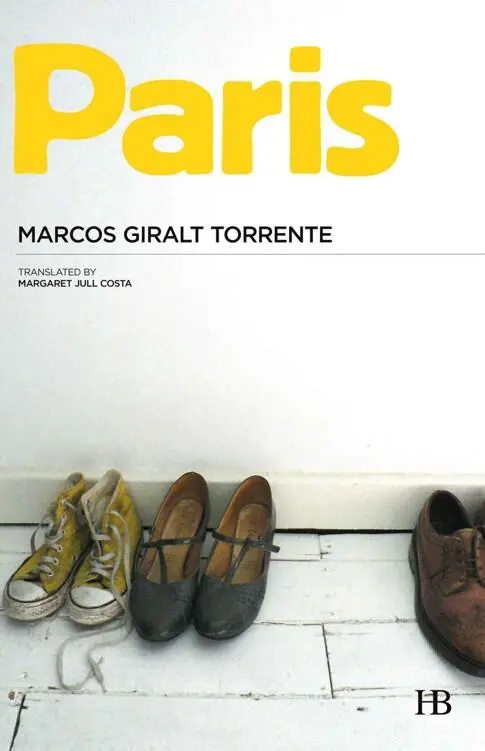
- Название:Paris
- Автор:
- Издательство:Hispabooks
- Жанр:
- Год:2014
- ISBN:9788494228452
- Рейтинг книги:5 / 5. Голосов: 1
-
Избранное:Добавить в избранное
- Отзывы:
-
Ваша оценка:
Paris: краткое содержание, описание и аннотация
Предлагаем к чтению аннотацию, описание, краткое содержание или предисловие (зависит от того, что написал сам автор книги «Paris»). Если вы не нашли необходимую информацию о книге — напишите в комментариях, мы постараемся отыскать её.
Paris — читать онлайн бесплатно полную книгу (весь текст) целиком
Ниже представлен текст книги, разбитый по страницам. Система сохранения места последней прочитанной страницы, позволяет с удобством читать онлайн бесплатно книгу «Paris», без необходимости каждый раз заново искать на чём Вы остановились. Поставьте закладку, и сможете в любой момент перейти на страницу, на которой закончили чтение.
Интервал:
Закладка:
Everything becomes mixed up in one’s memory, and I’m not even sure if that really is what happened or if it’s just me finding signs and symbols where there were none, especially when I can put no end-date on it, give no definite before and after. I would like to, but it doesn’t really help if I say that our move back to Madrid did not immediately cause a change in the texture of the lines and surface of the path we resumed together, or that my mother’s silence and the sparing, hesitant way in which she spoke about those months when we were separated for the first time continued unabated in Madrid, or that the blur of day-to-day routine quickly reinstated itself and I soon forgot what that separation had meant for us. I would like to give a date, but there is no beginning and no definite end. I know when the “before” ends, but not when the “after” begins. It’s something that affects all those years that were just about to begin. Something that happens without my realizing it. Something that is there in those identical days following one on the other, in the repeated embraces and expressions of joy at familiar situations or situations very similar to other situations, in my mother’s words of advice, in the light from her bedroom at night illuminating my dark bedroom, in our two doors left open, in the breathing of one being listened to by the other.
The years ushered in by my mother’s return are years in which my father is completely absent and we no longer expect to see him. They are years in which my image of him is the quick, broad-brush sketch of someone who has neither a future nor a present, when he is forbidden from entering our apartment, and we do not even miss him; years in which my mother does not object to talking to me about him when I ask her to, but when the only regular, constant news we get of him comes from the phone calls made by anxious, worried, bewildered people, phone calls that come in waves depending on whether he’s in Madrid or not, and with passing time, they will be our only surviving connection with him, even when we move to a new apartment and my father becomes someone forever erased and excluded from our lives. The years ushered in by my reunion with my mother are years in which my Aunt Delfina resumes her important but secondary role; years in which we still see her every summer, in which she continues to be my mother’s closest and most loyal ally, but during which she is not, as far as I know, counselor, accomplice, or confessor; years in which I overhear no behind-doors conversations or eavesdrop on dialogues in which I sense some intimate secret that I do not share, simply because there is nothing that requires any counseling, nothing to confess or to share. The years ushered in by my mother’s return are years in which nothing changes, and nothing new or unrelated to ourselves occurs. And at the same time, they are years in which time drags and becomes seemingly endless and oppressive, they are years of struggle, years in which I do battle with myself, in which I change completely and begin to judge and rebel and protest against my solitary existence, condemned never to share my feelings with or offload them onto anyone else, to suffer in solitude — myself as sole recipient, sole beneficiary — all the sacrifices and doubts, all the self-abnegation and devotion. The years ushered in by my mother’s return are years in which things linger and calcify, in which my mother withdraws further into herself and shows no sign of any anomalous behavior or perturbation of spirit; years in which only remnants of the past surface to worry me, fears that make the sacrifice still more sacrificial, the self-abnegation more self-abnegating. There is no before or after, the lines blur. During those years, life is just life, it’s just my mother and me.
XXII
It’s not easy to separate out in your memory different incidents that happened simultaneously. If your father died in the same year as some other misfortune occurred that seemed to alter the course of your life, setting it off along the tracks of despair, it’s hard not to connect the two things, not to fall into the temptation of thinking that your father’s death was a determining factor in that other event, in your failing your final exams, losing your job, or messing up your last opportunity to save a relationship. According to that same deductive process, it would be equally legitimate to infer the opposite: that your father died because you were about to drop out of college or undertake some venture doomed to failure. If we reject that possibility, we do so only out of prudence and not because it’s just as false or unlikely as the first hypothesis.
In the same way, I find it hard to separate out those first stirrings of rebellion and my feelings of detachment from my mother from the shadow of doubt that hung over me all those years. The two emotions have become confused in my memory, and I don’t know which caused which, or if they were entirely independent from each other.
But in order to speak about the uncertainties haunting my mind, first timidly and later ever more forcefully and urgently, I must first describe a curious incident that happened before that, when, to me, the city of Paris meant nothing more than the months I had spent away from my mother. It happened suddenly, without warning, at a time I can’t pin down exactly, but about one or two years after my mother came back to get me in La Coruña. It was winter, one afternoon when I’d already been home from school for some time. My mother was out, and I was sitting in my bedroom, waiting for her, when the apartment’s buzzer sounded. This did not surprise me, even though I knew we weren’t expecting anyone and that the street door downstairs was open, what with the doorman carrying out his usual duties as inquisitor and filter. While I slouched off reluctantly toward the kitchen, I thought it would probably be my mother calling up, as she often did, to tell me that she’d be slightly delayed because she had to go to the store or had stopped to talk to a neighbor. A few seconds later, however, the voice I heard on the other end was not hers but the weary, servile voice of the doorman. “Two men asking after your mother are coming up. I told them she wasn’t in, but they insisted.” I didn’t even have time to thank him before the doorbell rang. I hung up and went to open the door, which I did — as usual, disobeying all my mother’s instructions — without first looking through the peephole or putting on the security chain. I don’t know who I thought I would find there. The fact is that all my confidence vanished when I was confronted by a man wearing boots and a black leather jacket; he had curly hair, a defiant look on his face, and he stood on the landing, smiling at me, but making no attempt to say anything during the time it took me to look him up and down. He was probably in his late thirties, and his impeccable appearance struck me as somehow artificial and showy. I didn’t feel afraid, because he was standing very stiffly and some way away from the door, as if in order to ring the bell he’d had to reach out his arm as far as he could. I was, nevertheless, so disconcerted that I was completely unable to speak, until, after a few seconds, the stranger took one short step forward, while still remaining some distance away, and asked to speak to my mother, using her full name.
“She’s not here,” I said. “But if you’d like to leave a message, or if I can help you at all. .”
“Are you her son?” His smile had grown still broader, and he took advantage of the softening effect this might have on me by taking another step forward, thus placing himself in the normal position for ringing a doorbell. “May I come in?” he added, without waiting for me to respond. “I’m a friend of your parents. I haven’t heard from them for some time, and since I’m in Madrid for a few days, I thought I’d look them up.”
Читать дальшеИнтервал:
Закладка:
Похожие книги на «Paris»
Представляем Вашему вниманию похожие книги на «Paris» списком для выбора. Мы отобрали схожую по названию и смыслу литературу в надежде предоставить читателям больше вариантов отыскать новые, интересные, ещё непрочитанные произведения.









Обсуждение, отзывы о книге «Paris» и просто собственные мнения читателей. Оставьте ваши комментарии, напишите, что Вы думаете о произведении, его смысле или главных героях. Укажите что конкретно понравилось, а что нет, и почему Вы так считаете.