Marcos Giralt Torrente - Paris
Здесь есть возможность читать онлайн «Marcos Giralt Torrente - Paris» весь текст электронной книги совершенно бесплатно (целиком полную версию без сокращений). В некоторых случаях можно слушать аудио, скачать через торрент в формате fb2 и присутствует краткое содержание. Год выпуска: 2014, ISBN: 2014, Издательство: Hispabooks, Жанр: Современная проза, на английском языке. Описание произведения, (предисловие) а так же отзывы посетителей доступны на портале библиотеки ЛибКат.
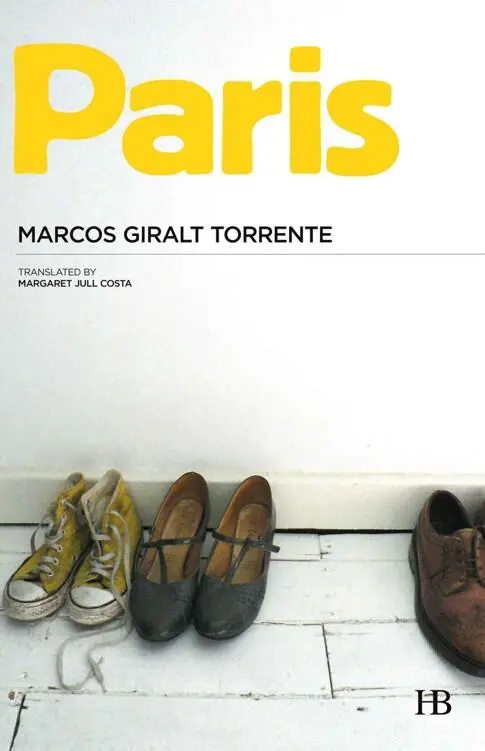
- Название:Paris
- Автор:
- Издательство:Hispabooks
- Жанр:
- Год:2014
- ISBN:9788494228452
- Рейтинг книги:5 / 5. Голосов: 1
-
Избранное:Добавить в избранное
- Отзывы:
-
Ваша оценка:
Paris: краткое содержание, описание и аннотация
Предлагаем к чтению аннотацию, описание, краткое содержание или предисловие (зависит от того, что написал сам автор книги «Paris»). Если вы не нашли необходимую информацию о книге — напишите в комментариях, мы постараемся отыскать её.
Paris — читать онлайн бесплатно полную книгу (весь текст) целиком
Ниже представлен текст книги, разбитый по страницам. Система сохранения места последней прочитанной страницы, позволяет с удобством читать онлайн бесплатно книгу «Paris», без необходимости каждый раз заново искать на чём Вы остановились. Поставьте закладку, и сможете в любой момент перейти на страницу, на которой закончили чтение.
Интервал:
Закладка:
“The doorman told me that a couple of shady-looking characters were here.” I didn’t reply at once, as if it were a matter of no importance.
“Yes, it was a mistake. They were looking for someone with the same name as you, but it turned out they were after someone else.”
XXIII
There are no strategies we can reliably adopt in our dealings with other people, there are no fixed patterns, not even if our overriding feeling is one of love. Why is it that I react to the same stimulus sometimes with anger and sometimes with sympathy or even satisfaction? Why is it that, depending on the day, something as ordinary as watching someone I love pick up their morning cup of coffee can fill me with either pleasure or revulsion? Why is it that sometimes a look is enough for me to feel forearmed against any future misfortune and yet, at others, that same look can plunge me into the blackest of melancholies? We tend to think of ourselves as immovable beings, firmly rooted in certain fixed codes and tastes, when, in reality, we are constantly at war with ourselves. We say things like “I love you” or “I can’t stand you any more” and think that those words define the state of our soul, when the truth is that we change with the ever-mutable winds of the emotions. That’s why young lovers, who are closest to the age when the flow of desire is as yet untamed by convention or self-interest, speak constantly about their love. “I love you,” they say. “Do you love me?” they ask. They need their affections to be constantly confirmed, because they know that nothing lasts and that while something may be true at this very moment, the next moment, it might not, that even the sincerest of feelings can change in a matter of minutes.
Not even those who can no longer answer us are free from these vacillations of the mind, not even my mother, who neither listens nor speaks nor even thinks. Why did she not make a better choice? Why did she not get out sooner? Why did she enlarge my solitude with hers? Was it just because she married in haste? Did she sacrifice herself for me, or was I the sacrifice? The questions pile up, the justifications and complaints follow thick and fast. It doesn’t matter that there is no reply or that the only person who could reply keeps silent. We felt happy or angry with our living father just as we feel happy or angry with our dead father, the only difference being that in the latter case, the sorrow is greater. Remorse haunts us because we know that it depends entirely on us which pan of the scales weighs heaviest.
I can’t remember the first occasion on which either a tantrum or a sharp reply directed at my mother was followed, on reflection, by a hasty attempt to find some justification for it in our strange life, in her kindness, her overattentiveness. I don’t remember a single scene in which I responded sharply to some affectionate comment she made, to an inopportune caress, or a perfectly ordinary question like “How are you?” or “What have you been up to?” At first, these were mere flashes of anger that faded almost before they began, like the flame from some pantomime dragon. I remember my confusion, my regret, my attempts to make up for each explosion with subsequent affectionate outbursts. I remember my continuing doubts once I had been forgiven and, afterward, my search for new reasons to exonerate myself, for imagined changes I thought I’d noticed since her return, as if anything that came between us had only appeared since then, as if they were bad habits acquired during her time in Paris. I felt, for example, that she was far more protective of me than before, and I found this irksome. It bothered me to notice how little she went out, and I was sure that before we had spent a whole winter apart, she had been far less preoccupied with me, had had her own life, which she didn’t need to supplement with mine. It bothered me that she was always giving me advice on what I should wear or how I should behave, which, it seemed to me, she hadn’t done before, at least not so frequently. Of course, I myself realize that these were mere ploys, comparisons dictated by necessity, but they worked. They were not legitimate, but they helped to justify my irritation. Whether rightly or wrongly, I felt that my mother had not been the same since she returned from Paris, and although it’s true that I could not have said what that difference was, I was sure she had undergone some kind of transformation. We are, of course, all in a state of perpetual change, adopting new characteristics and new customs as we grow up and grow older. You may not notice it when you live with someone on a daily basis, but you only have to spend some time away from them for that whole evolution to spring out at you. We pick up a certain turn of phrase, an unusual word we find amusing; someone infects us with a particular gesture and someone else with the way he blinks his eyes. Often we don’t need the influence of others, we sometimes change of our own accord — the constant jiggling of one leg, which we control one day with our arm in order to disguise the embarrassing tic in front of strangers, only to realize a few months later that it isn’t just our leg we’re moving, but the arm we placed over it in order to keep it still; the cloud casting a shadow over our face dissolves and disappears if there’s no one to look at it. The changes I noticed in my mother were of a different order, they affected the very essence of her being, rather than its parts. That’s why they were so impossible to enumerate or define. They were, or so I imagined, tiny details, questions of emphasis or nuance, which meant little or nothing on their own, and only gained force when they came together. I don’t know if she always used to leave her slippers neatly lined up next to each other beside the bed, but it’s then that I begin to give them a little kick when I go into her bedroom to kiss her goodnight. I don’t know if she always used to be such a light sleeper, but it’s then that I notice it and can’t help but feel annoyed every time I get up to go to the bathroom and hear her voice in the hallway asking if I’m all right. I don’t know if she used to submit me to the same interrogation each time I went out on my own, but it’s then that it starts to bother me and that I begin deliberately keeping things from her.
Initially, comparing past and present was the most effective antidote against the unease created in me by my sudden attacks of anger or disdain. It didn’t matter what provoked those negative reactions. I could always resort to looking back at our previous life, I could always point to some detail in our present life together that made the perimeter fence around me more frustrating, and my irritation more understandable. There’s a moment, however, when that recourse to the past stops, when time passes and my mother’s return is not so recent, and yet those misunderstandings, those unexpressed feelings of annoyance, that pressure are all still there. . The old excuses no longer work, and I don’t even bother with them. It’s from that point on that conflicts accumulate, and I begin sometimes to resent the sheer weight of her devotion. It’s not so much that she’s become more demanding or that she behaves very differently or has become more obsessive. It’s the tension between the lack of any real grievance or objective reason to justify my rebellious feelings on the one hand and my need, nonetheless, to rebel against my family situation on the other that makes the years since the resumption of our life together different from all the previous years. That, for me, is the main difference between them, the different color of the lane markings, so to speak: the weight of that debt, which I did not accept but which I could not reject, either, the one my aunt tried to talk to me about that afternoon in La Coruña when she took me out to a café and then had to take back her words when she saw my reluctant tears. I don’t want to continue being the center of attention, I want my mother to go out and have fun, to begin to lead a life different from mine, not to worry if I’m late and not to postpone things in order to do them later on with me. I don’t want to hear her breathing from the darkness of my room.
Читать дальшеИнтервал:
Закладка:
Похожие книги на «Paris»
Представляем Вашему вниманию похожие книги на «Paris» списком для выбора. Мы отобрали схожую по названию и смыслу литературу в надежде предоставить читателям больше вариантов отыскать новые, интересные, ещё непрочитанные произведения.











Обсуждение, отзывы о книге «Paris» и просто собственные мнения читателей. Оставьте ваши комментарии, напишите, что Вы думаете о произведении, его смысле или главных героях. Укажите что конкретно понравилось, а что нет, и почему Вы так считаете.