Marcos Giralt Torrente - Paris
Здесь есть возможность читать онлайн «Marcos Giralt Torrente - Paris» весь текст электронной книги совершенно бесплатно (целиком полную версию без сокращений). В некоторых случаях можно слушать аудио, скачать через торрент в формате fb2 и присутствует краткое содержание. Год выпуска: 2014, ISBN: 2014, Издательство: Hispabooks, Жанр: Современная проза, на английском языке. Описание произведения, (предисловие) а так же отзывы посетителей доступны на портале библиотеки ЛибКат.
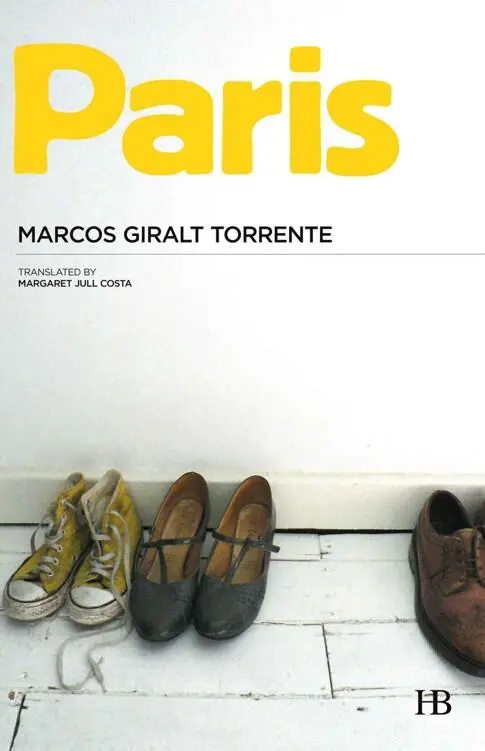
- Название:Paris
- Автор:
- Издательство:Hispabooks
- Жанр:
- Год:2014
- ISBN:9788494228452
- Рейтинг книги:5 / 5. Голосов: 1
-
Избранное:Добавить в избранное
- Отзывы:
-
Ваша оценка:
Paris: краткое содержание, описание и аннотация
Предлагаем к чтению аннотацию, описание, краткое содержание или предисловие (зависит от того, что написал сам автор книги «Paris»). Если вы не нашли необходимую информацию о книге — напишите в комментариях, мы постараемся отыскать её.
Paris — читать онлайн бесплатно полную книгу (весь текст) целиком
Ниже представлен текст книги, разбитый по страницам. Система сохранения места последней прочитанной страницы, позволяет с удобством читать онлайн бесплатно книгу «Paris», без необходимости каждый раз заново искать на чём Вы остановились. Поставьте закладку, и сможете в любой момент перейти на страницу, на которой закончили чтение.
Интервал:
Закладка:
I no longer went to school on the school bus but traveled there and back alone, with a change on the subway and a bus ride. I didn’t always go straight home but hung around with a school friend, making secret forays into the city, which I was just beginning to get to know. Sometimes I didn’t bother going to class in the afternoon, and after a hurried lunch — eaten at a local café rather than in the school dining hall — I’d go to a movie theater with continuous showings and get home at more or less my normal time, as if I’d come straight from school. I don’t know if it was on one of those days when, after eating lunch, I decided to skip the last part of the day or if it was one afternoon, after five o’clock, when I took longer than usual on my journey home. The only lasting image I have is of the already fading light and of me sitting at a bus stop reading a book. It was one of those glazed bus shelters with advertising posters on the end panels. Sitting on the narrow metal bench that ran along the inside wall of the shelter, I could see only what was directly in front of me on the other side of the quiet, narrow, one-way street: a green door, a mailbox, a shop selling household appliances, and a café whose windows were slightly steamed up, at least those I could see from my rather limited viewpoint. A light drizzle had been falling for some time, and the passers-by were walking along with heads down and shoulders hunched against the fine rain. My reading, which had been very focused to begin with, had gradually become more distracted and fragmented, and I spent more and more time watching the hurried footsteps of the people a yard or so away on the other side of the gray asphalt and the swift, fleeting mist of passing cars. Apart from occasional sideways glances to see if the bus was coming, I observed their comings and goings, whether to the right, where the last thing I could see was a store selling dried fruit and nuts, or to the left, where my visual boundary was provided by the corner of a building at the intersection with the next street.
Everything happened very fast. Just as I was despairing at the lateness of the bus and had closed my book and placed it on top of the folder on my lap, I noticed a blind man emerging from the café opposite and heading off to the left, with his guide dog at his side. I watched their slow, deliberate passing, the man apparently more confident than his dog, which seemed uneasy and hesitant, and saw them turn the corner and disappear. I had not even had time to look elsewhere in search of some new prey when I saw him appear around that same corner, but heading in my direction, walking so quickly and keeping so close to the wall that he had probably had to flatten himself against it in order not to bump into the blind man and his dog moments before. I recognized him at once. He was wearing a brick-red jacket, a scarf, and boots. He had a folded newspaper under one arm, was carrying a furled umbrella, and walking along with head held high, not hunched against the rain like the other passers-by. I didn’t think anything, I wasn’t even startled. In the few seconds it took my father to reach the café and go in with the determined air of someone who has reached his final destination, I merely followed him with my eyes as indifferently as if he’d been just another anonymous pedestrian.
As soon as he disappeared inside, as soon as the glass doors closed behind him, all the things that I could or should have done rushed into my head; my initial coolness was shattered by curiosity, by a cascade of voices and memories, in which my mother was a constant presence, observing my indecisiveness from the stage of memory. For an indeterminate length of time, I remained sitting on that bench, and a few minutes later, while I was still debating what to do, the bus I had been waiting for finally arrived, but I let it pass without getting on. I could have caught it, I could also have gotten up before it arrived and walked to the next stop, as I had considered doing during the time that had passed since my father’s unexpected arrival. Either of those things would have preserved me from witnessing what happened next, and yet I did not move.
Shortly after the automatic doors had wheezed shut and the bus itself had lurched off, I began to look around me for a place where I could safely watch what was happening inside the café, because its broad window was too far to my left for me to be able to see in. For a moment, I wondered if I ought to cross the road, but that seemed too dangerous, too indiscreet, too exposed in the event that my father were to leave the café suddenly. After getting up from my seat, I went over to a wooden bench on the same side of the street as me, next to a newsstand and behind two parked cars with enough space between them to allow me a clear view. I sat down with my book and folder clutched against me to protect them from the rain and so that I could easily beat a hasty retreat if my presence were discovered. I was now in an excellent position directly across from the café window, but when I peered through the glass in search of my father, there was no sign of his tall, slim figure. The problem wasn’t that I was too far away. As I said, it was a narrow street, and for a young person like myself with perfect vision, it was easy enough to see across. The café, however, went back quite a long way inside, which meant that most of the bar, only the near end of which was next to the door, and the tables at the rear were completely invisible to me; the former because it was obscured from my perspective by the glass doors, and the latter because the fading, orangey, late-afternoon light clashed with the café’s scattering of bright neon bulbs, and the collision of the two bathed everything inside in a kind of nebulous penumbra, apart from the tables nearest the window and the central part of the bar, which was full of mirrors and lit by various spotlights. I got up and moved three or four yards further to the left, in search of a more diagonal sightline, to a point where, instead of a bench, there was a tree and two more parked cars, and from which I could see my father leaning on the corner of the bar. He was sideways to me with one foot up on the foot rail, facing the door that I could no longer see. He still had his newspaper under one arm, and in the hand closest to me, he held a glass of some dark liquid, probably wine, while the curved, black handle of his umbrella was hooked over the edge of the bar and resting against his raised knee.
Once again, I don’t remember what went through my mind that afternoon as I observed my father after having spent two or three years with no news of him; meanwhile, I grew increasingly wet in the rain, which, while it failed to soak through, was gradually dampening my hair and the folder and the book I was clutching to my chest — for either out of forgetfulness or adolescent disdain, I hadn’t bothered to protect my head with the hood of my red parka. I knew that I wasn’t going to approach him, so I don’t know what my plan was or what I was hoping to achieve by watching him standing at the bar, finishing his drink, summoning the waiter, talking to him and nervously changing position, then receiving a glass of wine identical to the first, along with a small plate, which he rejected with a brief, dismissive lift of the chin, before once again turning his gaze toward the door. I imagine that very little went through my mind in the few minutes my father was alone in the café and I watched from afar, incapable of making a decision and oblivious to the rain slowly impregnating me with the smell of moss and wet grass. Soon after the waiter had served him his second glass of wine, when he had picked it up with his right hand and taken one or two sips, my father removed his foot from the rail, took a step forward, smiled in the direction of the door, put down his glass, drew himself up to his full height, as if to welcome the person coming into the café, whom I tried in vain to identify when all I could see were the two closing leaves of the door, which was slightly set back in the colonnade. At the time, I couldn’t know that the person he was preparing to greet was my mother, but that was what I thought in the seconds it took me to glance over at the window and again peer inside, trying unsuccessfully to find out who it was, because my father’s back was blocking my view. There was nothing to make me suspect it could be her, but that was what I continued to think and fear during the brief but, to me, seemingly endless time they remained standing, one in front of the other, only a few feet from the bar, saying words I could not hear or see them speak. I had no reason to suspect that the person was my mother, but I did — however strange that may seem now, and even though she was indeed the person who finally emerged from behind my father when he, taking a step back, stretched out one arm in my direction, ushering her toward one of the tables nearest the window through which I was spying on them.
Читать дальшеИнтервал:
Закладка:
Похожие книги на «Paris»
Представляем Вашему вниманию похожие книги на «Paris» списком для выбора. Мы отобрали схожую по названию и смыслу литературу в надежде предоставить читателям больше вариантов отыскать новые, интересные, ещё непрочитанные произведения.







Обсуждение, отзывы о книге «Paris» и просто собственные мнения читателей. Оставьте ваши комментарии, напишите, что Вы думаете о произведении, его смысле или главных героях. Укажите что конкретно понравилось, а что нет, и почему Вы так считаете.