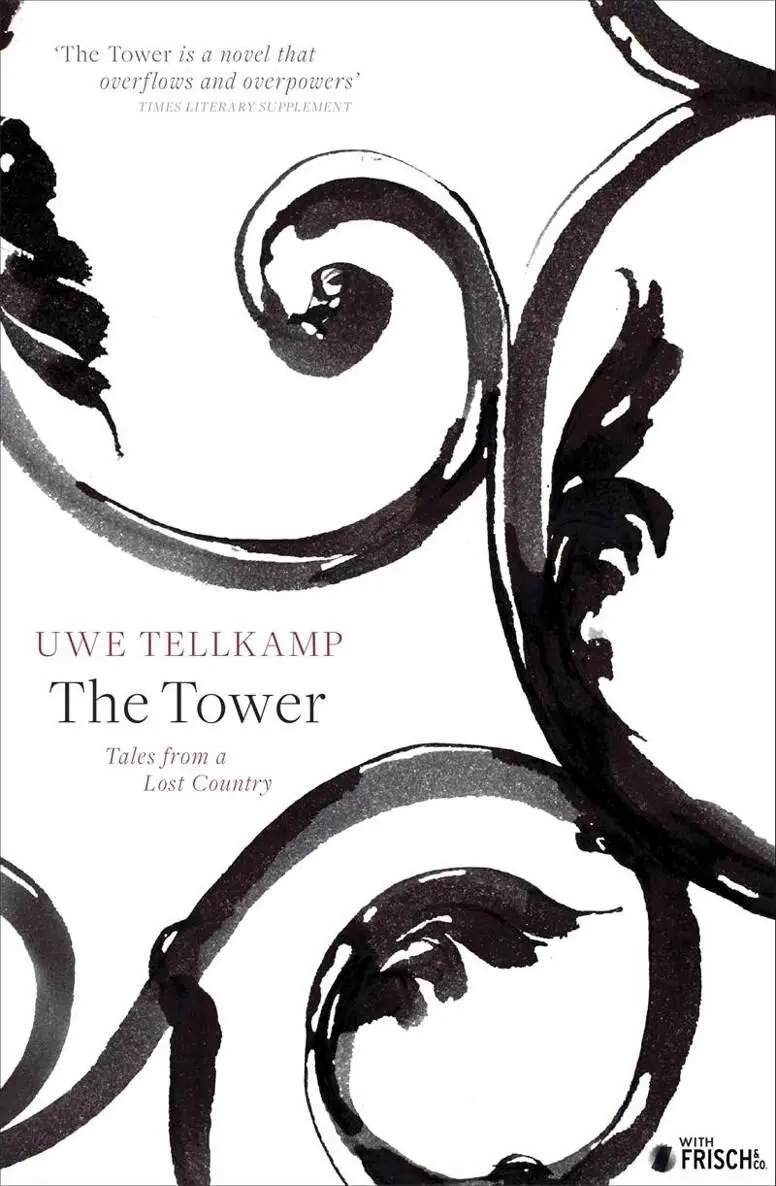
Uwe Tellkamp - The Tower
Здесь есть возможность читать онлайн «Uwe Tellkamp - The Tower» весь текст электронной книги совершенно бесплатно (целиком полную версию без сокращений). В некоторых случаях можно слушать аудио, скачать через торрент в формате fb2 и присутствует краткое содержание. Год выпуска: 2014, Издательство: Penguin, Жанр: Современная проза, на английском языке. Описание произведения, (предисловие) а так же отзывы посетителей доступны на портале библиотеки ЛибКат.
- Название:The Tower
- Автор:
- Издательство:Penguin
- Жанр:
- Год:2014
- ISBN:нет данных
- Рейтинг книги:5 / 5. Голосов: 1
-
Избранное:Добавить в избранное
- Отзывы:
-
Ваша оценка:
The Tower: краткое содержание, описание и аннотация
Предлагаем к чтению аннотацию, описание, краткое содержание или предисловие (зависит от того, что написал сам автор книги «The Tower»). Если вы не нашли необходимую информацию о книге — напишите в комментариях, мы постараемся отыскать её.
The Tower — читать онлайн бесплатно полную книгу (весь текст) целиком
Ниже представлен текст книги, разбитый по страницам. Система сохранения места последней прочитанной страницы, позволяет с удобством читать онлайн бесплатно книгу «The Tower», без необходимости каждый раз заново искать на чём Вы остановились. Поставьте закладку, и сможете в любой момент перейти на страницу, на которой закончили чтение.
Интервал:
Закладка:
The kasha smelt and tasted of wall filler, the Old Man of the Mountain was the only one who hadn’t finished when Barsano went round personally pouring vodka he’d spiced with ginger and nutmeg, a little sugar and cinnamon, the ‘concertina’ mixture, of which Meno had unhappy memories from previous visits. Barsano grinned as he filled Meno’s glass to the brim. ‘Y’spend too much time at y’r desk, comrade. Can’t take a drink. Well, I’ll treat you to a real one. Y’r mother could take her drink, a revolutionary through and through she was. There you are, get that down you and you’ll see splendid … whatsit.’ Meno had little desire to see splendid ‘whatsit’, the last time it had been a porcelain oval in Barsano’s personal toilet; at least that had revealed to Meno that the District Secretary must be a great fan of the ‘Digedags’ and ‘Abrafax’ series of children’s comics, huge piles of which were stacked on a ledge in the middle of the glazed tiles with the panorama of ‘Our World of Tomorrow’: blond children were sitting on the arms of full-bosomed tractor drivers waving to their fathers, who were zooming across the cloudless sky in jet aeroplanes; on the left-hand side was a lab full of microscopes and retorts with well-known scientists in gleaming white coats bending over them; magnetic suspension railways, an underground chicken farm, viaducts on several levels with futuristic cars gliding along them; deserts and steppes were transformed into blooming landscapes by canals; on the right-hand wall star-cities on distant planets were to be seen, orbited by spaceships and glass-roofed island resorts; and on the floor was a Lenin quotation, in the original Russian: ‘So let us dream! But on condition that we seriously believe in our dream, that we observe real life most precisely, that we connect our observations to our dream, that we conscientiously work to realize what we imagine! Dreaming is necessary … VLADIMIR ILYICH LENIN.’
‘To the Great Socialist October Revolution,’ Barsano cried, raising his glass. Schubert and Paul Schade uttered a ‘Gorko, gorko’, as was usual in the Soviet Union — ‘Bitter, bitter — and downed with good cheer / as if it were water clear’. Judith Schevola didn’t seem to be bothered by the ‘concertina’ either. After his glass had been filled, Meno had quickly gone over to the cabinet with the presents from delegations of friendly governments; there was a carpet from the Frunze Military Academy on which the heads of Marx, Engels and Lenin had been sewn with tiny glass beads beneath crossed Kalashnikovs; a model of the Moscow television tower in malachite; a Bulgarian wine cask Young Communists had made by sticking halves of clothes pegs together and with folk designs burnt into it, and a ‘Cup of Friendship between the Nations’ in the form of a brass amphora, from Greece; that was what Meno was heading for; he didn’t want to make the acquaintance of Our World of Tomorrow again; pretending to suffer from a coughing fit, he poured his ‘concertina’ into the Friendship between the Nations; it swirled round in it. ‘To the memory of our great Comrade Vladimir Ilyich Lenin’, ‘… to the good health of our great Comrade Yuri Vladimirovich Andropov’, ‘… to the Party’, ‘… to world revolution’.
Judith Schevola wasn’t even swaying when all the toasts had been drunk. Paul Schade gave her a tap of appreciation on her shoulder, ‘Great girl! I’ll venture a dance with you’, and Schiffner, a beatific smile on his face, patted her cheek.
By that time Ritschel had finished his work in the film theatre. The projectionist, with several rolls of film over his shoulder, went up some stairs into the projection room; behind a little window the size of an embrasure in a castle wall was an ancient Ernemann projector, as Meno knew from the Londoners, whom Barsano quite often invited to his film evenings. The film theatre was not solely used for Barsano’s personal hobby, films were previewed there, decisions were taken as to whether a film could be shown to the general public or not. The light went out once the District Secretary and those he wanted with him in the front row had dropped into their seats, the machine began to rattle, a shaft of light with motes of dust floating in it cast the opening images onto the screen, which had risen as if by magic; at first a white pane with rounded edges was to be seen with black scratches scurrying over it, figures appeared in cross-hairs, a crackly, quivering countdown, Barsano and Paul Schade shifted expectantly from side to side in their seats.
33. Pre-military training camp
Garden smells, the fragrance of the rhododendrons, of jasmine opening, pale-faced, in the evening, white mouths of the murmuring twilight, and blue, ochre, water-tinted currents, fanned by the breeze; the secrets of the cuckoo-striped grass that deepened to purple at the edges, suddenly the call of a bird from the top of a maple full of trickling green, elderberry, its whispers sounding as if someone were pouring sand,
a leaf, a gleaming paddle, carried up by a thermal, it whirled back down and stopped on the branch from which it had fallen off, so that you looked at the street to make sure the passers-by weren’t walking backwards, as in silent films; the sudden flash of bicycle spokes as a boy turned a bike propped up on the curb; dissonance: a thistle in a meadow with fruit trees,
cats slumbering on stacks of wood behind sheds, first two, then three, then another grey one, a brown one stretching on brown wood and there: a tabby, dozens of cats sitting in the sun, at a stubbornly respectful distance from each other, no cat looked at another, none was lying parallel to another or behind another’s back, they looked past each other at angles that seemed precisely calculated, however minimal they were, and more and more kept appearing, as silently as outlines on a developing photograph, some might be touchable, some not; as if the colony were made up out of different June days and through a disruption of the normal course of time all the cats that had sat on this spot over the last hundred years had become visible,
then summer came.
‘We would prefer not to see you for the time being,’ Josta had written after her discharge from hospital and it was that ‘we’ — which included Daniel and Lucie as well, who didn’t understand what had happened — that disturbed Richard and increased the melancholy that often, after the peaceful enticement of spring, its vulnerable and non-assertive green, befell him in the hot months. The summer was demanding, driving, everything was going full throttle, a hectic, sweat-soaked hustle, the sky seemed to be turning like a millstone, weighing down on treetops and roofs, honing the river to a shining blade; the blossoms didn’t calm down at all, they had no time, or so it seemed, and burst open, pumping aggressive white out onto the streets that, around midday, beneath a pebble-grey sun scratched like old films, was swirled up into streaks of heat then withered and, when the blossoms, crackling, fell onto the paths, billowing up like clouds of plaster dust. Richard went swimming on Thursdays — despite the heat he preferred the indoor to outdoor pools — circled round Josta’s house, found the shop where Frau Schmücke sold fish. ‘The boy’ll be on holiday soon,’ she said in response to his cautious enquiry when the shop was empty and the tench in the glass tank sank lethargically back down to the bottom, ‘it looks as if they intend to go away. The little girl doesn’t laugh any more. By the way, someone came for the children, I didn’t need to look after them. — A woman,’ she added, ‘I don’t know her. From the city’s Family Welfare Office, she said.’
The boys from the eleventh grade went to the training camp. Christian brought home a light-green uniform and a gas mask he’d been given and had a pair of black boots over his shoulder. ‘It’s only two weeks,’ he said to Anne, who was concerned. The uniform came from a depot, stank of mothballs; Robert, who was unhappy that his brother was back in Caravel for the holidays, threw the windows wide open: ‘That stuff’s stinking out the whole pad! And by the way, bro, some tart keeps calling, is she the one from Waldbrunn? Reina, she says she’s called, Reina Kossmann.’
Читать дальшеИнтервал:
Закладка:
Похожие книги на «The Tower»
Представляем Вашему вниманию похожие книги на «The Tower» списком для выбора. Мы отобрали схожую по названию и смыслу литературу в надежде предоставить читателям больше вариантов отыскать новые, интересные, ещё непрочитанные произведения.




Обсуждение, отзывы о книге «The Tower» и просто собственные мнения читателей. Оставьте ваши комментарии, напишите, что Вы думаете о произведении, его смысле или главных героях. Укажите что конкретно понравилось, а что нет, и почему Вы так считаете.