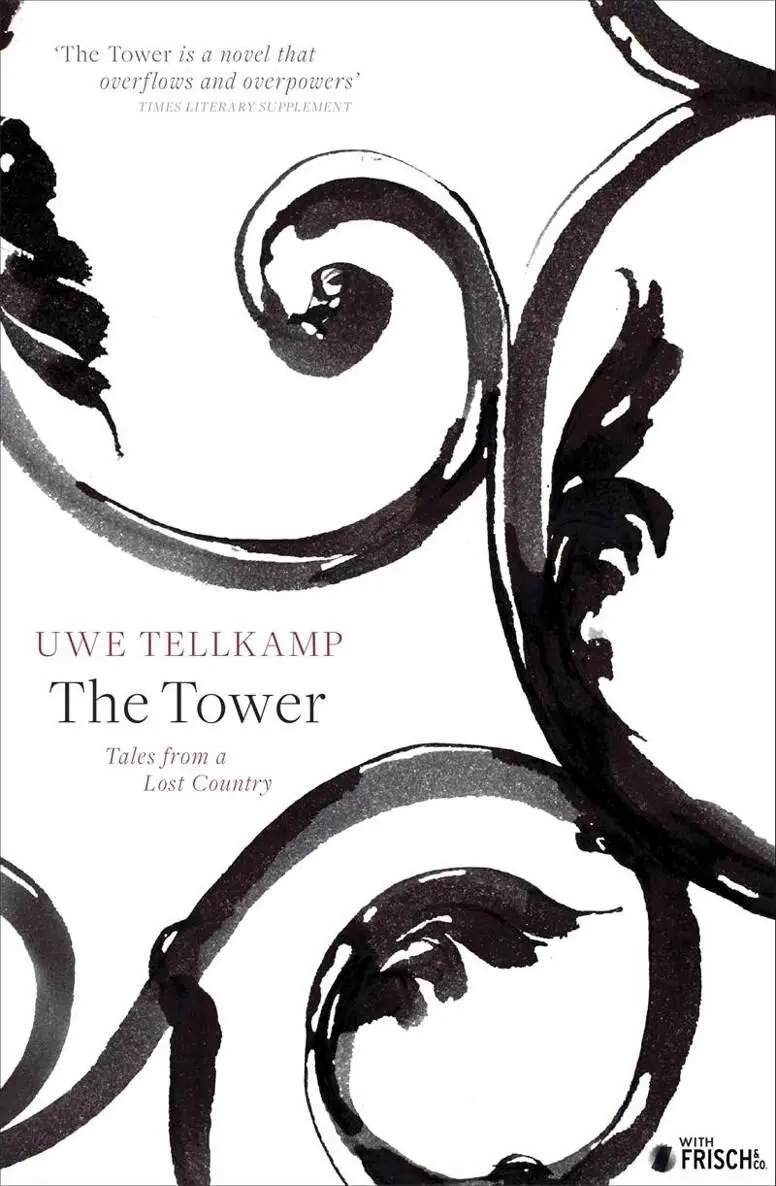
Uwe Tellkamp - The Tower
Здесь есть возможность читать онлайн «Uwe Tellkamp - The Tower» весь текст электронной книги совершенно бесплатно (целиком полную версию без сокращений). В некоторых случаях можно слушать аудио, скачать через торрент в формате fb2 и присутствует краткое содержание. Год выпуска: 2014, Издательство: Penguin, Жанр: Современная проза, на английском языке. Описание произведения, (предисловие) а так же отзывы посетителей доступны на портале библиотеки ЛибКат.
- Название:The Tower
- Автор:
- Издательство:Penguin
- Жанр:
- Год:2014
- ISBN:нет данных
- Рейтинг книги:5 / 5. Голосов: 1
-
Избранное:Добавить в избранное
- Отзывы:
-
Ваша оценка:
The Tower: краткое содержание, описание и аннотация
Предлагаем к чтению аннотацию, описание, краткое содержание или предисловие (зависит от того, что написал сам автор книги «The Tower»). Если вы не нашли необходимую информацию о книге — напишите в комментариях, мы постараемся отыскать её.
The Tower — читать онлайн бесплатно полную книгу (весь текст) целиком
Ниже представлен текст книги, разбитый по страницам. Система сохранения места последней прочитанной страницы, позволяет с удобством читать онлайн бесплатно книгу «The Tower», без необходимости каждый раз заново искать на чём Вы остановились. Поставьте закладку, и сможете в любой момент перейти на страницу, на которой закончили чтение.
Интервал:
Закладка:
‘He’s giving illustrated talks. Most recently in the Magdeburg House of Culture.’
‘Aha, in the Magdeburg House of Culture. Just needs to go down the Elbe. I wouldn’t put it past him. Kurt Rohde gets in a canoe and paddles to Magdeburg.’
Schubert and Josef Redlich were the first to laugh.
‘You’re the spitting image of your mother,’ Barsano said, subduing the laughter with a wave of the hand. ‘Brave Luise. I’ve lots of memories.’ He turned to Paul Schade. ‘Do you remember her facing Nadezhda and showing her Vladimir Ilyich’s letter?’ Schade’s leathery face brightened. ‘And the hand grenade she threw back into the train, a real partisan!’ As he spoke he gave Meno a disparaging look.
‘Let’s go into the film theatre,’ Barsano said. ‘Communal viewing of TV News at half past seven, the reports at eight.’
Meno and Schevola were the last to go in. Once they’d left, the foyer filled with members of staff from Party headquarters. A secretary attempted to breathe fresh life into three ceiling-high yellow rubber plants with water and peat. Voices could be heard from the offices again, one after the other lights gradually went on in the telephone booths underneath the picture of the General Secretary of the Communist Party of the Soviet Union.
‘Probably government lines,’ Schevola said. Black telephone receivers were painted sloping diagonally across the glass doors, below them was the yellow glow of the letter T engraved on the frosted glass. ‘Do you know the man with the ponytail? And could you introduce me to him?’ Schevola hadn’t turned to Meno but addressed the air between him and Philipp Londoner, who was in front of them; she’d spoken loud enough for Philipp to slow down until he and Schevola were side by side; she tried clearing her throat, which Meno discourteously cut through with a ‘And how is Marisa? Did you leave her in Leipzig?’ and an innocent expression, at which Philipp muttered that she was still tired from a trip to Moscow as a member of the Chilean delegation to celebrate Yuri Vladimirovich’s appointment. The film theatre was a box-shaped, wood-panelled room on the first floor. After impatiently shooing his guests to their seats, Barsano pressed a button; blinds came down over the windows, televisions slid out from the walls, immediately followed by the signature tune of TV News . ‘Lower Jaw’ was reading the news. That was what the newsreader was popularly called; with sparse hair and square spectacles, he sat stiff as a poker on the screen, like a mummy, holding a sheet of paper from which he read the news without making a single mistake and emphasizing each syllable equally — Lower Jaw had never made a slip of the tongue, the whole Republic seemed to be waiting for that unheard-of event to happen; only the lower half of his angular face moved, grinding out news item after news item at the calm, steady speed with which a cable is unrolled from a cable drum … moving purposefully towards the realization . Schevola and Philipp Londoner were sitting in front of Meno, on Schevola’s left was Barsano’s deputy, Schubert, who’d squeezed into the row at the last minute … comprehensive exchange of views … in a constructive atmosphere . On the screens combine harvesters advanced in formation over the wide grain fields of the Uckermark … impressive testimony … all-round strengthening . Barsano pointed to the screen, a jubilant sea of waving hands as the General Secretary of the Central Committee of the Socialist Unity Party and Chairman of the State Council of the German Democratic Republic, Comrade … shook the hand of the Chairman of the Praesidium of the State Great Hural of the Mongolian People’s Republic, Comrade … matter of prime concern … unshakeable foundation . Now the bottling plant of the state-owned Wine and Preserves Combine was shown, muted clinking of glass as bottling forewoman Comrade … spoke of the overfulfilment of the plan’s targets for gooseberry juice … the assent of millions . The next picture showed tanks in the course of a NATO exercise, Paul Schade roared ‘Imperialist swine!’ … indestructible relationship based on mutual trust . Aeroplanes thundered across the sky, rockets jutted out their noses threateningly. Cut: a major in the ‘army service uniform/summer’ of the land forces of the National People’s Army in a steel helmet, binoculars to his eyes, scanning the horizon: … impressive testimony . Eschschloraque took out his handkerchief and quietly blew his nose. Now the reporters of TV News were visiting the Agricultural Cooperative ‘Forward’ that had harvested the largest pumpkin in the Republic. ‘’s already been on Unique or Freak !’ Paul Schade crowed … worldwide recognition … dynamic growth . Three of the four televisions suddenly went dark. Barsano pressed a button, there was a knock at the door, Herr Ritschel in an Arbogast Institute lab coat came in and inquired, emphasizing each word equally, what Barsano’s wishes were … far-reaching change came from the television, which was still on; the General Secretary flapped his hands at the three sets and told Comrade Ritschel to repair them immediately.
Barsano had chairs taken to his office, a sparsely furnished room at the end of a corridor with a grey PVC floor that swallowed up the sound of their footsteps; the murmur of voices behind the doors with the official signs, the sound of roll-fronted cupboards being opened and closed, the clatter of typewriters seemed to fade away in the puddles of light left by the fluorescent tubes with yellowing protective strips. While Paul Schade arranged his manuscript on the lectern and started to speak when Barsano gave the nod, Meno looked round: wood-panelling, a few veneered cupboards, a wide desk with a pennant on the right and a signed portrait of Lenin, which Barsano was very proud of, on the left corner, photographs of his wife — she was a doctor at the Friedrich Wolf Hospital, one of the few wives of senior functionaries who still went out to work — and of his daughter, about whom, as far as Meno knew, Barsano never spoke. Paul Schade’s voice grew higher, the worker-writer’s cheeks were flushed bright red and what had happened at the congress was about to happen again: one of his feared fits of rage, foaming with coarse venom, that the audience let wash over them with closed eyes and stony expressions and that in Berlin had come to a ghastly and grotesque end: Paul Schade’s false teeth had come loose and, rattling like those of a ghostly skeleton, shot out between his lips, which had brought a horrified expression even to the face of the chairman of the Writers’ Association. Meno shuddered as he recalled the urge to laugh welling up inside him, like a poisonous liquid boiling over in a hot saucepan, at the sight, at the icily embarrassed silence of the gathering: woe to anyone who lost control of themselves; the corners of Judith Schevola’s mouth had twitched, as they did now when Schade raised his left forefinger to castigate ‘parasites, formalists, scribblers out of touch with the people and the real world’, during which, remarkably, he did not look at Meno, the Old Man of the Mountain or Schevola, as he had in Berlin, but at Eschschloraque, who was sitting in the front row beside Barsano, legs crossed, and was giving his fingernails all the more bored and weary looks the more enraged Paul Schade became. Judith Schevola had assumed her insect-researcher look again, the cold, stone-grey interest in a man with medals and decorations bobbing up and down on his chest as he continued his vulgar vituperation. What was she thinking? Was she reflecting on the fact that Paul Schade had been in a concentration camp, had experienced the Gestapo’s torture chambers? Was she thinking of his book in which he described his childhood in a working-class district of Berlin and with which he had made his name until no one read him of their own free will any more since ‘Roar, Russia’ and various novels in which Stalin was portrayed as a father and the Germans — with the exception of those who had emigrated to the Soviet Union or communists working in the underground — as a wolfish race of incorrigible fascists? Josef Redlich was squirming restlessly in his seat in the second row beside Schiffner. Was it just that he couldn’t stand the shouting or was he thinking of Paul Schade’s editor, whom no one envied … Art was a weapon in the war between the classes, Schade bawled, today it was no longer enough to sit quietly in one’s attic room, turning well-crafted sentences, the world was once more threatened by the old enemy, by imperialism and its accomplices, literature had to go on the offensive, novels had to be like MIG fighters and articles like a salvo from a MIG and he demanded that agitators be sent to the schools to practise revolutionary poetry with the children; he had noticed that bourgeois ideas were creeping back into the teaching of literature and music, formalism, defeatism, recently he’d discovered poems by Eichendorff in a school reader, that was pure reactionary ideology. And by other Romantics! In earlier days people like that were strung up from the nearest lamp post. Eschschloraque nodded.
Читать дальшеИнтервал:
Закладка:
Похожие книги на «The Tower»
Представляем Вашему вниманию похожие книги на «The Tower» списком для выбора. Мы отобрали схожую по названию и смыслу литературу в надежде предоставить читателям больше вариантов отыскать новые, интересные, ещё непрочитанные произведения.


Обсуждение, отзывы о книге «The Tower» и просто собственные мнения читателей. Оставьте ваши комментарии, напишите, что Вы думаете о произведении, его смысле или главных героях. Укажите что конкретно понравилось, а что нет, и почему Вы так считаете.