Enrique Vila-Matas - Montano's Malady
Здесь есть возможность читать онлайн «Enrique Vila-Matas - Montano's Malady» весь текст электронной книги совершенно бесплатно (целиком полную версию без сокращений). В некоторых случаях можно слушать аудио, скачать через торрент в формате fb2 и присутствует краткое содержание. Год выпуска: 2007, Издательство: New Directions, Жанр: Современная проза, на английском языке. Описание произведения, (предисловие) а так же отзывы посетителей доступны на портале библиотеки ЛибКат.
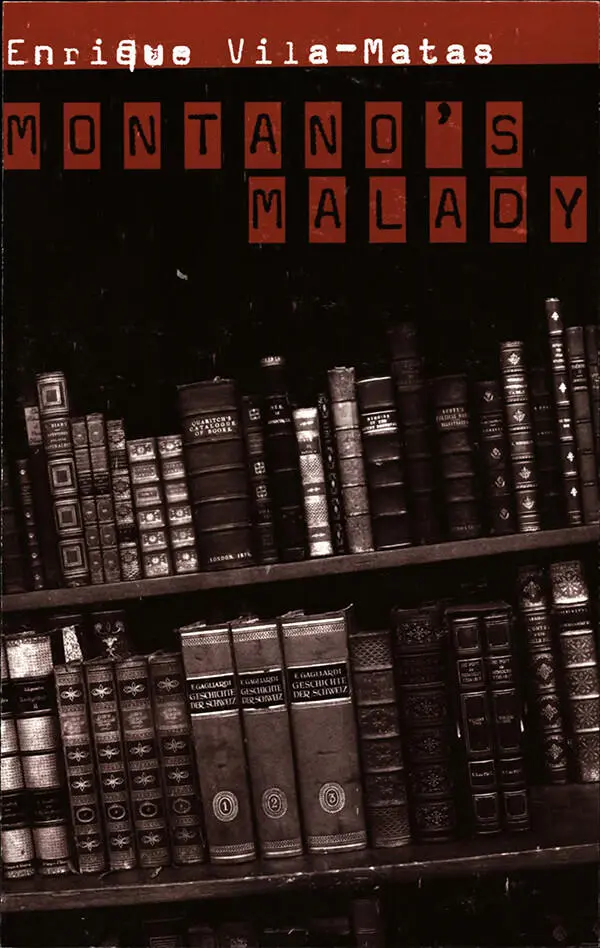
- Название:Montano's Malady
- Автор:
- Издательство:New Directions
- Жанр:
- Год:2007
- ISBN:нет данных
- Рейтинг книги:5 / 5. Голосов: 1
-
Избранное:Добавить в избранное
- Отзывы:
-
Ваша оценка:
Montano's Malady: краткое содержание, описание и аннотация
Предлагаем к чтению аннотацию, описание, краткое содержание или предисловие (зависит от того, что написал сам автор книги «Montano's Malady»). Если вы не нашли необходимую информацию о книге — напишите в комментариях, мы постараемся отыскать её.
is a writer named Jose who is so obsessed with literature that he finds it impossible to distinguish between real life and fictional reality. Part picaresque novel, part intimate diary, part memoir and philosophical musings, Enrique Vila-Matas has created a labyrinth in which writers as various as Cervantes, Sterne, Kafka, Musil, Bolano, Coetzee, and Sebald cross endlessly surprising paths. Trying to piece together his life of loss and pain, Jose leads the reader on an unsettling journey from European cities such as Nantes, Barcelona, Lisbon, Prague and Budapest to the Azores and the Chilean port of Valparaiso. Exquisitely witty and erudite, it confirms the opinion of Bernardo Axtaga that Vila-Matas is "the most important living Spanish writer."
Montano's Malady — читать онлайн бесплатно полную книгу (весь текст) целиком
Ниже представлен текст книги, разбитый по страницам. Система сохранения места последней прочитанной страницы, позволяет с удобством читать онлайн бесплатно книгу «Montano's Malady», без необходимости каждый раз заново искать на чём Вы остановились. Поставьте закладку, и сможете в любой момент перейти на страницу, на которой закончили чтение.
Интервал:
Закладка:
Hungry.
I have been fasting hard in Buda for several days, only two sandwiches in one week, seven fruit juices, and water. But I want to make it clear from the start that I am hungry because I choose to be, having declined to eat at the Kakania, for example.
Fasting in Buda, I have very deliberately sought to appear before you today in a weak state, having apparently lost control of my thoughts, but not all control, just enough to enable you, live and in real time, to witness the public construction of the private journal of a writer who is hungry and who is pleased to deliver his lecture on the edge of the abyss, to risk his life for all to see, to pronounce some nocturnal words — I am taking a certain risk — on the diary as narrative form, always placing himself on the edge of the abyss, but clinging to it in precarious balance.
SO I’M NOT RELAXED
With the sensation that I could drop dead at any moment — the truth is I have given my best lectures in a state of tension, far from being relaxed — dying of hunger before you all today, I consider it helpful to inform you that my visit to Budapest’s Literature Museum has forced me to interrupt the novel I am writing in Barcelona on the subject of writers’ private journals, no less. This novel is also a diary, my diary as a literature-sick writer, in Budapest today doubly sick, because of hunger, my hunger as a fasting artist.
I interrupted the novel to be with you today, I interrupted it in a passage referring to Valéry’s notebooks, the notebooks, a form of private journal, which gave rise to the intellectual figure of Monsieur Teste, whose extended shadow — embodied here today by the repellent Monsieur Tongoy — is projected over this historic room. I interrupted it in this passage, but I plan to continue it, using whatever may happen here today, using whatever may take place during this lecture. You are, therefore, characters in my fictionalized diary and must keep alert and wide-awake before events and actions that can affect your lives at any stage. So I’m not relaxed, but my distinguished public would do well not to be either and to remember that, as John Donne would say, nobody falls asleep in the cart taking him to the gallows.
EVERYONE ELSE IS DEAD
Not everybody knows that the mendicant Rosa in the front row, the beautiful beggar seated next to the monster, is a femme fatale. What’s more, with her presence in this room today, I’m not joking, she could embody the diary’s sensationalist fatality as an element of a literary genre.
Yes, ladies and gentlemen, I do not forget that this symposium requires me to speak of the private journal as narrative form, I do not forget this; and that is why I now refer to the theme — my beggarly and professional duty is to stick to the symposium’s theme — and I tackle the question of fatality encapsulated in every private journal and also in Rosa and in Detour , a film I had the misfortune to see here in Budapest.
I said the diary’s “sensationalist fatality.” Well, sensationalist is the adjective that Alan Pauls uses to describe the recurring fact that, whenever you find a diary (“because a diary never appears: you find it, come across it, or stumble on it, even when you’ve been looking for it with desperation”), next to its pages, often staining them, there is a corpse.
We are faced, therefore, by a dramatic convention that is fatal. We find this convention, disguised as an anecdote, in the preface to the first volume of Strahlungen , Ernst Jüngers Second World War diaries, where the author tells us about the seven sailors who in 1633 spent the winter on the island of St. Mauritius, in the Arctic Ocean: “The Dutch Society of Greenland had left them there, with their consent, to carry out research or the Arctic winter and polar astronomy. In the summer of 1634, when the whaling fleet returned, they found the diary and seven corpses.” For Pauls, the scene could be the beginning of another version of The Thing , Christian Nyby’s classic horror movie: “A remote, frozen landscape, the corpses that turn up, one by one, showing no signs of violence, dotted about the camp, seemingly turned to stone in the middle of a final, casual gesture, the diary kept under lock and key, the forced box, a trembling hand that opens the worn covers and avidly seeks out the last observations.”
The last observation by the last sailor to die was this: “I don’t know if I’ll be able to write here what has happened, but I’m the only one who can. Everyone else is dead.”
The corpse of the author is almost always guaranteed in conventional diaries, perhaps less so in diaries that transform the genre — fictitious diaries or diaries construed as literary creation, where, however, the corpse of the author turns up eventually, as a fact of life. This is what must also happen sooner or later — especially if I stay this hungry — to the diary I am currently composing, live and out loud, for all of you. But let’s keep going, for the moment let’s go on. As long as there’s life, there’ll always be the hope of reaching the end of this lecture and receiving the fee and being able to give Monsieur Tongoy back the foul cents I owe him.
We have already broached the subject, we have already tackled the theme of the private journal as narrative form, we have already begun to demonstrate live how a lecture can be solemn or simply — as in the case of this one — solemnly free, combining as it does a certain narrative form, the essay’s reflective flight, and an autobiographical voice, among other registers. The last of these, the autobiographical voice, I now reintroduce to say that among other things I owe Monsieur Tongoy the cost of two movie tickets, since he insisted — on the same day we arrived in Budapest and visited what he terms his “cabin”—that Rosa and I go with him to see a film by Edgar G. Ulmer.
I had never heard of Ulmer, a Viennese director who settled in Hollywood in the 1940s. The film, shot in 1945, was called Detour . A very strange film, extremely strange and fatalistic, it brings everybody bad luck; you only need to see the way Monsieur Tongoy looks today.
To begin with, I refused to go and see this film because I couldn’t spend the few cents I had to pay for our boardinghouse in Buda. We were visiting what Monsieur Tongoy, who had arrived in Budapest before the mendicant Rosa and myself, termed his “cabin” and we started arguing because he said I could pay for all of us; if I had enough for the boardinghouse in Buda, I also had enough for the cinema. Deep down I am horrified by stupid, drunken arguments between tramps, and even more by the places where they live. Monsieur’s cabin was in fact a wooden shack whose door he had ripped off to build a fire. A shack in very poor condition. The window was missing its pane and the roof had caved in at various points. It was all disgusting. In a cowpat, for example, Monsieur Tongoy had drawn a heart transfixed by an arrow. On the ground, among wine bottles that were his only possessions, was the Kemnitzer Cinema’s program. He became very tedious with the program and his grotesque praise of Ulmer — just because this Viennese director had shot a film with Lugosi called The Black Cat , another ill-omened title — and in the end, tired from the journey and from so much arguing, tired also of looking at the repulsive cowpat, we agreed to go and see the film, especially when monsieur revealed that he could make an effort and pay for us, after all, he said, I could give him back the money with interest when I received the fee for this lecture.
I shouldn’t have accepted this proposal, I should never have gone to see this film, since fatality went hand in hand with it, the same fatality that can reach us one day through “some miscarriage, some wrong turning” on a road somewhere.
Читать дальшеИнтервал:
Закладка:
Похожие книги на «Montano's Malady»
Представляем Вашему вниманию похожие книги на «Montano's Malady» списком для выбора. Мы отобрали схожую по названию и смыслу литературу в надежде предоставить читателям больше вариантов отыскать новые, интересные, ещё непрочитанные произведения.



Обсуждение, отзывы о книге «Montano's Malady» и просто собственные мнения читателей. Оставьте ваши комментарии, напишите, что Вы думаете о произведении, его смысле или главных героях. Укажите что конкретно понравилось, а что нет, и почему Вы так считаете.