Enrique Vila-Matas - Montano's Malady
Здесь есть возможность читать онлайн «Enrique Vila-Matas - Montano's Malady» весь текст электронной книги совершенно бесплатно (целиком полную версию без сокращений). В некоторых случаях можно слушать аудио, скачать через торрент в формате fb2 и присутствует краткое содержание. Год выпуска: 2007, Издательство: New Directions, Жанр: Современная проза, на английском языке. Описание произведения, (предисловие) а так же отзывы посетителей доступны на портале библиотеки ЛибКат.
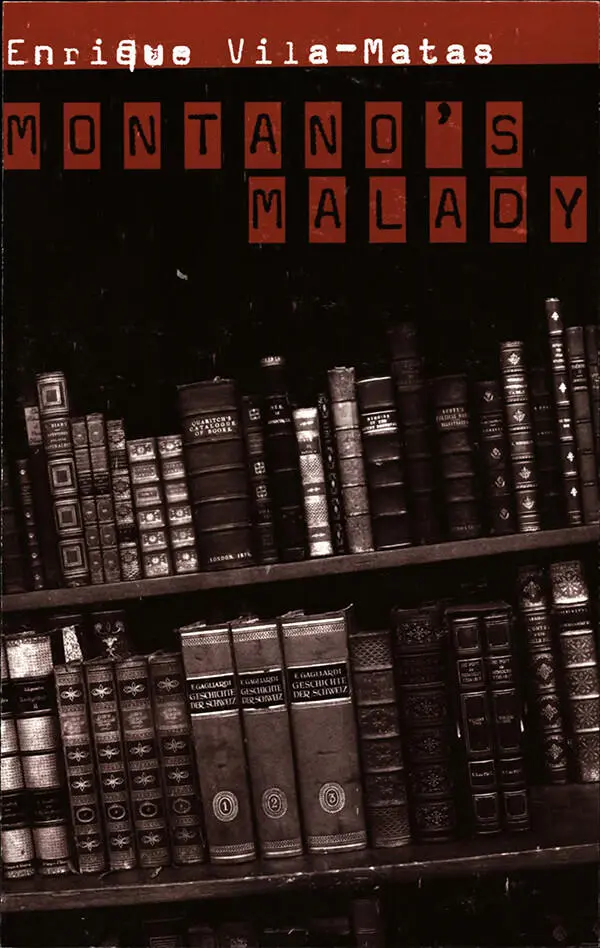
- Название:Montano's Malady
- Автор:
- Издательство:New Directions
- Жанр:
- Год:2007
- ISBN:нет данных
- Рейтинг книги:5 / 5. Голосов: 1
-
Избранное:Добавить в избранное
- Отзывы:
-
Ваша оценка:
Montano's Malady: краткое содержание, описание и аннотация
Предлагаем к чтению аннотацию, описание, краткое содержание или предисловие (зависит от того, что написал сам автор книги «Montano's Malady»). Если вы не нашли необходимую информацию о книге — напишите в комментариях, мы постараемся отыскать её.
is a writer named Jose who is so obsessed with literature that he finds it impossible to distinguish between real life and fictional reality. Part picaresque novel, part intimate diary, part memoir and philosophical musings, Enrique Vila-Matas has created a labyrinth in which writers as various as Cervantes, Sterne, Kafka, Musil, Bolano, Coetzee, and Sebald cross endlessly surprising paths. Trying to piece together his life of loss and pain, Jose leads the reader on an unsettling journey from European cities such as Nantes, Barcelona, Lisbon, Prague and Budapest to the Azores and the Chilean port of Valparaiso. Exquisitely witty and erudite, it confirms the opinion of Bernardo Axtaga that Vila-Matas is "the most important living Spanish writer."
Montano's Malady — читать онлайн бесплатно полную книгу (весь текст) целиком
Ниже представлен текст книги, разбитый по страницам. Система сохранения места последней прочитанной страницы, позволяет с удобством читать онлайн бесплатно книгу «Montano's Malady», без необходимости каждый раз заново искать на чём Вы остановились. Поставьте закладку, и сможете в любой момент перейти на страницу, на которой закончили чтение.
Интервал:
Закладка:
It was no use trying to make them see and understand that the plot of Montano’s Malady required the narrator — not to be confused with me — to embody literature. Drunk in the night, they were soulless. I felt extremely downhearted when I considered that, if even Rosa, my wife, and my good friend the vampire were unable to comprehend and celebrate with me certain ideas of mine for the fiction I was writing, if neither one was able to share certain concerns about the future of literature with me, then clearly I was very alone in the world, obviously; though I had a wife and vampire friend, I could not be more alone in that paradise of the Azores.
I told myself that the Azores were a paradise because I needed to cling to a comforting idea in that general air of anxiety. It was then that something happened that has always struck me as unusual, to say the least. It was then something must have sparkled through a worn fabric. Tongoy, as if his intoxication or perhaps an invisible glimmer allowed him to read my thoughts, said in an abruptly conciliatory voice:
“You’re very alone in paradise, aren’t you?”
Time has gone by and I still don’t quite believe it, I consider it now and tell myself that there are more mental connections than we think, but we do not get any further because the original fabric seems to have become very worn and only occasionally does something sparkle in it. We see strange coincidences that no doubt have an explanation, which we do not manage to find. We go through life without correctly understanding many things. “There’s a misunderstanding, and this misunderstanding will be our downfall,” said Kafka.
The worn fabric is perhaps from some paradise where formerly the day was lit by another world; the logical thread of a verbal fabric that gave life meaning died. They were better times. But someone in that paradise upset the inventor of language; the fabric wore away and our lives became absurd, without the old order and the old meaning. This fabric, unrecognizable today, could be the same one which, though worn, is sensed by Sebald; we receive, when we receive them, fleeting but startling sparkles that perhaps are telling us we do not know what exactly can have happened and what the misunderstanding was, but there were definitely shots in some paradise or, in any case — as Sergio Pitol said to me when I showed him documents revealing a curious coincidence that had passed through our lives, betraying another sparkle in the worn fabric—“something must have happened, that’s for sure.”
PITOL, SERGIO (Puebla, Mexico, 1933). Of all the diarists gathered in this dictionary, he is the one who has collaborated longest in the construction of my timid identity. A key figure in my life. He turns up punctually and mysteriously, like a strange ambassador of the most reasonable thread in the worn fabric, and does so at those moments in my life most closely linked to the fantasy genre. I met him in Warsaw in 1973, when I traveled to this city, expressly hoping to share with him my impressions as a reader of his stories and, in passing, to get to know him. I ended up staying in his home for a whole month, and Pitol became my teacher. I aspired then to be a writer and was still unclear whether or not I would be, I wasn’t even using the name Rosario Girondo. He was already the author of a novel and various books of stories and worked as cultural attaché in the Embassy of Mexico in Poland. No writer before then had bothered to talk to me about literature as he did over unforgettable dinners during those days I stayed in his home. They ended up being key in my decision to write; those days marked my destiny and sowed the seed of my Montanism .
On August 23, 1973, the day I left Warsaw, Pitol presented me with a copy of his novel El tañido de una flauta and dedicated it to me with some words in English that alluded to Provence. It was the first book to have been dedicated to me, and for years I would visualize that dedication, I would often see it and finally knew it by heart. During those years, we never spoke by phone nor wrote each other a letter, but we would meet, often by chance, in the most diverse places. We saw each other, for example, in Bukhara, Trieste, Mérida in Venezuela, Beijing, Veracruz, Paris, Prague, and Mojácar. One day, August 23, 1993, he decided to send me a letter from Brasilia, the first he had ever sent me. On receiving it, I soon realized that exactly twenty years separated the Varsovian dedication and the Brazilian letter. I photocopied the documents, hoping eventually to show them to Sergio and to witness his reaction to this curious, surprising coincidence. The opportunity finally arrived, in the Provence of the dedication no less. Sergio and I met at a tribute to a writer and mutual friend in Aix-en-Provence. One night, in this city, I suddenly showed him the two documents and waited to see his reaction. Sergio pored over the photocopies, then took off his glasses, smiled, almost imperceptibly, allowed the silence to take hold of the situation, put his glasses back on, smiled a little nervously, re-examined the photocopies, raised his head and arched his eyebrows, lowered his head again and finally said, “Something must have happened, that’s for sure.”
I understood that there was little more he could say and what he said was already a lot; he preferred to be prudent and not to speculate in vain, but in any case obviously “something must have happened” in some place with light from another world, where something occasionally sparkles through a worn fabric.
This morning I read an interview with Sebald in which he admits to having paid tribute on occasion, albeit without naming him, to the hiker Robert Walser. Forerunner of Kafka, interned for many years in a Swiss sanatorium, Walser left his enclosure only to go for long walks in the snow. After lunch on December 25, 1956, he went out dressed in warm clothes, he emerged into the bright light of the snowy landscape surrounding the sanatorium. The solitary hiker, in search of “the mountain spirit,” filled his lungs with the clear winter air. He walked for a long time until he fainted and dropped dead in the snow. He was found by two children coming down the hill on a wooden sled.
Asked about his tributes to Walser the hiker, Sebald says that there is in fact an autobiographical reason for such tributes: “I was always puzzled that Walser should have died on the same day as my grandfather, whom I grew up with. What’s more, the two looked very alike and were both long-distance walkers and met similar ends, since my grandfather also died while out in the snow alone. The places Walser walked in were only sixty miles from my grandfather’s house in Wertach.”
Something’s happening here now in Café Atinel, that’s for sure. I think about Herminio, my friend who disappeared prematurely. And I hear beside me some voices, voices from other tables in Portuguese and other discussions and conversations, everyman’s concerns, the concerns of the quick and the dead. And I am reminded of Pessoa and the metaphysics mislaid in the corners of cafés everywhere, the chance ideas of so many chancers, the intuitions of so many little people. Perhaps one day, with some abstract fluid and impossible substance, they will form a God or a new fabric and with the light of another life occupy the world.
RENARD, JULES (Chalons, Mayenne, 1864–Paris, 1910). In his well-known diary, Renard reveals himself to be a man permanently installed on the hardest bunk in the carriage, taking the hardest drug of literature. Take, for example, this sentence: “Writing is a way of speaking without being interrupted.” At present I am looking at one of his family photographs and in it he appears with a terrifying expression of bad temper: the classic chronic sufferer of literature-sickness. The photograph is taken outside, the day extremely pleasant. The children, his son and daughter, look marvelous. His wife, in good health. But he is in a foul mood, as if someone had interrupted him while he was speaking. He clearly has withdrawal symptoms and thinks that he should be in his study by now.
Читать дальшеИнтервал:
Закладка:
Похожие книги на «Montano's Malady»
Представляем Вашему вниманию похожие книги на «Montano's Malady» списком для выбора. Мы отобрали схожую по названию и смыслу литературу в надежде предоставить читателям больше вариантов отыскать новые, интересные, ещё непрочитанные произведения.







Обсуждение, отзывы о книге «Montano's Malady» и просто собственные мнения читателей. Оставьте ваши комментарии, напишите, что Вы думаете о произведении, его смысле или главных героях. Укажите что конкретно понравилось, а что нет, и почему Вы так считаете.