Enrique Vila-Matas - Montano's Malady
Здесь есть возможность читать онлайн «Enrique Vila-Matas - Montano's Malady» весь текст электронной книги совершенно бесплатно (целиком полную версию без сокращений). В некоторых случаях можно слушать аудио, скачать через торрент в формате fb2 и присутствует краткое содержание. Год выпуска: 2007, Издательство: New Directions, Жанр: Современная проза, на английском языке. Описание произведения, (предисловие) а так же отзывы посетителей доступны на портале библиотеки ЛибКат.
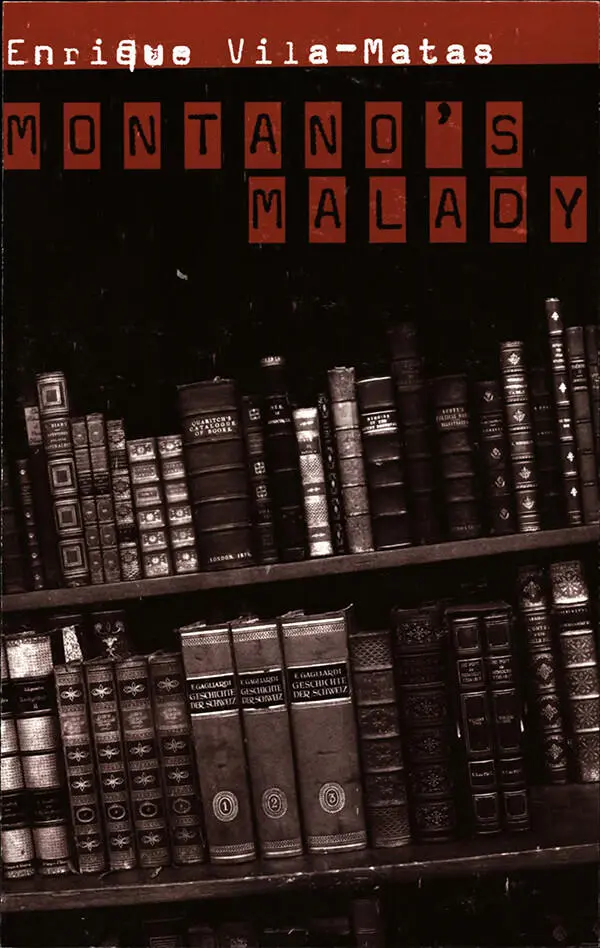
- Название:Montano's Malady
- Автор:
- Издательство:New Directions
- Жанр:
- Год:2007
- ISBN:нет данных
- Рейтинг книги:5 / 5. Голосов: 1
-
Избранное:Добавить в избранное
- Отзывы:
-
Ваша оценка:
Montano's Malady: краткое содержание, описание и аннотация
Предлагаем к чтению аннотацию, описание, краткое содержание или предисловие (зависит от того, что написал сам автор книги «Montano's Malady»). Если вы не нашли необходимую информацию о книге — напишите в комментариях, мы постараемся отыскать её.
is a writer named Jose who is so obsessed with literature that he finds it impossible to distinguish between real life and fictional reality. Part picaresque novel, part intimate diary, part memoir and philosophical musings, Enrique Vila-Matas has created a labyrinth in which writers as various as Cervantes, Sterne, Kafka, Musil, Bolano, Coetzee, and Sebald cross endlessly surprising paths. Trying to piece together his life of loss and pain, Jose leads the reader on an unsettling journey from European cities such as Nantes, Barcelona, Lisbon, Prague and Budapest to the Azores and the Chilean port of Valparaiso. Exquisitely witty and erudite, it confirms the opinion of Bernardo Axtaga that Vila-Matas is "the most important living Spanish writer."
Montano's Malady — читать онлайн бесплатно полную книгу (весь текст) целиком
Ниже представлен текст книги, разбитый по страницам. Система сохранения места последней прочитанной страницы, позволяет с удобством читать онлайн бесплатно книгу «Montano's Malady», без необходимости каждый раз заново искать на чём Вы остановились. Поставьте закладку, и сможете в любой момент перейти на страницу, на которой закончили чтение.
Интервал:
Закладка:
I’m going to go to the kitchen to have a yogurt; I shall be accompanied by the desperate friend who always goes with me, that friend who is myself and who, so as not to fall into the clutches of cursed despair, writes this diary, this story of a soul trying to save itself by helping the survival of literature, this story of a soul no sooner strong and steady than it succumbs to depression, in order then, laboriously, to get back on its feet, to readjust through work and intelligence, constantly battling with Pico’s moles. I wonder now why I said yesterday that I was not in tune with Pavese if he is my shadow, I, my own reader, the desperate friend who always goes with us literature-sick, who are constantly fighting against despair and defeat.
PESSOA, FERNANDO (Lisbon, 1888–1935) invented a character by the name of Bernardo Soares, to whom he delegated the mission of writing a diary. As Antonio Tabucchi writes, “Soares is a fictional character who adopts the subtle literary fiction of autobiography. In this autobiography without facts, of a nonexistent person, is the only great narrative work left to us by Pessoa: his novel.”
Pessoa gave this diary, signed by Soares, the title The Book of Disquiet . He simply called the overall project of his work — mysterious and unrealizable, as if he had sought to dissolve in the fabric of his own unending “autofiction”—The Book (of disquiet), perhaps thinking of that mythical text Mallarmé longed for all his life, Le Livre , an impossible volume, whose completion — others may try, but the same thing will happen to them — is probably only ever to be found in the project itself, a project containing the seed of the decomposition of literary genres. The Book of Disquiet , like the project it was and could only be, was discovered one day in the trunk that, for almost fifty years, had guarded it in secret: the famous trunk containing 23,000 Pessoan documents. There rested The Book, the insomniac Soares’ book. A first version appeared in 1982 and later the publishing house of my friend Manuel Herminio Monteiro — who went in search of the lost trunk and found it — published a greatly enlarged and definitive edition of the clerk Soares’ diary.
What is meant by “disquiet”? Judging by what the assistant bookkeeper Soares reveals, we are to understand by disquiet a certain unease and, above all, a certain incompetence regarding life. This incompetence is like an illness that, at one point, he himself makes explicit and defines, calling it mal-de-viver (life-sickness). Disquiet is very possibly a manifestation of this illness. In his discreet office where he works as assistant bookkeeper, Soares daily discusses death, beauty, loneliness, and identity — and the barber on the corner. Soares the clerk writes about all this far from the ballrooms of Vienna or from the luxurious mountain health spas, he writes from the grayness of the window in his office, he writes from the standpoint of the daily and ordinary, of the simple and normal. In short, Soares the clerk and his diary seem real .
Soares’ look, which from a window surveys all the disquiet of his days and is articulated in The Book by a strange association between what he perceives and the alteration of these experiential data. The outside world becomes his I , meaning that his I takes possession of what is outside it. It can be said that Soares lives and does not live, his existence is placed between life and an awareness of life. Pessoa became one big Look thanks to Mr. Soares looking through him. Pessoa lived and Soares was life-sick , Soares had a window and wrote the diary, and his disquiet was the manifestation of his life-sickness . Perhaps Montano’s is just another variation on Soares’ illness. However that may be, perhaps the most attractive aspect of the Lisbon assistant bookkeeper’s bizarre world is, more than anything, this surprising way of being outside himself and looking. Right now it seems to me that someone who can look in this way is not very attached to life’s substance and is a walking ghost. Rosario Girondo, for example — me, not my mother — is also a walking ghost who wanders across these pages trying to learn to know how to read others, trying to be outside himself and to look, because he hopes one day to look as Soares looked, or to read as Pessoa read, always at a slight distance — unless the book were by Soares — because at each step — as happened to me the day before yesterday, when I was reading Michaux — memory would disrupt the narrative sequence: “After a few minutes, I was the one writing, and what was written was nowhere.” An elegant way of saying that his I took possession of what was outside it. This is what my I has been trying to mimic for some time. And I am not without a window.
Wednesday
I recommend that the traveler wishing to fall in love with Portugal calmly follow the course of the Tagus, see it first gravely flowing through the austere lands of Castile — all bare fields and solemnity — and then see it entering Portuguese territory, where the tragic Castilian Tagus undergoes, as Julio Camba wrote, “a lyrical tendency and is lined by trees, covered in boats shaped like a half moon, accompanied by songs.” Another world.
Portugal seems real , seems like another world. When I go to Lisbon, I walk down the streets of this city as if I had always been there. This was not the case when I first visited it, in 1968, when I went to work as a supporting actor in a James Bond film, the first not starring Sean Connery. On that occasion, my excessive and brazen youth made me wander through Lisbon like a “walking ghost in halls of memories,” as Pessoa wrote. I observed hardly anything, I didn’t see Lisbon, I didn’t see anything. But when I returned in 1989, I had the impression I had always been in this city, at each corner I sensed the diffuse memory of having already turned it. When? I didn’t know. But I had already been there before, never having been there.
When I go to Lisbon, I spend hours in Terreiro do Paço, on the riverbank, mimicking Soares, contemplating in vain: “I spend hours, sometimes, in Terreiro do Paço, on the banks of the Tagus, contemplating in vain […]. The quay, the evening, the smell of the sea, all combine to make up my anxiety.”
Excessive anxiety of the spirit for nothing. I go to Terreiro do Paço and then ritually head for Café Martinho da Arcada, where in earlier times the conversant Pessoa’s arrival was sad and sacred, punctual, methodical. The poet went every afternoon, according to legend, from his mournful office to Café Martinho, where he stretched out in thick silences of observation and agile thrusts of irony, and from there back home, slipping through the shadows.
When I go to Lisbon, I go to the Martinho in the early evening — I am Soares in my own way — and listen to what is said in conversations of yesteryear and today, because time is annulled, I listen to what is said in conversation, all the “metaphysics mislaid in the corners of cafés everywhere, the chance ideas of so many chancers, the intuitions of so many little people.”
When I go to Lisbon and walk in the Baixa, I drift like a melancholic child down the rua da Prata, down the rua dos Douradores, down the rua dos Franqueiros, and I know that tomorrow I shall also disappear and like my friend Herminio, stop walking down these streets, one less pedestrian in the street life of this city where I have always been: “Lisbon with its houses / of divers colors, / Lisbon with its houses / of divers colors, / Lisbon with its houses / of divers colors …”
In Lisbon I feel at home. “We meet again, Lisbon and Tagus and everything.” But it’s also true that, when I’m in this city, I want to be in Boca do Inferno and, when I’m in Boca do Inferno, I want to be in Lisbon. Excessive anxiety of the spirit for nothing. Often, when I’m in Barcelona, I should like to be in Boca do Inferno so that I should want to be in Lisbon. But today is another day, because I’m in Lisbon, wanting to be here as never before.
Читать дальшеИнтервал:
Закладка:
Похожие книги на «Montano's Malady»
Представляем Вашему вниманию похожие книги на «Montano's Malady» списком для выбора. Мы отобрали схожую по названию и смыслу литературу в надежде предоставить читателям больше вариантов отыскать новые, интересные, ещё непрочитанные произведения.







Обсуждение, отзывы о книге «Montano's Malady» и просто собственные мнения читателей. Оставьте ваши комментарии, напишите, что Вы думаете о произведении, его смысле или главных героях. Укажите что конкретно понравилось, а что нет, и почему Вы так считаете.