Enrique Vila-Matas - Montano's Malady
Здесь есть возможность читать онлайн «Enrique Vila-Matas - Montano's Malady» весь текст электронной книги совершенно бесплатно (целиком полную версию без сокращений). В некоторых случаях можно слушать аудио, скачать через торрент в формате fb2 и присутствует краткое содержание. Год выпуска: 2007, Издательство: New Directions, Жанр: Современная проза, на английском языке. Описание произведения, (предисловие) а так же отзывы посетителей доступны на портале библиотеки ЛибКат.
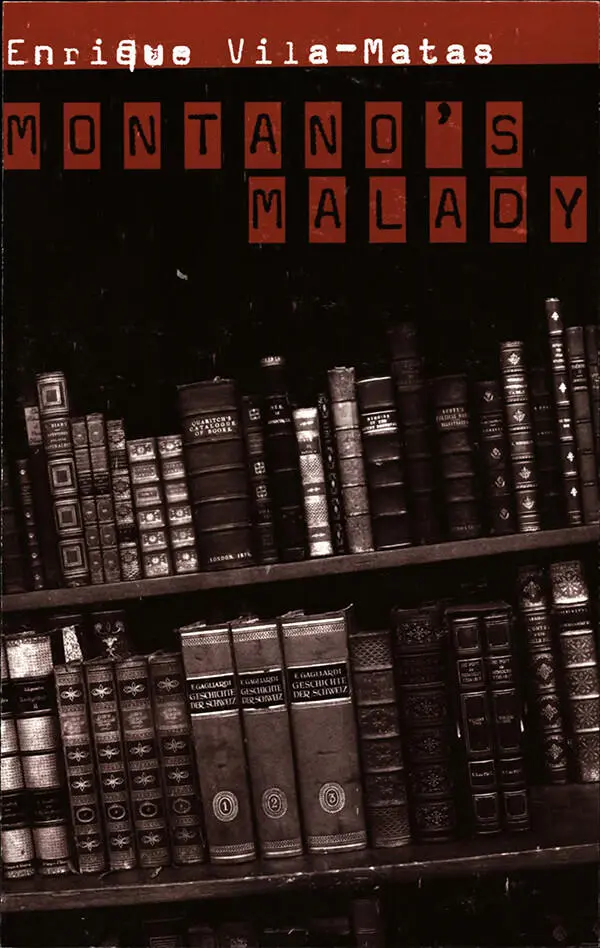
- Название:Montano's Malady
- Автор:
- Издательство:New Directions
- Жанр:
- Год:2007
- ISBN:нет данных
- Рейтинг книги:5 / 5. Голосов: 1
-
Избранное:Добавить в избранное
- Отзывы:
-
Ваша оценка:
Montano's Malady: краткое содержание, описание и аннотация
Предлагаем к чтению аннотацию, описание, краткое содержание или предисловие (зависит от того, что написал сам автор книги «Montano's Malady»). Если вы не нашли необходимую информацию о книге — напишите в комментариях, мы постараемся отыскать её.
is a writer named Jose who is so obsessed with literature that he finds it impossible to distinguish between real life and fictional reality. Part picaresque novel, part intimate diary, part memoir and philosophical musings, Enrique Vila-Matas has created a labyrinth in which writers as various as Cervantes, Sterne, Kafka, Musil, Bolano, Coetzee, and Sebald cross endlessly surprising paths. Trying to piece together his life of loss and pain, Jose leads the reader on an unsettling journey from European cities such as Nantes, Barcelona, Lisbon, Prague and Budapest to the Azores and the Chilean port of Valparaiso. Exquisitely witty and erudite, it confirms the opinion of Bernardo Axtaga that Vila-Matas is "the most important living Spanish writer."
Montano's Malady — читать онлайн бесплатно полную книгу (весь текст) целиком
Ниже представлен текст книги, разбитый по страницам. Система сохранения места последней прочитанной страницы, позволяет с удобством читать онлайн бесплатно книгу «Montano's Malady», без необходимости каждый раз заново искать на чём Вы остановились. Поставьте закладку, и сможете в любой момент перейти на страницу, на которой закончили чтение.
Интервал:
Закладка:
This morning, while searching for Ecuador , I came across the essay by Proust I had forgotten about. I started flicking through it — only to find out what it was about — and in the end I couldn’t put it down. In his essay, Proust speaks of that confusion — still in force today, by the way — regarding the episode of the madeleine. He bemoans the fact that certain people, some of them extremely learned, ignorant of the rigorous but veiled composition of Swann’s Way , believed that the novel was a kind of book of memories, linked according to the accidental laws of the association of ideas. “In support of this He,” says Proust, “they quoted pages in which some crumbs of madeleine dunked in herbal tea remind me of a whole period from my life. Well […], to switch from one scene to another, I simply used not a fact, but the purest and most useful join I could find, a phenomenon of memory.”
Proust then suggests we read Chateaubriand’s Memoirs , in which he says it is perfectly clear that the author was also familiar with this method of abrupt transition, this phenomenon of memory . While in Montboissier, Chateaubriand suddenly hears a thrush sing. And this song he had listened to so much when he was young immediately takes him back to Combourg, urges him, together with the reader, to switch time and place. Immediately the narrative is situated somewhere else.
This technical device, this phenomenon of memory , this method of abrupt transition reminded me this morning of the overwhelming simplicity of a method I learned about from Jean Echenoz, the French novelist, who one evening, in the Aviador — a bar in Barcelona, decorated with propellers and shields, remains of airports and air disasters — talked to me about abrupt but effective transitions in his stories. “A bird goes by,” he said. “I follow it. This enables me to go wherever I like in the narrative.” It struck me as a very interesting lesson, one to bear in mind, and I remember that I thought that, viewed in this way, any line in a story could become a migratory bird, for example. I took note of all this because it struck me as a very good means by which, in the moment that a written sentence lasts, one can simply start listening to other voices, other rooms. In fact Echenoz applies his theory in Double Jeopardy , where the duke, Pons, handles some binoculars in the south of Asia and, on focusing them, sees the flight of some migratory birds — in a way that recalls those minute signs in Cosmos that reveal to Gombrowicz the direction of the flight of the narrative — which in arrowhead formation — apparently pointing to the next chapter — head straight for Paris. As a result, confronted by such an instantaneous change of scene, the reader is likewise obliged to get hold of some good binoculars.
Years later, in Montano’s Malady , I made use of Echenoz’s lesson in the Aviador bar to move the action quickly from a Chilean landscape to Barcelona: “Back on terra firma, I looked up at the cloudless sky of San Fernando and saw a bird go by. I followed it. And it seemed to me that following it enabled me to go wherever I liked, to make use of all my possible mental mobility. A few hours later I was flying in the direction of Barcelona….”
The technical solution of the migratory bird is surprising both for its effectiveness and for its great simplicity. But this is how certain technical problems that put writers in double jeopardy are often resolved. After all, the instantaneous switch to other voices, other rooms, is one of the secret advantages that literature has over life, because in life this switch is never so simple, whereas in books everything is possible, and often amazingly easy.
To return to this morning, having read Proust’s essay, I renewed the search for my copy of Ecuador , which I eventually found and began to reread, suddenly experiencing a Proustian phenomenon of memory when, seated in my favorite armchair, I embarked on a peaceful journey to Ecuador, which very soon ceased to be comfortable. On various occasions an icy headwind pushed me violently backward, transferring me to Atlantic scenes that everything indicated were behind me: unmistakable scenes from the Azores and, more specifically, from the islands of Fayal and Pico.
The first time that this phenomenon of memory took place was when I read that Michaux, on his way to Ecuador, on the island of Guadeloupe, had a room overlooking a volcano (“My room overlooks a volcano. / In short a volcano. / I’m two steps away from a volcano. / […] Volcano, volcano, volcano. / This is my music for tonight.”), which caused the appearance of the icy, Proustian headwind. I lifted my eyes from the book and traveled back in my memory to hear the voices of that pleasant Atlantic scene in the hotel room Rosa and I shared in February this year in Fayal, with its balcony overlooking the volcano on the enigmatic island of Pico, the hotel room next to Tongoy, who accompanied us on our four-day trip to the Azores. I couldn’t help recalling Tongoy as he rested in a hammock in the hotel in Fayal when I read in Michaux’s diary, “Drops of blood fall from the hammock placed over me. This is the danger with vampires, they suck your blood without your realizing. Once you have been a victim, the vampires recognize you among the others and are drawn toward you.”
When shortly afterward I left the image of Tongoy in the hammock in the Azores and managed to start reading Michaux again, another icy headwind blew when I read the description of the climate of Ecuador, so similar to that of the Azores: “It is difficult to establish the climate of this country. In the altiplanos people tend to say — and it’s fairly accurate — four seasons in one day.”
This happened again and again. I would read Michaux, and the Proustian wind would take me back to the Azores. As, for example, when he describes how he disembarked on the island of Curaçao. The charm he notices there strikes me as identical to that which Tongoy, Rosa, and I felt this February when, arriving from Fayal, we disembarked on the enigmatic island of Pico. Michaux writes, “Nothing so seductive as an island. There is nothing on the planet, I assure you, that looks so like a cloud as an island. Each time we are captivated by it.”
So it is that Ecuador at various points contains clear and somewhat mysterious similarities to our trip to the Azores. I would read Ecuador and a migratory bird or an icy wind would carry me back, leave me in my memories of the Azores: a nearly constant phenomenon of memory. As if this were not enough, I would sometimes come across lines in Michaux that reminded me of — in tribute to Michaux, let us call them intravenous —relations between Tongoy, Rosa, and me: “On this last day in the month of February, a sudden wind carried me mentally to my house in Paris, where I spent a few imaginary hours in the company of my wife and a friend, before returning intact to this steep, straight Ecuador.”
Although we went to the Azores on holiday, each of us had another reason to add to the idea of traveling for the sake of it. I was prompted also by my curiosity to see Café Sport, which Tabucchi talks about in The Woman of Porto Pim , Tongoy went because he had always been curious to experience a whaler’s life first hand, and Rosa — who initially was the only one without a special reason apart from being a tourist — also found an additional reason when at the Lisbon Airport she bought a book by one Antonio Caiado—“a secret, hidden writer, like Julien Gracq, who lurks on the island of Pico, in the Azores,” it says on the back cover — and she was so fascinated by the story told in this book that she even planned to locate this “hidden writer” and suggest being his literary agent.
Читать дальшеИнтервал:
Закладка:
Похожие книги на «Montano's Malady»
Представляем Вашему вниманию похожие книги на «Montano's Malady» списком для выбора. Мы отобрали схожую по названию и смыслу литературу в надежде предоставить читателям больше вариантов отыскать новые, интересные, ещё непрочитанные произведения.





Обсуждение, отзывы о книге «Montano's Malady» и просто собственные мнения читателей. Оставьте ваши комментарии, напишите, что Вы думаете о произведении, его смысле или главных героях. Укажите что конкретно понравилось, а что нет, и почему Вы так считаете.