Enrique Vila-Matas - Montano's Malady
Здесь есть возможность читать онлайн «Enrique Vila-Matas - Montano's Malady» весь текст электронной книги совершенно бесплатно (целиком полную версию без сокращений). В некоторых случаях можно слушать аудио, скачать через торрент в формате fb2 и присутствует краткое содержание. Год выпуска: 2007, Издательство: New Directions, Жанр: Современная проза, на английском языке. Описание произведения, (предисловие) а так же отзывы посетителей доступны на портале библиотеки ЛибКат.
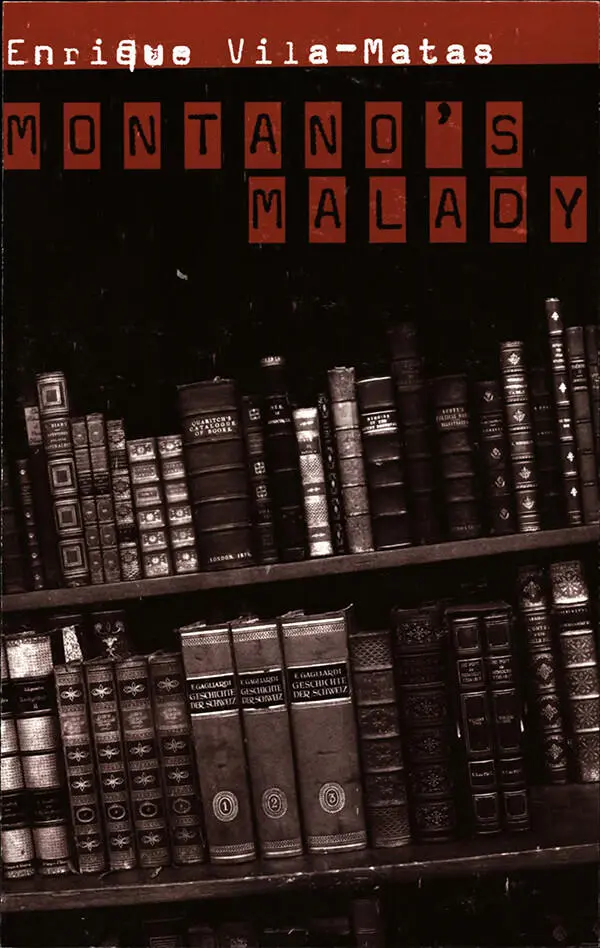
- Название:Montano's Malady
- Автор:
- Издательство:New Directions
- Жанр:
- Год:2007
- ISBN:нет данных
- Рейтинг книги:5 / 5. Голосов: 1
-
Избранное:Добавить в избранное
- Отзывы:
-
Ваша оценка:
Montano's Malady: краткое содержание, описание и аннотация
Предлагаем к чтению аннотацию, описание, краткое содержание или предисловие (зависит от того, что написал сам автор книги «Montano's Malady»). Если вы не нашли необходимую информацию о книге — напишите в комментариях, мы постараемся отыскать её.
is a writer named Jose who is so obsessed with literature that he finds it impossible to distinguish between real life and fictional reality. Part picaresque novel, part intimate diary, part memoir and philosophical musings, Enrique Vila-Matas has created a labyrinth in which writers as various as Cervantes, Sterne, Kafka, Musil, Bolano, Coetzee, and Sebald cross endlessly surprising paths. Trying to piece together his life of loss and pain, Jose leads the reader on an unsettling journey from European cities such as Nantes, Barcelona, Lisbon, Prague and Budapest to the Azores and the Chilean port of Valparaiso. Exquisitely witty and erudite, it confirms the opinion of Bernardo Axtaga that Vila-Matas is "the most important living Spanish writer."
Montano's Malady — читать онлайн бесплатно полную книгу (весь текст) целиком
Ниже представлен текст книги, разбитый по страницам. Система сохранения места последней прочитанной страницы, позволяет с удобством читать онлайн бесплатно книгу «Montano's Malady», без необходимости каждый раз заново искать на чём Вы остановились. Поставьте закладку, и сможете в любой момент перейти на страницу, на которой закончили чтение.
Интервал:
Закладка:
To counteract the constant appearance of clichés in my father’s discourse, I had to — and this is what I did — concentrate all my energy on snippets of homespun skulduggery, short and avant-garde skirmishes with which I built up a nonconformist and eccentric literary style: an avant-garde style to begin with, which with time has simmered down. A style opposed to family boredom, that of my parents’ home, but also to the crushing boredom of the country in which I had chanced to be born. A contradictory style, an attempt always to say something different, with humor if possible, to break with the lack of irony in the head of the family’s antiquated and one-sided monologue. A style without too many flesh-and-blood literary characters. A style in revolt against everything, most of all against the sleep-inducing Spanish realism, a style that was always ironic toward the marchionesses and proletarian women, lovers and prostitutes, coming and going at five in the afternoon in today’s Spanish novels.
I originate from the avant-garde movement and the skirmishes that family boredom forced me into. And, although I later simmered down, I have devoted my whole life to shunning the established order and trying to create my own style and to say something different. I hate it, for example, when taxi drivers talk to me about the weather and abruptly initiate a string of set phrases. Just yesterday, when I was heading toward the Avenida Palace, the taxi driver said something to me about the gallons of rain that had fallen. During a pause in his leaden discourse, I hijacked the conversation and said (knowing that this would confuse and silence him), “Just today I was given the opportunity to kill bad weather. Do you know what I did?” Anxious silence, bewilderment. “I simply washed the weather’s face. That’s why it appears to be raining. You may not have realized that, in fact, it’s not raining.”
Thanks to my style, I can survive even in a taxi. With the taxi driver talking to me about the weather, I must have reached the Avenida Palace yesterday at about seven in the evening. The presentation in La Central was at eight, and Ferdydurke the book we were going to speak about. First we discussed other matters in the hotel, and did so with the steady, persistent rain of unexpected melancholy.
The real rain was waiting for us outside, when at about half-past seven we started walking along the Rambla de Catalunya, toward the bookshop. We were protected from that real rain by the red umbrella that had accompanied me in the rain in Nantes and had witnessed the birth of Montano’s Malady , an umbrella to which I had since attributed creative powers.
A single umbrella for two fans of Gombrowicz. But two rains for them. And even an imaginary sun.
“It’s not raining,” I said. “The sun’s coming out.”
Rita understood me, she grasped the tribute to Gombrowicz’s anti-maternal style and joked, with a happy and unforgettable wink:
“But it’s raining!”
The red umbrella started trying to unbalance me, the wind shook it from side to side and never have two fans of Gombrowicz gotten so wet. In the face of such an assault, it occurred to me to say to Rita that our umbrella wanted to commit suicide. “Clearly you’re not only concerned about flesh-and-blood characters, you also see a soul in umbrellas,” she said. I would have replied that in my books such characters are conspicuous by their absence, but I preferred not to speak about me and asked her if she was particularly interested in the flesh-and-blood people who appear in novels. She stopped abruptly in the middle of the street, in the rain, almost taking root in the wet tarmac while, among the gusts of wind, she considered her response. “I’m interested,” she said slowly, “in the traces of tears but not the tears. I’m interested in what flesh-and-blood characters leave in writing, and not so much in them.”
As I was about to say that not everybody leaves something in writing, Rita startled me by referring to an anonymous suicide note. The note simply said, “So much doing up and undoing.”
At that moment, the red umbrella took flight (its remains rest today in the kitchen at home), drawing a strange parabola and crashing against a tree in the Rambla. To indicate that I had liked the anonymous farewell note, with another wink of Gombrowicz collusion, I touched my ear as a sign of approving the phrase “so much doing up and undoing.” But Rita was no longer there, she had sensibly sought refuge in a doorway. While the umbrella left the tree and again took to its wings and started forging its own style on discovering revolt and freedom, I stood there absurdly still in the middle of the Rambla, a flesh-and-blood character soaked to the skin, representing for whoever wished to see the grotesque figure of a madman who has lost his umbrella and touches an ear. There I stood, a victim of my own style, there I stood for a short while, very still, as if I believed that really it was not raining, but a perfect midday sun was shining.
KAFKA, FRANZ (Prague, 1883–Kierling, 1924). “My outer ear felt fresh, rough, cold, and juicy to the touch, like the leaf of a tree,” writes Kafka in his 1910 diary. His remark refers me to another, reminds me of something I heard Claudio Magris say one evening in Barcelona: “Literature may also be part of the world in the same way as leaves are, for example.”
Magris’ remark not only consoles me, but returns me to the world. Literature and the world enter into harmony. I no longer consider it so serious to be literature-sick. It is pleasant to feel, as I feel this morning, in harmony with the world. But I remember a day in the summer of 1965, I remember that day very well, because I think I have never been so far removed from that harmony with the world.
Since, on that August afternoon, the notion of literature barely existed for me — I read little, spy novels, and I still hadn’t discovered Cernuda, I still didn’t know that I could find a warm but sickly refuge in literature, a refuge from the roughness of life — I could not find a place in the world, I felt deeply lost and disconsolate.
I could not find a place in the world, and not for lack of trying. I was anxious to find a place, however humble, in whatever Order: in the infinite universe, in the grayness of the world of work, in a spy ring, in a lunatic asylum, in a family with parents more sensible than my own, in the mediocrity of a peaceful married life seen as a lesser evil next to loneliness …
I had a lot of the sad hero of our time. But since I hardly read anything at all — I was almost completely detached from the literature that would later ensnare me — I could not draw on the happy and imaginative resources that reading offers us, allowing us to escape from the anxiety which sometimes pins us down. And, as for being ignorant, I didn’t even know — how it would have helped me that day! — that this is what I was, that at the age of fifteen I was the classic hero of our time. Knowing it would undoubtedly have benefited me, would even have made me feel — in my sadness — like an important young man, would even have given my life a certain meaning, would have helped me not to fall into the absolute disconsolation I fell into completely at around seven in the evening of that summer’s day, when, in my father’s absence, it was my turn to lock up the office on the Costa Brava where I helped him to sell apartments. On other days when I had been the one to lock up the office, I had felt a special satisfaction at having that responsibility. But on that summer’s day I was deeply disconsolate. I closed the office and looked at the world, I looked at the sea and then at the mountain. Sea and mountain, mountain and sea, sleeping and waking, studying and working, waking and sleeping, so much doing up and undoing …
Читать дальшеИнтервал:
Закладка:
Похожие книги на «Montano's Malady»
Представляем Вашему вниманию похожие книги на «Montano's Malady» списком для выбора. Мы отобрали схожую по названию и смыслу литературу в надежде предоставить читателям больше вариантов отыскать новые, интересные, ещё непрочитанные произведения.





Обсуждение, отзывы о книге «Montano's Malady» и просто собственные мнения читателей. Оставьте ваши комментарии, напишите, что Вы думаете о произведении, его смысле или главных героях. Укажите что конкретно понравилось, а что нет, и почему Вы так считаете.