Enrique Vila-Matas - Montano's Malady
Здесь есть возможность читать онлайн «Enrique Vila-Matas - Montano's Malady» весь текст электронной книги совершенно бесплатно (целиком полную версию без сокращений). В некоторых случаях можно слушать аудио, скачать через торрент в формате fb2 и присутствует краткое содержание. Год выпуска: 2007, Издательство: New Directions, Жанр: Современная проза, на английском языке. Описание произведения, (предисловие) а так же отзывы посетителей доступны на портале библиотеки ЛибКат.
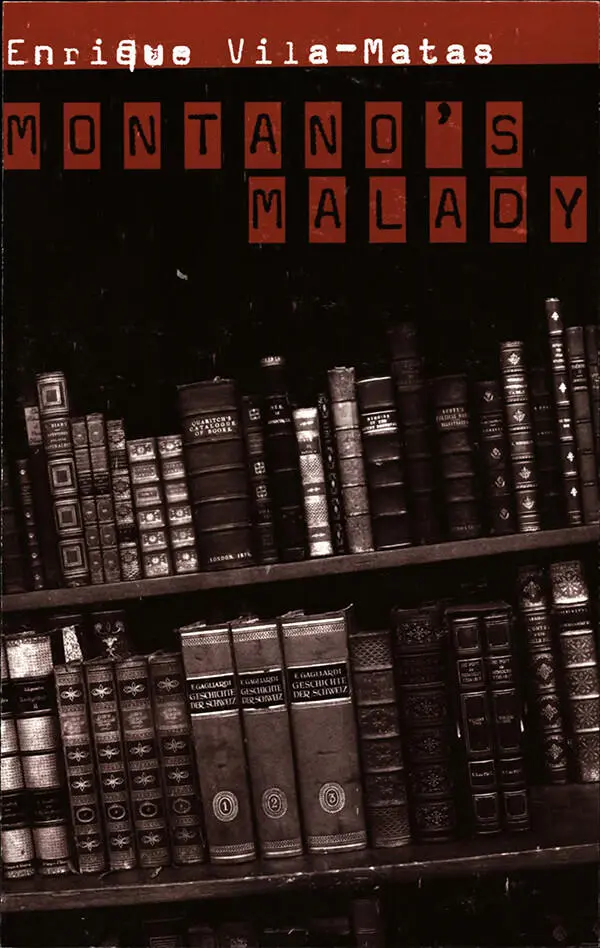
- Название:Montano's Malady
- Автор:
- Издательство:New Directions
- Жанр:
- Год:2007
- ISBN:нет данных
- Рейтинг книги:5 / 5. Голосов: 1
-
Избранное:Добавить в избранное
- Отзывы:
-
Ваша оценка:
Montano's Malady: краткое содержание, описание и аннотация
Предлагаем к чтению аннотацию, описание, краткое содержание или предисловие (зависит от того, что написал сам автор книги «Montano's Malady»). Если вы не нашли необходимую информацию о книге — напишите в комментариях, мы постараемся отыскать её.
is a writer named Jose who is so obsessed with literature that he finds it impossible to distinguish between real life and fictional reality. Part picaresque novel, part intimate diary, part memoir and philosophical musings, Enrique Vila-Matas has created a labyrinth in which writers as various as Cervantes, Sterne, Kafka, Musil, Bolano, Coetzee, and Sebald cross endlessly surprising paths. Trying to piece together his life of loss and pain, Jose leads the reader on an unsettling journey from European cities such as Nantes, Barcelona, Lisbon, Prague and Budapest to the Azores and the Chilean port of Valparaiso. Exquisitely witty and erudite, it confirms the opinion of Bernardo Axtaga that Vila-Matas is "the most important living Spanish writer."
Montano's Malady — читать онлайн бесплатно полную книгу (весь текст) целиком
Ниже представлен текст книги, разбитый по страницам. Система сохранения места последней прочитанной страницы, позволяет с удобством читать онлайн бесплатно книгу «Montano's Malady», без необходимости каждый раз заново искать на чём Вы остановились. Поставьте закладку, и сможете в любой момент перейти на страницу, на которой закончили чтение.
Интервал:
Закладка:
For the first time ever, I took a second sedative. I continued talking to my friend, but every time he said something, I silently exacted revenge thinking about the day in Rome when he told me that he was going to commit suicide and I, already envious of him and also distrustful of his suicidal threats, did not lift a finger to dissuade him — I went so far as to tell him that, if he was planning to kill himself because the critic Stanisław Wiciński was miles better than him, he would do very well to take himself out of the picture — I opened a bottle of red Imola wine and sat down in the sitting room of the house in Rome and, having taken my seat, waited to see if by chance the explosion went off.
To return to today, at around ten in the evening, suddenly distressed at not being a critic and above all depressed because Rosa was not talking to me — she was absorbed watching a program on Catalan TV–I started reading Virginia Woolf’s diary and wondering whether or not to include it in this dictionary. For a long time I was lost among all those intelligent and angst-ridden pages she wrote over twenty-seven years, always in the half hour following teatime. “I will go down with my colors flying,” she wrote in the penultimate entry recorded in her diary, three weeks before her suicide. The sentence contains great pride and is very moving, but it is also true to say that the sentence has an unbearable aura of sadness, which managed to depress me even more. I decided to forget Virginia Woolf for today and started reading a story by Samuel Beckett, “From an Abandoned Work,” in which an old man, clearly mad, perhaps stultified by age, attempts to remember a day from his past, from the moment he left home in the morning to the time he came back at night. And one has the impression that three days, not one, have gone by.
Even the old man’s life seemed more interesting than my own and I told myself that I do well to invent when I devote myself to literary creation and renounce realism, because I would be stuck if I had to talk all the time about my gray existence as a housewife who writes. In short, I read the story of this dumb old man created by Beckett and was on the verge of taking a third sedative. Increasingly anxious and sleepy, I ate a potato omelet that Rosa had prepared and went to bed. I dreamed that I was more dumb than Beckett’s old man. Then I woke up and wrote down here what I did today, since I want the reader to have a certain idea of what I am like in my daily life, in which I lead such a monotonous and horrific existence that not infrequently I try to escape from it by writing about realities far removed from my real life. Of course, if I did not write, I wouldn’t have to spend so much time at home, and perhaps then I would lead a less gray life than at present. But what’s the use? “What’s the use of Pentothal,” as my mother would say. I’m not so obsessed about literature-sickness as I was when, for example, I arrived in Nantes in November of last year. That is why I can now say with an easy conscience that, between life and books, I choose the latter, which help me to make sense of the former. Literature has always enabled me to understand life. And for precisely that reason it leaves me outside it. I mean it: I wouldn’t have it any other way.
Thursday (extract from Gombrowicz’s diary)
I got up, as usual, around ten, and had breakfast: tea with cakes, followed by oatmeal. Letters: one from Litka in New York; another from Jelenski in Paris. At midday I went to the office (on foot, it’s not far). I spoke to Marrill Alberes on the phone about the translation and to Russo to discuss the proposed trip to Goya. Ríos called to tell me they were already back from Miramar, and Drabrowski (regarding the flat).
At three, coffee and bread with ham.
At seven, I left the office and headed in the direction of Costanera Avenue for a breath of fresh air (it’s very hot, about 90 degrees). I was thinking about what Aldo told me yesterday. Then I went to Cecilia Benedit’s home and we went out for dinner together. I had soup, steak frites, and salad, stewed fruit. I hadn’t seen her for some time, so she told me about her adventures in a Mercedes […]. From there, around midnight, I went to the Rex for a coffee […]. On the way home, I went into the Tortoni to pick up a package and talk to Pocho. At home, I read Kafka’s diary. Went to sleep around three. I tell you all this for you to know what I am like in my daily life.
Friday
“Then,” says Justo Navarro, “you grab the thing that is closest: you talk about yourself. And, writing about yourself, you begin to see yourself as if you were another, you treat yourself as if you were another: you move away from yourself in proportion as you approach yourself.”
Saturday
In an essay by Alan Pauls on the genre, I have just read that the great theme of the private journal in the twentieth century is sickness. I didn’t know, I had never thought about this. And yet — curious coincidence — one of my diary’s central ideas, one of its most recurring themes, is undoubtedly that of sickness, in this case literature-sickness, Montano’s malady in short.
“The great theme of the private journal in the twentieth century,” writes Alan Pauls, “is sickness. The annotations which the writer attaches to this illness represent something like a daily, unflagging report, giving an account of its progress, a kind of clinical history that seems only to have ears for the stealthy expressiveness of the ailment.”
As I deduce from what I have read in this essay on the genre, those writing great private journals in the last century did not do so to know who they were, but kept them to know what they were turning into , in which unforeseeable direction catastrophe was taking them. “It is not, therefore, the revelation of a truth that these diaries could or wanted to give us, but the crude, clinical account of a mutation.”
We are, therefore, face-to-face with writing’s clinical dimension. Surely in these pages I have been striving — perhaps without being entirely aware of it until now — to find out where the elimination of my illness, of my Montano’s malady, would lead me. To silence, probably. Is this a good thing? I don’t think so, because I would be back to where I was in the beginning: seated before the rickety chair of someone who is tragically agraphic. So surely the illness is better than the cure.
But is the illness a good thing? At the moment the best thing would be to keep smoking, to keep writing: to write, for example, that I am smoking. I take a drag from my cigarette and remember that, in Gombrowicz’s diary, the writer ends up identifying himself with the evil: “I myself was the illness, meaning the anomaly, meaning something related to death….”
But was Gombrowicz being sincere when he wrote this? His diary is not exactly a masterpiece of sincerity, that quality so many hope to find in a private journal. In his diary, he accomplished a new inventive form and at the same time invented a new form of writing a diary. And he did this perhaps because, as a writer, what Gombrowicz feared most was Sincerity, he knew that Sincerity in literature led nowhere: “Has there ever been a diary that was sincere? The sincere diary is without a doubt the most fallacious, because frankness is not of this world. And also — sincerity, what a bore! It isn’t even faintly fascinating.”
Because of all this, he did not allow his diary to become confessional. He understood in time that in his diary he had to present himself in action , in his intention to impose himself on the reader in a certain way, in his will to create himself in sight of and with the knowledge of everyone. To tell the reader, “This is how I want to be for you,” and not, “This is how I am.” Gombrowicz claimed the right to his own face: “Surely I do not have to allow every Tom, Dick, and Harry to disfigure me as he pleases.”
Читать дальшеИнтервал:
Закладка:
Похожие книги на «Montano's Malady»
Представляем Вашему вниманию похожие книги на «Montano's Malady» списком для выбора. Мы отобрали схожую по названию и смыслу литературу в надежде предоставить читателям больше вариантов отыскать новые, интересные, ещё непрочитанные произведения.



Обсуждение, отзывы о книге «Montano's Malady» и просто собственные мнения читателей. Оставьте ваши комментарии, напишите, что Вы думаете о произведении, его смысле или главных героях. Укажите что конкретно понравилось, а что нет, и почему Вы так считаете.