Enrique Vila-Matas - Montano's Malady
Здесь есть возможность читать онлайн «Enrique Vila-Matas - Montano's Malady» весь текст электронной книги совершенно бесплатно (целиком полную версию без сокращений). В некоторых случаях можно слушать аудио, скачать через торрент в формате fb2 и присутствует краткое содержание. Год выпуска: 2007, Издательство: New Directions, Жанр: Современная проза, на английском языке. Описание произведения, (предисловие) а так же отзывы посетителей доступны на портале библиотеки ЛибКат.
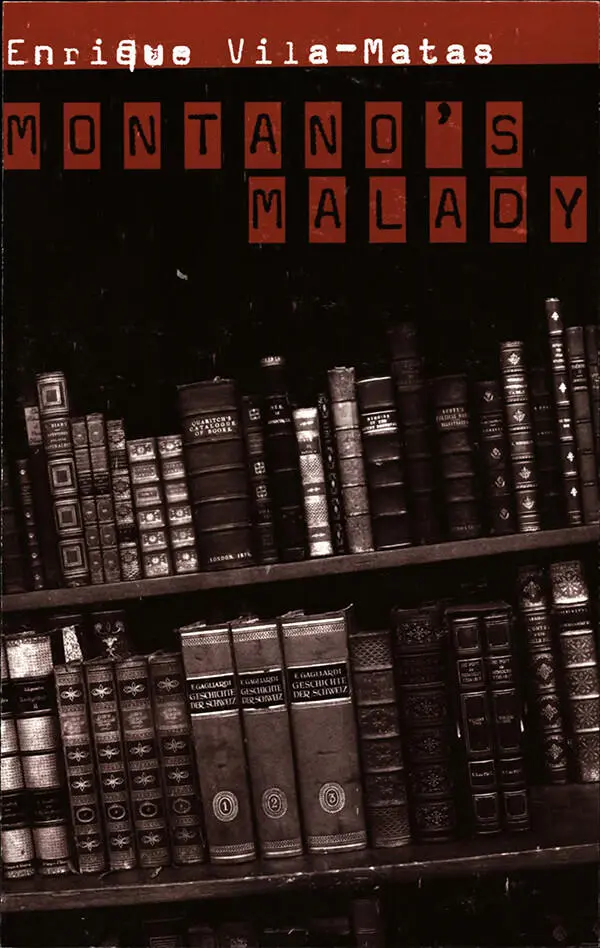
- Название:Montano's Malady
- Автор:
- Издательство:New Directions
- Жанр:
- Год:2007
- ISBN:нет данных
- Рейтинг книги:5 / 5. Голосов: 1
-
Избранное:Добавить в избранное
- Отзывы:
-
Ваша оценка:
Montano's Malady: краткое содержание, описание и аннотация
Предлагаем к чтению аннотацию, описание, краткое содержание или предисловие (зависит от того, что написал сам автор книги «Montano's Malady»). Если вы не нашли необходимую информацию о книге — напишите в комментариях, мы постараемся отыскать её.
is a writer named Jose who is so obsessed with literature that he finds it impossible to distinguish between real life and fictional reality. Part picaresque novel, part intimate diary, part memoir and philosophical musings, Enrique Vila-Matas has created a labyrinth in which writers as various as Cervantes, Sterne, Kafka, Musil, Bolano, Coetzee, and Sebald cross endlessly surprising paths. Trying to piece together his life of loss and pain, Jose leads the reader on an unsettling journey from European cities such as Nantes, Barcelona, Lisbon, Prague and Budapest to the Azores and the Chilean port of Valparaiso. Exquisitely witty and erudite, it confirms the opinion of Bernardo Axtaga that Vila-Matas is "the most important living Spanish writer."
Montano's Malady — читать онлайн бесплатно полную книгу (весь текст) целиком
Ниже представлен текст книги, разбитый по страницам. Система сохранения места последней прочитанной страницы, позволяет с удобством читать онлайн бесплатно книгу «Montano's Malady», без необходимости каждый раз заново искать на чём Вы остановились. Поставьте закладку, и сможете в любой момент перейти на страницу, на которой закончили чтение.
Интервал:
Закладка:
At around half past nine, I stopped reading Barnes and put on some music by Tom Waits, my favorite song by this musician, “Downtown Train,” the story of someone who is lost and wants to find his way back to the center of his city, or at least to the center of something. With music by Tom Waits this morning, I started writing down in the diary my recollections of last Friday, my (not entirely childish) recollections of when I smoked in front of the mirror and called myself either José or Rosario and became drunk as a lord, hearing a booming voice that invited me to keep smoking. It was an interesting and difficult recreation on paper of a drinking spree in which I ended up receiving the visit of a ghost.
I wrote until two in the afternoon, this is my usual timetable. Normally, every day at about two, I go down to the lobby to collect my mail and from there to the newsstand on the corner to buy the papers. I have a quick lunch in a restaurant nearby, where I read my letters and also the press and come into contact with reality, with the news items that the papers carry and which — perhaps because of my matutinal and fictional enclosure — always surprise and puzzle me. On my return home, I listen to the messages on the answering machine — I reply when I have to reply, meaning only when it is strictly necessary — and then I switch on the computer and check my e-mail, and again only answer when it is essential. I do not use the computer to write my literary work, only for e-mail and for newspaper articles.
Letters I received today: two from Buenos Aires (both from Juan Carlos Gómez, El Goma , one of Gombrowicz’s young friends before Gombrowicz left Argentina in 1963; in his two letters today, El Goma , in his aggressive and poorly imitated Gombrowicz style, repeatedly calls me “sleepyhead” for not writing to him or for being so slow to answer him); and one from New York, in which the critic Stanisław Wiciński asks me if everything I write in the book I am preparing “is true word for word.”
Messages on the answering machine: a) From the town hall in Sant Quirze del Vallès, an invitation to deliver a lecture on James Joyce’s Finnegans Wake , an extravagant proposal since I have never been regarded as an expert on this book; b) three annoying requests from the press offices of three publishers in Barcelona to present three books by authors who are more or less friends or acquaintances of mine, three books I know to be horrendous and which remind me of something Bioy Casares said, how sometimes there are friends who send you their books seemingly in an effort to make you lose your fascination for literature.
E-mails: only one, but a very special one, coming from the Swiss-German publisher that recently began publishing my books. In it, I am invited at the beginning of June to catch a plane to Geneva, then a train, after that a bus, and finally a cable car that will leave me at the top of a Swiss mountain: a long trip to the summit of a mountain — which I shall call Matz Peak — to attend a Literature Festival that takes place there every year — the participants are all German speakers, I would be the only one from Spain, which means I would not understand a thing of what was said or happened there — and to absorb what in the e-mail is called the mountain spirit . It made me think of the hiker Robert Walser, a great walker. And of Mann’s The Magic Mountain . I imagine the writers on Matz Peak in shorts, with lots of torches and Tyrolese songs…. I don’t think I shall go, I think I shall reply that I have a prior engagement that makes it impossible for me to visit Matz Peak, this would seem to be the most sensible course of action, you never know, I might turn up at the peak, after the long journey, and, while I am absorbing the mountain spirit, be murdered or raped. I shall say I can’t go. But what I shall do is keep the e-mail, it really is a very interesting document, which, owing to the lack of proficiency in English, veers from the comical to the profound or unsettling: “I hope all well. Subject: Swiss montains. Precious Rosario Girondo: It would be most kind say to me if you have time to go to the Literature Festival at which we already spoke you. It is a festival in the montains of Swiss, very wonderful, very interesting. A mix of vacations and of intellectual inspiring. My joy if you want to pick up this invitation. (There is people there who speaks Spanglish, at least I …) Much greetings from Zurigo, think about it: is the mountain spirit.”
At five in the afternoon, most days — today was one of them — I write one of the four articles I compose each week to ensure a regular monthly salary. Today I wrote on Kafka’s relations with his friend Max Brod, I wrote it fairly quickly and sent it, having barely revised it, by e-mail. In the article, I discussed how poor Brod would advise Kafka to choose more elevated themes than the ones he used for his stories of rodents, moles, and dogs. I recalled the admirable response by this hero of subordinate aesthetics, namely Kafka: “You’re right, Max, but not entirely, only in one sense. In another, what counts are not proportional numbers, I also should like to be tested in my mouse hole.”
Around the same time, Kafka also wrote to Brod regarding great themes and other nonsense: “What am I building? I wish to dig a tunnel. I need to make some progress. My position is too high up there […]. We are digging in the pit of Babel.”
The reader, if he has not already gotten it, might be interested to know that the moles, which the narrator in Montano’s Malady saw in Teixeira’s home on the island of Pico, come straight from Kafka’s world, all I did was give the more or less innocent Kafkaesque moles digging in the pit of the Tower of Babel a twist by turning them into hugely pernicious moles, with their head office in Pico, working away inside the volcano against the literary. I think I did well and it is better to know where the enemies of the literary are hiding themselves.
Having written and sent the article, I went down to the street to take a breather. As a writer, clearly, I live like a housewife. So to get out of the house and go for a walk each day is always beneficial. Otherwise I would end up drowning at home. I went for a wander in the vicinity and unexpectedly bumped into Rosa coming the other way, back from work. We were both overjoyed to recognize each other among the anonymous people in the street. It was preferable to meet there than at home, where there is no surprise and it’s always the same, Rosa comes back from work and we give each other a peck on the cheek. But today in the street was something else, we were both overjoyed. It must have been the best moment in a day, which is — I hope — already finishing.
Around eight, I took a sedative that relaxes me and calms my desire at that time in the evening, and started drinking in an attempt to bring the day to an abrupt close, to wait for tomorrow to return to my routine life as a housewife who gets up at eight, has an instant coffee, reads for encouragement to write, writes until two, then has lunch in the awful restaurant on the corner, later attends to his mail and the telephone and around five writes an article for a living and, with moderate enthusiasm, as the evening draws in, welcomes his wife home, and then watches television and goes mad if he does not take a sedative. If he takes the sedative, he goes mad as well, he just does so in a more relaxed way, without, however, ceasing to notice the grayness of his existence as a writer tied for life to his trade and the monotony of the daily tragedy of his life.
OK, not all the days are exactly the same. Today, for example, I took the sedative and, just as it was taking effect, received a call from a friend — whom I envy, I should like to copy him, lead his adventurous life and possess the intelligent vision he, as a literary critic, has of everything he reads, I said before that I was a frustrated critic — he wished to thank me for having recommended that he read César Aira. “The guy’s crazy, but he’s good,” he told me. I wanted to know why he thought he was crazy. “Well, his humor is completely round the bend,” he said. “Aira’s humor is totally unintentional,” I corrected him, on a war footing, a little nervous and uneasy despite the sedative. “I don’t think so,” my friend the critic replied. At this point I felt obliged to explain to him, having to control my temper — at this stage in the day I am fairly irritable and anything can wind me up further, sedative time is never a good time for me, even though it relaxes me or precisely because of this — I felt morally obliged to clarify one or two things about Aira and I told him — as if I were the critic, no doubt motivated by the envy I feel toward him — that Aira never tires of saying that he writes seriously and people find him hilarious and that is why he has turned into a misanthrope. “It’s strange that you should not see that you don’t exactly have to believe every word Aira says,” he told me, recovering his position as an intelligent man who defeats me in arguments.
Читать дальшеИнтервал:
Закладка:
Похожие книги на «Montano's Malady»
Представляем Вашему вниманию похожие книги на «Montano's Malady» списком для выбора. Мы отобрали схожую по названию и смыслу литературу в надежде предоставить читателям больше вариантов отыскать новые, интересные, ещё непрочитанные произведения.







Обсуждение, отзывы о книге «Montano's Malady» и просто собственные мнения читателей. Оставьте ваши комментарии, напишите, что Вы думаете о произведении, его смысле или главных героях. Укажите что конкретно понравилось, а что нет, и почему Вы так считаете.