Enrique Vila-Matas - Montano's Malady
Здесь есть возможность читать онлайн «Enrique Vila-Matas - Montano's Malady» весь текст электронной книги совершенно бесплатно (целиком полную версию без сокращений). В некоторых случаях можно слушать аудио, скачать через торрент в формате fb2 и присутствует краткое содержание. Год выпуска: 2007, Издательство: New Directions, Жанр: Современная проза, на английском языке. Описание произведения, (предисловие) а так же отзывы посетителей доступны на портале библиотеки ЛибКат.
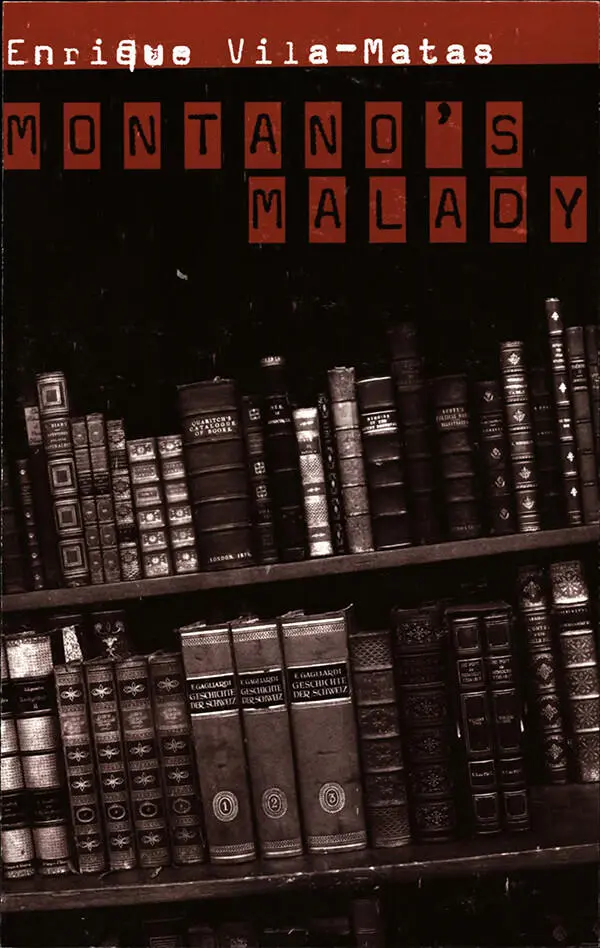
- Название:Montano's Malady
- Автор:
- Издательство:New Directions
- Жанр:
- Год:2007
- ISBN:нет данных
- Рейтинг книги:5 / 5. Голосов: 1
-
Избранное:Добавить в избранное
- Отзывы:
-
Ваша оценка:
Montano's Malady: краткое содержание, описание и аннотация
Предлагаем к чтению аннотацию, описание, краткое содержание или предисловие (зависит от того, что написал сам автор книги «Montano's Malady»). Если вы не нашли необходимую информацию о книге — напишите в комментариях, мы постараемся отыскать её.
is a writer named Jose who is so obsessed with literature that he finds it impossible to distinguish between real life and fictional reality. Part picaresque novel, part intimate diary, part memoir and philosophical musings, Enrique Vila-Matas has created a labyrinth in which writers as various as Cervantes, Sterne, Kafka, Musil, Bolano, Coetzee, and Sebald cross endlessly surprising paths. Trying to piece together his life of loss and pain, Jose leads the reader on an unsettling journey from European cities such as Nantes, Barcelona, Lisbon, Prague and Budapest to the Azores and the Chilean port of Valparaiso. Exquisitely witty and erudite, it confirms the opinion of Bernardo Axtaga that Vila-Matas is "the most important living Spanish writer."
Montano's Malady — читать онлайн бесплатно полную книгу (весь текст) целиком
Ниже представлен текст книги, разбитый по страницам. Система сохранения места последней прочитанной страницы, позволяет с удобством читать онлайн бесплатно книгу «Montano's Malady», без необходимости каждый раз заново искать на чём Вы остановились. Поставьте закладку, и сможете в любой момент перейти на страницу, на которой закончили чтение.
Интервал:
Закладка:
I am doing something similar here, in this dictionary, resounding fortissimo with one of the great themes of existentialism: the creation of one’s self.
“But,” the reader might say, “you’ve been trying for some time now to be sincere, to give reliable information about your life.”
And it’s true, in many pages of this dictionary I have been kneeling before the altar of Truthfulness and offering an amount of reliable information about my life, about how I composed the fictional Montano’s Malady , I have opened a parenthesis here with great pleasure, and I have done so in the form of a timid autobiography, but it’s also true that, by the time I reach Monsieur Teste and Paul Valéry, the final entries planned for this dictionary of writers of private journals, I intend to enter a space bordering fiction and reality, possibly as a way of letting off steam after having been so veracious, after having told truths — for now, I shall carry on doing so — about my fragmented life, very truthful truths, recounted as if I didn’t know that the truth is also invented, as Antonio Machado said.
GOMBROWICZ, WITOLD (Małoszyce, 1904–Vence, 1969). At the end of the twentieth century, Rosa and I went to Valparaiso to think about explosions. It isn’t that we had agreed beforehand on something so extravagant as traveling to a distant place just to think about something so alien to us as explosions. No, in reality we went to Valparaiso just to celebrate the end of the century, but what happened was that, once we were on the hanging terrace of the Brighton Hotel, watching the fireworks launched from ships anchored in the bay, neither Rosa nor I could stop thinking about something normally so far from our minds as blessed explosions. So much so, that Valparaiso will always be linked in our minds with explosions and the names of six Chilean friends: Paula and Roberto Brodsky, Andrés, Rodrigo, Carolina, and Gonzalo. With all of them we spent the restless night of December 30, in a house facing the Pacific, in Tunquén, and the following day, with the idea of celebrating the end of the century, we made the long drive to the Brighton in Valparaiso, where we had booked all six rooms in this small hotel equipped with a truly unforgettable terrace, a terrace with a wonderful view of the city and bay, a space that today, with the perspective afforded by memory, strikes me as one of the central places in my life.
In Tunquén, the night before, we had been chatting and drinking until the early hours of the morning, in an ideal atmosphere for me, since our Chilean friends showed — or at least very politely feigned — a certain interest to know episodes and memories from my life: something that does not tend to happen to me in Barcelona, for example, where nobody seems interested in knowing fragments of my life — they behave as if they already knew it — and that may explain why they arrange to meet me in the city’s rowdiest bars and restaurants, they deliberately arrange to meet me in a place where they know that conversations will always be disrupted and nervous. In Tunquén, however, I was listened to with respect, laughter, and attention. Even Rosa seemed to be amused by my recollections and was especially charming when she laughed in the company of the others.
A long, unforgettable evening, with laughter at times punctuating some of my remarks. As, for example, when Carolina — an inspired journalist, a good interviewer in real life — asked me point-blank, almost treacherously, what I should like to be were I not a writer. And, after a brief hesitation, I replied that I should like to be a psychiatrist specializing in dissociative post-traumatic stress and disorders, and a member of the International Society for the Study of Dissociation. (Response followed by prolonged laughter.)
I have never recalled so many things out loud as I did that night in Tunquén. I recalled, for example, the time in the 1970s when I lived between Paris and Berlin and considered myself to be a radical leftist and undergrounder and was friends with people like Ingrid Caven, Paloma Picasso, and Ulrike Meinhof (before she became a terrorist). And I recalled how in those days it seemed that my destiny — like that of many of my peers — would be loneliness, drugs, violence, or suicide. I remembered my mother, so fragile and strange, a secret poet, resembling Alejandra Pizarnik, permanently halfway between barbiturates and (the as yet unnamed) Montano’s malady. I remembered how my generation wanted to change the world, though said perhaps it was far better that our dreams never came true. I recalled the day I discovered that writing is like walking in the library of life. I recalled the day I discovered Cernuda and he made me literature-sick: “Light is the part of life / that like gods poets rescue.” I remembered how I used to sell apartments with my father on the Costa Brava. I remembered a trip to Warsaw, when I was twenty-five, a trip from Paris made exclusively to have dinner with Sergio Pitol. And finally I recalled how two days previously, on the airplane bringing Rosa and me to Chile, I had dreamed that I was married to the Canadian filmmaker Julia Rosenberg and how by chance, hours after that dream, I had learned that Rosenberg was married to a writer, the New Yorker Jonathan Lethem, who — and this was the strangest part — looked a lot like me when I was young, as I suddenly discovered in a photograph I came across completely by chance in one of the inflight magazines; he looked like the young man who had walked in Paris and Berlin in the 1970s, he looked like me before I began to resemble the elegant but vampiric Christopher Lee: a slightly tragic and regrettable destiny, but, when it comes to it, no harder than any other.
The evening was a little spoiled at the end, when Gombrowicz’s name was mentioned and our Chilean friends, wanting to see how I reacted when I got angry, piqued me by suggesting in a snide and persistent way, using the most varied arguments, that on more than one occasion I had copied the Polish writer.
There the night came to an end.
I slept little and badly. I dreamed that Julia Rosenberg was dancing with an iguana on a beach on the Pacific full of old people talking constantly about funereal themes, about how in their time it was customary for all the mirrors in the house of the deceased to be covered over with silk crêpe as a sign of mourning.
The following morning, none of us having rested very much, we began the long and tortuous journey — owing to the general hangover — to the Brighton, where we arrived at about half-past one in the afternoon and where the first thing Rosa and I were able to confirm was that the hotel’s famous hanging terrace was as spectacular as the Brodskys had told us.
The hotel was occupied by us, but the terrace at that time seemed to belong to the entire city of Valparaiso, there wasn’t room for another soul. What I saw as soon as I stepped onto it, I put down to the hangover: beneath a sunshade, an old and very ugly man, with horrible, grandiose ears and shaved head, appeared to be absorbed in reading Pornografia , a book by Gombrowicz.
As the Brodskys had told me that we were due to meet a friend of theirs who had been unable to come to Tunquén, I thought that this horrible, vampiric old man could be the person they planned to introduce to me. Separating from the group and spontaneously taking the initiative, as if drawn by the brotherly call of Nosferatu’s blood, I approached the old man and jokingly asked how much the Brodskys were paying him to pretend to be reading Gombrowicz.
The look that man directed toward me I would not wish on anyone.
“The Brodskys?” he said. “What on earth are you talking about? Those creatures who, with your lordship, have just stepped on to the terrace? Are they the Brodskys? I have to tell you, sir, those kids must be very good at playing ball.”
Читать дальшеИнтервал:
Закладка:
Похожие книги на «Montano's Malady»
Представляем Вашему вниманию похожие книги на «Montano's Malady» списком для выбора. Мы отобрали схожую по названию и смыслу литературу в надежде предоставить читателям больше вариантов отыскать новые, интересные, ещё непрочитанные произведения.



Обсуждение, отзывы о книге «Montano's Malady» и просто собственные мнения читателей. Оставьте ваши комментарии, напишите, что Вы думаете о произведении, его смысле или главных героях. Укажите что конкретно понравилось, а что нет, и почему Вы так считаете.