Enrique Vila-Matas - Montano's Malady
Здесь есть возможность читать онлайн «Enrique Vila-Matas - Montano's Malady» весь текст электронной книги совершенно бесплатно (целиком полную версию без сокращений). В некоторых случаях можно слушать аудио, скачать через торрент в формате fb2 и присутствует краткое содержание. Год выпуска: 2007, Издательство: New Directions, Жанр: Современная проза, на английском языке. Описание произведения, (предисловие) а так же отзывы посетителей доступны на портале библиотеки ЛибКат.
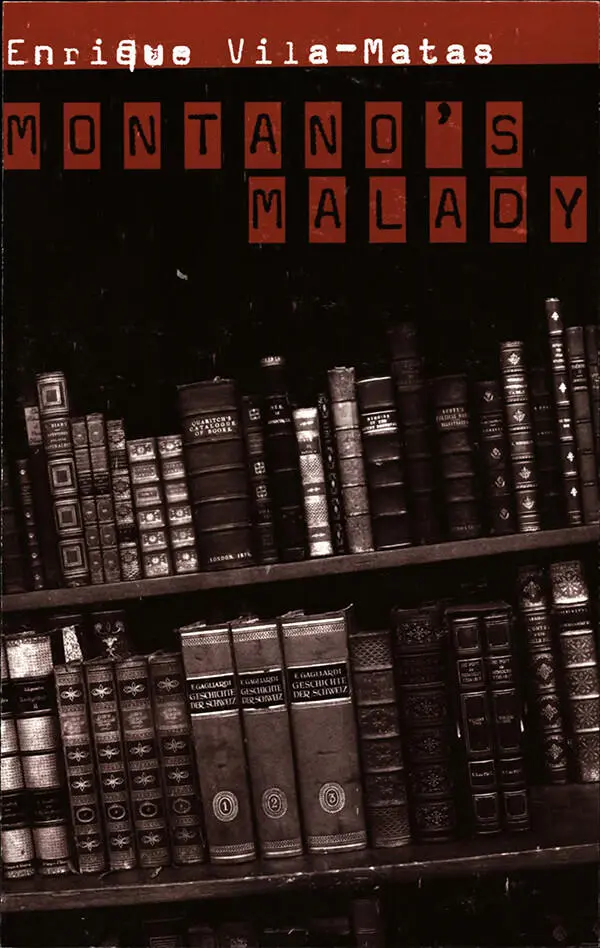
- Название:Montano's Malady
- Автор:
- Издательство:New Directions
- Жанр:
- Год:2007
- ISBN:нет данных
- Рейтинг книги:5 / 5. Голосов: 1
-
Избранное:Добавить в избранное
- Отзывы:
-
Ваша оценка:
Montano's Malady: краткое содержание, описание и аннотация
Предлагаем к чтению аннотацию, описание, краткое содержание или предисловие (зависит от того, что написал сам автор книги «Montano's Malady»). Если вы не нашли необходимую информацию о книге — напишите в комментариях, мы постараемся отыскать её.
is a writer named Jose who is so obsessed with literature that he finds it impossible to distinguish between real life and fictional reality. Part picaresque novel, part intimate diary, part memoir and philosophical musings, Enrique Vila-Matas has created a labyrinth in which writers as various as Cervantes, Sterne, Kafka, Musil, Bolano, Coetzee, and Sebald cross endlessly surprising paths. Trying to piece together his life of loss and pain, Jose leads the reader on an unsettling journey from European cities such as Nantes, Barcelona, Lisbon, Prague and Budapest to the Azores and the Chilean port of Valparaiso. Exquisitely witty and erudite, it confirms the opinion of Bernardo Axtaga that Vila-Matas is "the most important living Spanish writer."
Montano's Malady — читать онлайн бесплатно полную книгу (весь текст) целиком
Ниже представлен текст книги, разбитый по страницам. Система сохранения места последней прочитанной страницы, позволяет с удобством читать онлайн бесплатно книгу «Montano's Malady», без необходимости каждый раз заново искать на чём Вы остановились. Поставьте закладку, и сможете в любой момент перейти на страницу, на которой закончили чтение.
Интервал:
Закладка:
I locked up and sat on the ground, in front of the closed office. I sat on the ground because I didn’t know where to go. After a short while, a respectable couple came by, who were friends with my parents. By way of greeting and a little surprised, they asked me, with no intention of interfering in my life or rebuking me for something, what I was doing there on the ground. “Business is going well,” I told them, “but I cannot talk to the employees, I cannot talk to the customers.” They were a little perplexed. My father had no employees, or, rather, I was his only employee. “Is something the matter?” they asked me. From the ground, I replied with another question: “Where am I going to go?” A slight panic took hold of them, I noticed that they were disturbed. And shortly afterward I discovered that the same thing was happening to these two poor creatures, they didn’t know where to go either. It seemed odd to me that this should happen to them as well, given that they were responsible and respectable adults. But, however odd it may have seemed to me, this was the case. I felt almost panic-stricken seeing them like this, so disoriented, inhibited and directionless, viewing the world with the same surprise with which I viewed it that afternoon. I should have liked to lend them a hand, but I was not the most suitable person to do this, I was not exactly in a fit state to help these adults, these respectable friends of my parents.
Another Kafkaesque episode, an incident that still haunts me now: the memory of the day I turn eighteen and insult my mother when I discover that she has lent my copy of Camus’ The Stranger to the daughter of a friend. “Leave my books alone! They’re all I have.” I say this to her, and also other, more aggressive things, charged with real fury. Without realizing, I am beginning to suffer from Montano’s malady. And then, at night, my parents whispering in bed, in the room next to mine. The enigmatic whisper of their voices. The almost complete certainty that they’re talking about me and about my angry outburst on account of Camus’ book. My ear pressed against the door of their bedroom and my inability to hear a single word, only the terrible, indecipherable murmurings. I think of suddenly opening the door of their room and telling my father, “Hold on to her, grab the flesh that’s next to you, your wife’s flesh is bound to calm you down, stop talking about your son who’s a stranger.” But no, I don’t open the door of my parents’ bedroom. No, I don’t open it.
I should have liked to have three sisters and to talk to them in Yiddish, to talk in a language my parents could not understand. It was not good to be an only child and to confront alone the terror that the manly resonance of my father’s voice and my mother’s weak voice — like the whisper of fallen leaves — caused me. I should have liked to have three sisters, and for the eldest to spend the day lounging on the sofa in my parents’ sitting room and to have shapely, bare, rounded, strong, dark shoulders that I would spy on at every moment, always proud that these shoulders belonged to the family estate. I should have liked my middle sister to walk around the house in an ash-colored corset, the lower part of which would be so far from her body that one could straddle it. I should have liked my youngest sister to be my favorite and to have a tender regard for her madness, I should have liked very much for my youngest sister to remind me of that young descendant of Lord Byron whom I saw one evening in Caffé Florian in Venice, that beautiful, deranged young woman who kept on asking for her ancestor. “Where is my George? What have you done to him?” she would shout out. I don’t know, I should have liked to have three sisters and to talk to them in Yiddish and not to have been the only child I was, a clumsy stranger in my parents’ home.
Sunday
An incredible, sunny spring day on which Rosa is in Turin and I am home alone and decide to lower the blinds and do without the happy, festive day, purely because I have an impression of absolute freedom, that I can do whatever I feel like, and the only thing I really feel like doing is not being too free and shutting myself up in darkness, thinking about Kafka and this dictionary where I try to comment on the world with my favorite diarists and which, if I am not careful, could turn into one of those texts commenting unendingly on the world.
I don’t think anyone is more literature-sick than Kafka. His diary is terrifying. At eight in the morning, he would arrive punctually at his office. He would write documents and reports, make inspections. He worked there, in that crowd of miserable workers and employees, where his superiors did not know him, only because he knew that he should not devote all his time to literature. He was afraid that literature would suck him in, like a whirlpool, causing him to lose his bearings in its limitless expanse. He could not be free, he needed a limitation, to have all the time to write struck him as dangerous, terrible. He would return to his parents’ home at about quarter-past two in the afternoon. He said that he felt like a stranger, although he had great love for his family, parents, and sisters. From time to time it occurred to him that he should move away from his friends and do so without the slightest consideration, become enemies with everyone, talk to no one. Other times, the opposite: he sought out his friends or favorite writers to establish a dialogue and to begin to comment unendingly on the world, as if what he wanted was to reach the source of all writing.
An incredible spring Sunday on which I close the windows and reread The Castle , a novel that cannot end, among other reasons because in it the Surveyor does not travel from one place to another, but from one interpretation to another, from one commentary to another. The Surveyor pauses at every bend in the imaginary road and comments on everything. One has the impression that he writes in order to reach the source of all writing, and in the meantime — in a series of commentaries that become endless — he comments on the world. He seems always to be searching for the first person to name something, for the original source. He strives to find the first to write something, the man who wrote the first word or phrase. But, for this, he must take on three thousand years of writing. Unlike Don Quixote , Kafka’s novel is not explicitly about books — K. is a surveyor, not a reader or writer — and so does not suffer from Montano’s malady or pose problems relating to writing; it carries those problems in its own structure as a novel, given that essentially K.’s pilgrimage does not involve changing places, but going from one exegesis to another, from one commentator to another, listening to each one of them with avid interest and then participating and arguing with everybody, following a method of thorough examination.
As Justo Navarro told me one day, The Castle is the torment of an unending commentary. I think of this statement and tell myself that no doubt it is also the journey of someone searching for the first word, the original word, the source of all writing.
“I know, there need to be two of us.”
“But why two? Why two words to say the same thing?”
“Because it’s always the other who says it.”
I wish to free myself from Montano’s malady, but hopefully the gods and Kafka won’t let me. I wish to free myself from the malady, and that is why I write obsessively about it. However, I know that, were I to achieve this, I could not comment on my achievement, I could not write about it, because, if I did, this would show — since, directly or indirectly, I would have to name the malady to say that I had forgotten it — that I was still thinking about it in some way. This would obviously be as bad as having the malady itself and would end up giving me the impression that my progress toward death and my progress toward the word were one and the same. I wish to free myself from Montano’s malady, but, should this diary ever reach its final hour and I overcome the illness and my salvation be a possibility, I’m not at all sure that it really will be, I think it will be something I need to comment on. This confirms my suspicion that these pages could go on forever; I don’t know if it is desirable either that they do so or that they come to an end. This is how things stand and, living as much with dread of this diary’s infinite movement as with fear of its death, one calms down on this spring night and even rejoices to see that, although one is writing obsessively about it, one is fortunately still Montano-stricken.
Читать дальшеИнтервал:
Закладка:
Похожие книги на «Montano's Malady»
Представляем Вашему вниманию похожие книги на «Montano's Malady» списком для выбора. Мы отобрали схожую по названию и смыслу литературу в надежде предоставить читателям больше вариантов отыскать новые, интересные, ещё непрочитанные произведения.





Обсуждение, отзывы о книге «Montano's Malady» и просто собственные мнения читателей. Оставьте ваши комментарии, напишите, что Вы думаете о произведении, его смысле или главных героях. Укажите что конкретно понравилось, а что нет, и почему Вы так считаете.