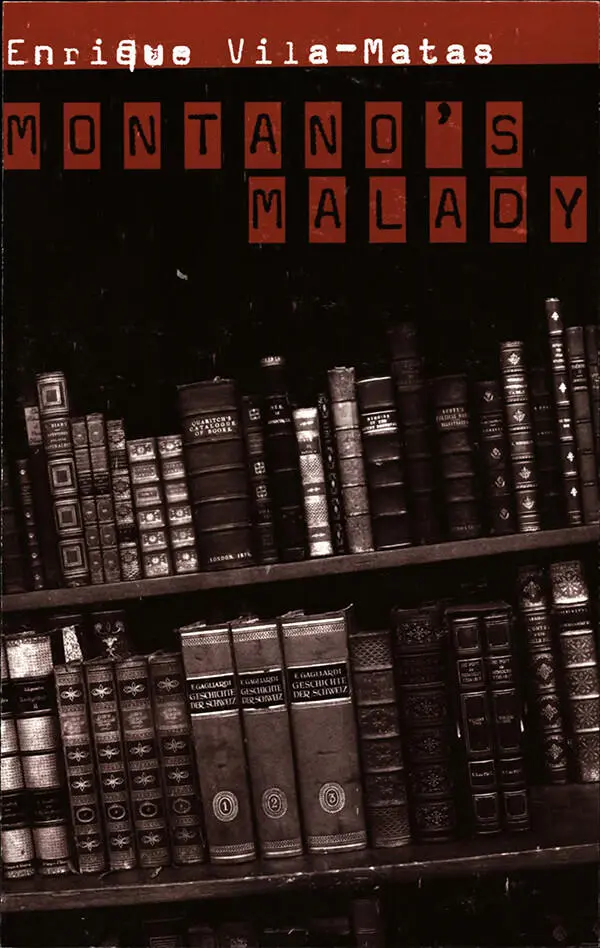
Enrique Vila-Matas - Montano's Malady
Здесь есть возможность читать онлайн «Enrique Vila-Matas - Montano's Malady» весь текст электронной книги совершенно бесплатно (целиком полную версию без сокращений). В некоторых случаях можно слушать аудио, скачать через торрент в формате fb2 и присутствует краткое содержание. Год выпуска: 2007, Издательство: New Directions, Жанр: Современная проза, на английском языке. Описание произведения, (предисловие) а так же отзывы посетителей доступны на портале библиотеки ЛибКат.
- Название:Montano's Malady
- Автор:
- Издательство:New Directions
- Жанр:
- Год:2007
- ISBN:нет данных
- Рейтинг книги:5 / 5. Голосов: 1
-
Избранное:Добавить в избранное
- Отзывы:
-
Ваша оценка:
Montano's Malady: краткое содержание, описание и аннотация
Предлагаем к чтению аннотацию, описание, краткое содержание или предисловие (зависит от того, что написал сам автор книги «Montano's Malady»). Если вы не нашли необходимую информацию о книге — напишите в комментариях, мы постараемся отыскать её.
is a writer named Jose who is so obsessed with literature that he finds it impossible to distinguish between real life and fictional reality. Part picaresque novel, part intimate diary, part memoir and philosophical musings, Enrique Vila-Matas has created a labyrinth in which writers as various as Cervantes, Sterne, Kafka, Musil, Bolano, Coetzee, and Sebald cross endlessly surprising paths. Trying to piece together his life of loss and pain, Jose leads the reader on an unsettling journey from European cities such as Nantes, Barcelona, Lisbon, Prague and Budapest to the Azores and the Chilean port of Valparaiso. Exquisitely witty and erudite, it confirms the opinion of Bernardo Axtaga that Vila-Matas is "the most important living Spanish writer."
Montano's Malady — читать онлайн бесплатно полную книгу (весь текст) целиком
Ниже представлен текст книги, разбитый по страницам. Система сохранения места последней прочитанной страницы, позволяет с удобством читать онлайн бесплатно книгу «Montano's Malady», без необходимости каждый раз заново искать на чём Вы остановились. Поставьте закладку, и сможете в любой момент перейти на страницу, на которой закончили чтение.
Интервал:
Закладка:
MANSFIELD, KATHERINE (Wellington, 1888–Fontainebleau, 1923). We had left the vampiric Tongoy in Valparaiso welcoming me to the Brighton’s terrace; we had left him there after that strange exchange of greetings by ear, which was the start of our friendship. Hours later, that night of the end of the year and the century, endless drinking bout, joyful explosions. At midday on January 1, I again saw Tongoy on the Brighton’s terrace. “How odd he is,” said Rosa. We went toward where he was seated in a corner of the terrace, looking like he had an almighty hangover. It wouldn’t be long now before our man seriously martyred a fly.
We were making friendly remarks about the awful hangover face or mask he was wearing when he suddenly noticed that a fly had fallen into his dry martini and was trying weakly, but desperately, to climb out again. He gave us a frightful look and smiled, baring his fangs in all their splendor. After that he took a teaspoon and elegantly removed the fly from the glass and plopped it on to a paper napkin. A delicate gesture from the monster. The fly soon began to shake its front legs and, raising its tiny, soaked body, it undertook the heroic and moving task of cleaning the dry martini from its wings. Little by little, the fly began to recover and return to life. Tongoy did not stop looking at it. “It’s your good deed for the day,” Rosa said to him. Then Tongoy saw that the fly was about to take off again and he seemed not to like this. Using the teaspoon, he soaked it again in his dry martini. Three times he did this, until he killed it. “It was brave,” he said to us, “but I’m hungover and I’m not in the mood to spare anyone’s life.”
If he wanted to impress us, he had managed to do so, not a lot, but to a degree he had managed it. We remained in silence for a while. I don’t know what Rosa was thinking, I was thinking about Marguerite Duras. I was telling myself that, should Tongoy happen to remark that the fly had died at twenty minutes past twelve, he would be repeating some inspired words by Marguerite Duras, who, in a passage from her book Ecrire , explains how she was moved by a fly’s death throes in her garden at Neauphle-le-Château and how the exact time at which the fly had left this world had engraved itself upon her memory.
But Tongoy was not Marguerite Duras. If I had to compare him to a female writer, I would say he had something in common with Katherine Mansfield, Chekhovian storyteller and angst-ridden diarist, author of a story, “The Fly,” in which, with her customary poetic attention to detail and what is fleeting — with the same inspired melancholy that enabled Proust, for example, to describe the glimmer of twilight above the trees in the Bois de Boulogne — she recounted the forays into the dominions of death and return to life again and again of a fly trapped — a kind of literary illness — in a blot of ink.
I don’t think I shall be far off the mark if I say that the fly was Katherine Mansfield herself, who spent half her life fighting against consumption, fighting against death: “The clocks are striking ten […]. I have consumption. There is still a great deal of moisture ( and pain) in my BAD lung. But I do not care. I do not want anything I could not have. Peace, solitude, time to write my books …”
“In Mansfield,” Alan Pauls has written, “sickness is much more than a theme of the journal, it is its only subject matter, its obsession, its favorite prey, and at the same time what gives her writing a rhythm, a cadence, a regularity.”
Sickness was the axis of her tormented life and she spoke obsessively about her illness in the journal, just as the fly murdered by Tongoy — had it possessed the power of speech — could have spoken at great length about its own form of consumption: the moisture of the dry martini.
MAUGHAM, WILLIAM SOMERSET (Paris, 1874–Saint-Jean-Cap-Ferrat, Nice, 1965). This English writer, who was born and died in France, published in 1949 a summary of the fifteen volumes of notes he had taken over more than half a century, a diary — entitled A Writer’s Notebook —which invariably took as its inspiration Jules Renard’s diary, one he regarded as a lesser masterpiece of French literature.
Maugham’s diary has always accompanied me over the years. “I am on the wing” is how it ends, and I have always considered this sentence and applied it to my life.
I share Maugham’s belief that “there is in the heroic courage with which man confronts the irrationality of the world a beauty greater than the beauty of art […]. I find it,” he goes on, “in the cool determination of Captain Oates when he went out to his death in the arctic night rather than be a burden to his comrades. I find it in the loyalty of Helen Vagliano, a woman not very young, not very pretty, not very intelligent, who suffered hellish torture and accepted death, for a country not her own, rather than betray her friends.”
Maugham always reminds me that nobility of spirit exists and this nobility does not come from thought or depend on culture and education. It has its roots in the human being’s most primitive instincts. The refuge against despair is perhaps to be found in the consciousness that the spirit’s salvation is a possibility.
MICHAUX, HENRI (Namur, 1899–Paris, 1984). It’s the end of the year, but it’s not the end of the century, nor are we in Valparaiso with Tongoy, we are with Henri Michaux at sea aboard the Boskoop , which takes him—“severe and reserved the boat,” he tells us in his travel journal — in the direction of Ecuador, final or penultimate day of 1927, I cannot be sure about the date. If private journals have one limitation, it is the calendar. As Blanchot has observed, the journal, so susceptible to the movements of life and capable of every freedom — since dreams, fictions, thoughts, commentaries about oneself, important or insignificant events, everything suits the journal, whatever their order or disorder — the journal is, however, subject to a seemingly trivial, but fearful clause: it must respect the calendar. It’s strange, but this respect for dates — I don’t know if Blanchot thought about it — vanishes at sea, as is evident in Michaux’s travel journal, which right from the beginning is tossed about by the waves: “Let me see, are there thirty or thirty-one days in December? And is it two or three days that we have been at sea? In the non-calendar of the sea? Poor diary!”
This morning, shortly after Rosa left for work, I went looking for Ecuador , I searched for the book in the library in order to reread it before tackling this author’s entry in my timid dictionary. While I was searching for it, perhaps providentially, I came across a short essay by Proust on Flaubert, an essay I had forgotten about, which, after I reread it, ended up influencing the construction of my entry on Michaux, as will now become clear.
Let us start anew.
MICHAUX, HENRI. All his life, Michaux thought of man as a “broken animal” with an unsatisfied hunger for the infinite. His style is always very dry. His style, did I say? All his writing is in fact a hard struggle against it: “Style, the ability to install himself and to install the world, is that what man is? That suspicious acquisition for which the jolly writer is praised? […] Try to get out. See far enough inside yourself for your style not to be able to follow you.”
Michaux’s travels were always really inner, almost armchair, travels, though we see him at sea or in the thick of the Ecuadorean forest. They were really journeys of self-study. In Ecuador we see him board the Boskoop and, although we pass through varied scenery, we soon notice that what most interests us is the traveler himself and that unique way of relating to the environment that leads him to revolutionize the typical travel journal or description of what is seen en route and to turn it into a distressing private journal of anxiety. His language travels inward and is quick as a whip. Sometimes a sentence consists of two bare and solitary words. “Radical introspection,” he writes, for example, or “intravenous connections with the landscape.”
Читать дальшеИнтервал:
Закладка:
Похожие книги на «Montano's Malady»
Представляем Вашему вниманию похожие книги на «Montano's Malady» списком для выбора. Мы отобрали схожую по названию и смыслу литературу в надежде предоставить читателям больше вариантов отыскать новые, интересные, ещё непрочитанные произведения.






Обсуждение, отзывы о книге «Montano's Malady» и просто собственные мнения читателей. Оставьте ваши комментарии, напишите, что Вы думаете о произведении, его смысле или главных героях. Укажите что конкретно понравилось, а что нет, и почему Вы так считаете.