Enrique Vila-Matas - Montano's Malady
Здесь есть возможность читать онлайн «Enrique Vila-Matas - Montano's Malady» весь текст электронной книги совершенно бесплатно (целиком полную версию без сокращений). В некоторых случаях можно слушать аудио, скачать через торрент в формате fb2 и присутствует краткое содержание. Год выпуска: 2007, Издательство: New Directions, Жанр: Современная проза, на английском языке. Описание произведения, (предисловие) а так же отзывы посетителей доступны на портале библиотеки ЛибКат.
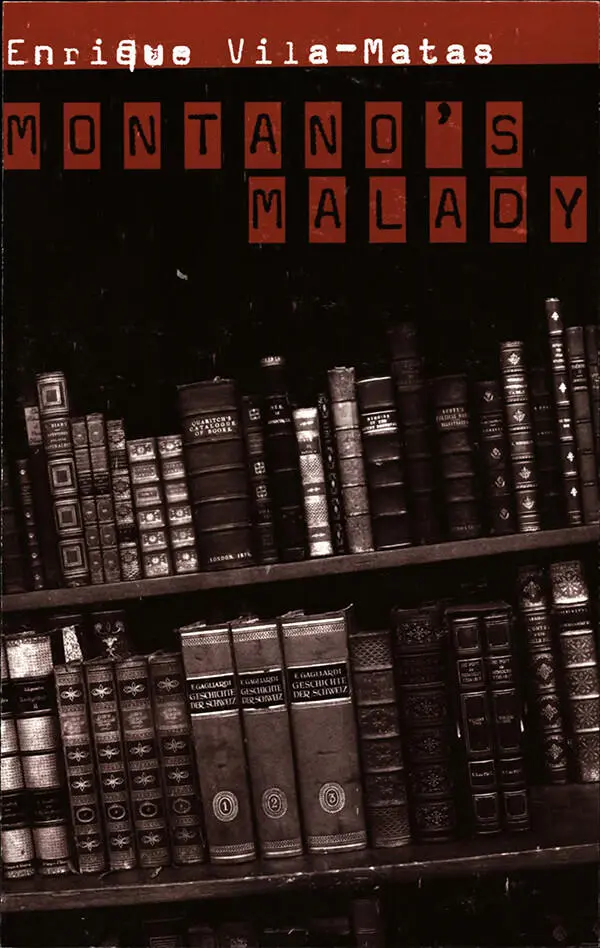
- Название:Montano's Malady
- Автор:
- Издательство:New Directions
- Жанр:
- Год:2007
- ISBN:нет данных
- Рейтинг книги:5 / 5. Голосов: 1
-
Избранное:Добавить в избранное
- Отзывы:
-
Ваша оценка:
Montano's Malady: краткое содержание, описание и аннотация
Предлагаем к чтению аннотацию, описание, краткое содержание или предисловие (зависит от того, что написал сам автор книги «Montano's Malady»). Если вы не нашли необходимую информацию о книге — напишите в комментариях, мы постараемся отыскать её.
is a writer named Jose who is so obsessed with literature that he finds it impossible to distinguish between real life and fictional reality. Part picaresque novel, part intimate diary, part memoir and philosophical musings, Enrique Vila-Matas has created a labyrinth in which writers as various as Cervantes, Sterne, Kafka, Musil, Bolano, Coetzee, and Sebald cross endlessly surprising paths. Trying to piece together his life of loss and pain, Jose leads the reader on an unsettling journey from European cities such as Nantes, Barcelona, Lisbon, Prague and Budapest to the Azores and the Chilean port of Valparaiso. Exquisitely witty and erudite, it confirms the opinion of Bernardo Axtaga that Vila-Matas is "the most important living Spanish writer."
Montano's Malady — читать онлайн бесплатно полную книгу (весь текст) целиком
Ниже представлен текст книги, разбитый по страницам. Система сохранения места последней прочитанной страницы, позволяет с удобством читать онлайн бесплатно книгу «Montano's Malady», без необходимости каждый раз заново искать на чём Вы остановились. Поставьте закладку, и сможете в любой момент перейти на страницу, на которой закончили чтение.
Интервал:
Закладка:
The story of The Rest Home for the Beauty-Sick —the tide of Caiado’s novel has always sounded almost Japanese to me — was the following: an Italian from Verona who considers himself a “hunter of beauty” arrives in Pico intending to find the perfect home in which to live out the rest of his days, but ends up being admitted to a kind of rest home or spa where a series of unusual travelers live, “all of whom are beauty-sick.”
It goes without saying that this story unsettled me, since I suspected that beauty-sick might simply mean “literature-sick,” and I found the idea of a spa to treat the literature-sick repulsive. I did not wish to run the risk and continue reading this novel. Tongoy sided with me (for different reasons) and likewise refused to read the book. He also refused to visit the aforementioned Caiado on the island of Pico. Tongoy is not without a sense of humor, and his fears were directly contrary to mine, he was simply afraid of not finding himself in the pages of this book.
The day the three of us traveled on the ferry from Fayal to Pico, there was a stiff breeze, which did not take us back in Proustian fashion to any strange country, but did threaten to land us on our backs on the deck of the boat. Rosa was in a happy mood, perhaps because she was convinced that it was a great adventure to go in search of the “hidden writer” of the island of Pico. The sea spray dashed against her face and Rosa was prettier than ever, I’ve never seen her looking so good, though I was silently conspiring against her, planning the way to avoid having to visit Caiado’s house or refuge. With her stunning appearance, Rosa looked wonderful, standing quietly, with the sea spray in her face. “Ocean,” writes Michaux, “what a beautiful toy they would make of you, if only your surface were able to support a man, as is often indicated by your stunning appearance, your solid plate. They would walk on you. On stormy days, in amazement they would descend your dizzy slopes.”
Rosa looked happy in the middle of the ocean, the wind stirred her hair at high speed and then left just as quickly. I looked at her in delight. But all of a sudden I had a strange sensation and I still do not know if it was due to the stark contrast between beauty and the beast, between her appearance and Tongoy’s somber, vampiric face. The fact is that suddenly, despite the wind and the ocean’s extreme mobility, it seemed as if Rosa and the seascape had turned into a dead photograph, a painfully frozen scene, on pause, lacking in nature and life. Weird and dreadful sensation. The sensation that everything was dead, including Rosa, Tongoy, and me. Today I tell myself, on remembering that sensation and the appallingly bad weather in the channel connecting Fayal and Pico, that some words by Michaux would have gone down very well and even helped me at that odd moment: “By dint of pains, of vain ascents, by dint of being rejected from the outside, from the outsides I had promised myself I would attain, by dint of rolling down from almost everywhere, I have carved out a deep channel in my life.”
Hence it might be said that the deathly vision of the ocean, the sudden absence of life and nature on the sea that day, carved out a deep channel, without life or a way out, in my insides. Add to this the realization that Tongoy was also aware of the deathly panorama and mysteriously asked me, “Will there not be another death in paradise?” And add on top of this the sense of unease caused by the island of Pico as the ferry approached. There was barely a soul in sight when we disembarked in Madalena’s ghostly harbor. The town was deserted and a vast silence hung over it, broken only by the gusts of wind and by the birds. I felt uneasy and anxious; it was as if I had traveled to Comala, the town in Pedro Páramo by Juan Rulfo, that town where everyone is dead.
Sad and solitary Madalena. To escape my anxiety, I asked Tongoy what we were doing there. “Visiting Antonio Caiado,” Rosa interposed. You’d think she’d have said, “I came to Pico because I was told a mysterious writer lived here.” We watched the four passengers traveling with us disembark from the ferry, they got off the boat with their bags and baskets, in grave silence. In a few seconds they disappeared like ghosts down the streets of Madalena, and that was the last we saw of them. “One visits Pico for the experience,” Tongoy remarked. We went for a wander in the town, but didn’t find or see anybody and, on returning to the pier, we found an old taxi driver in a run-down car, parked opposite the small town hall. He was clearly waiting for us, no doubt he had been warned from Fayal of the arrival of three tourists. “Where is everybody?” we asked him. “It’s Carnival, a holiday,” he answered. We hired him for a tour of the island, to drive down the road connecting Madalena and Lajes, the only road in Pico. Rosa asked about Caiado and the taxi driver, after a few moments’ hesitation, told us that he lived in a house on a small hill on the road to Lajes, but was never there; it was said on the island that he really lived in New York. “We won’t lose anything if we look to see if he’s there,” said Tongoy and, although I protested that it was a waste of time — perhaps because I felt jealous of the mysterious writer — it was decided, two against one, to visit Caiado. I didn’t forgive Tongoy his vote, I recall that I stared at him in anger and thought that he looked awful, more frightful than ever. But I later realized — while we were driving down the gloomy Lajes road — that by his presence Tongoy gave me a strange sense of security. Perhaps the kind of serenity he passed on to me was one of the reasons I had instinctively sought his friendship back on the terrace in Valparaiso. Tongoy possessed a monster’s warmth. “Very quickly,” writes Michaux, “it became obvious (from my teenage years) that I had been born to live among monsters.”
The only road on the island of Pico is — as I already described it in Montano’s Malady without adding a single drop of fiction — a narrow road that runs along the breakwater, with many curves and deep potholes, over and against a rebellious and very blue Atlantic Ocean. The road, which was once covered in vineyards and luxurious villas crosses a stony and melancholic landscape with occasional, isolated houses on small hills swept by the wind. In one of these houses on the hills, the taxi driver had fallen in love, and he told us about it. In another of these houses lived Caiado. When we parked a few yards from the mysterious writer’s house, because of the strong wind buffeting even the taxi, Tongoy refused to get out. “You go,” said Tongoy, “but I can tell you now that there’s no one in that house.” No doubt he was absolutely right. The house on the hill battered by the wind seemed firmly closed. In an act almost of courage, defying the strong wind in that region, Rosa and I abandoned the taxi and climbed the short slope, in constant danger of losing our balance, until we reached the front door.
I knocked at the door and it was like knocking at the door of lost time. We knocked three times, and the only answer we got was the fierce noise of the wind raging at the two pitiful trees that stood on top of the hill. On returning to the taxi, I thought that lost time doesn’t really exist, but what does exist — I told myself — is an empty, doomed house.
That night, back in Fayal, we went to Café Sport and drank gin with the old whalers and people from the yachts, all that bizarre set who cross the Atlantic in winter and turn up at Café Sport and chat to the whalers in a fascinating exchange of adventures. With the aid of alcohol, I began to imagine that a character by the name of Teixeira lived in that empty, doomed house on Pico’s small hill and taught laughter therapy, a copy of “the new man,” the man to come, that inhuman man who is about to arrive in the world, if he hasn’t already. I imagined him living in the house on the hill, facing the sea, his house secretly connected, by underground galleries, with a world of moles and enemies of the literary inhabiting the inside of the volcano.
Читать дальшеИнтервал:
Закладка:
Похожие книги на «Montano's Malady»
Представляем Вашему вниманию похожие книги на «Montano's Malady» списком для выбора. Мы отобрали схожую по названию и смыслу литературу в надежде предоставить читателям больше вариантов отыскать новые, интересные, ещё непрочитанные произведения.







Обсуждение, отзывы о книге «Montano's Malady» и просто собственные мнения читателей. Оставьте ваши комментарии, напишите, что Вы думаете о произведении, его смысле или главных героях. Укажите что конкретно понравилось, а что нет, и почему Вы так считаете.