Enrique Vila-Matas - Montano's Malady
Здесь есть возможность читать онлайн «Enrique Vila-Matas - Montano's Malady» весь текст электронной книги совершенно бесплатно (целиком полную версию без сокращений). В некоторых случаях можно слушать аудио, скачать через торрент в формате fb2 и присутствует краткое содержание. Год выпуска: 2007, Издательство: New Directions, Жанр: Современная проза, на английском языке. Описание произведения, (предисловие) а так же отзывы посетителей доступны на портале библиотеки ЛибКат.
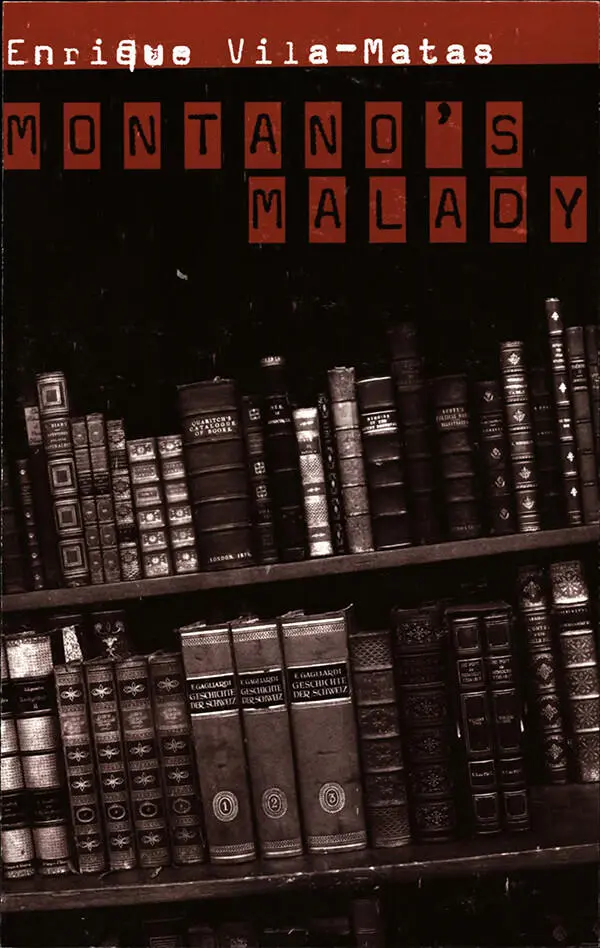
- Название:Montano's Malady
- Автор:
- Издательство:New Directions
- Жанр:
- Год:2007
- ISBN:нет данных
- Рейтинг книги:5 / 5. Голосов: 1
-
Избранное:Добавить в избранное
- Отзывы:
-
Ваша оценка:
Montano's Malady: краткое содержание, описание и аннотация
Предлагаем к чтению аннотацию, описание, краткое содержание или предисловие (зависит от того, что написал сам автор книги «Montano's Malady»). Если вы не нашли необходимую информацию о книге — напишите в комментариях, мы постараемся отыскать её.
is a writer named Jose who is so obsessed with literature that he finds it impossible to distinguish between real life and fictional reality. Part picaresque novel, part intimate diary, part memoir and philosophical musings, Enrique Vila-Matas has created a labyrinth in which writers as various as Cervantes, Sterne, Kafka, Musil, Bolano, Coetzee, and Sebald cross endlessly surprising paths. Trying to piece together his life of loss and pain, Jose leads the reader on an unsettling journey from European cities such as Nantes, Barcelona, Lisbon, Prague and Budapest to the Azores and the Chilean port of Valparaiso. Exquisitely witty and erudite, it confirms the opinion of Bernardo Axtaga that Vila-Matas is "the most important living Spanish writer."
Montano's Malady — читать онлайн бесплатно полную книгу (весь текст) целиком
Ниже представлен текст книги, разбитый по страницам. Система сохранения места последней прочитанной страницы, позволяет с удобством читать онлайн бесплатно книгу «Montano's Malady», без необходимости каждый раз заново искать на чём Вы остановились. Поставьте закладку, и сможете в любой момент перейти на страницу, на которой закончили чтение.
Интервал:
Закладка:
I traveled to this city to be in Terreiro do Paço and contemplate in vain. And now I’m here, thinking about Herminio, on the riverbank, watching the seagulls furiously spread their wings between the Tagus and me, until the animal curtain disperses and I again see the city, the Tagus, and everything, I again see everything, including my friend who disappeared in this climate that is suddenly moderate, perhaps it is a dream. I am in Terreiro do Paço; I stopped writing this dictionary in the middle of Pessoa’s entry, I stopped it in order to travel to Lisbon and so live, on my own boundary, inside this diary. I couldn’t write about Lisbon and Pessoa while still in my study, while still in my dictionary.
I am in Terreiro do Paço, thinking about my friend who disappeared. I have spent the day smoking. Slight, very slight, a breeze goes by. I am in a café next to the quay where the ferries berth, next to a large window that separates me from the river. For JOSÉ CARDOSO PIRES, there was no better place than the one I’m seated in: boats arriving, boats leaving, people coming and going, getting drinks at the bar, and me seated higher up the Tagus.
In this place, in this Café Atinel, Lisbon the city ends, and so does a book called Lisbon and subtitled Logbook , written by CARDOSO PIRES, JOSÉ (Peso, Ria Baixa, 1925–Lisbon, 1998), another writer of diaries — in this case, a logbook — who helps me construct my identity in this dictionary.
While Lisbon is a guide to this city — according to Melville, almost all literature, in a sense, is based on guidebooks — it is also a logbook, an urban one; its author journeys through a Lisbon that he sees literally perched on the Tagus, that he sees as a vessel, as a sailing city.
In this Café Atinel is the world’s end, finis terrae , here ends Lisbon and so does the book, the diary by Cardoso Pires, who had an unerring eye according to his good friend Antonio Tabucchi: “One look and it had absorbed everything.” Since I am now at the same table where Cardoso — Zé to his friends — finishes his book, the city is at my back. The Baixa, the Chiado, the crowds, Europe, everything has been left behind. “And don’t tell me,” writes Zé, “that it isn’t wonderful to be like this, at a table, by the water.” Tomorrow I shall go back to Barcelona and to the dictionary written in my study and not to the table of a port café. I shall go back and again wonder how to disappear, how to dissolve in this diary. Tomorrow, I shall go back to the dictionary and a cold hand, I’m sure, will continue to squeeze Pessoa’s throat, preventing him from breathing life. Tomorrow I shall go back, but I’m here now and I let myself be carried along by Zé’s look and see out Soares’ window. I feel anchored, with my unerring eye on loan, in this Lisbon that will see me off tomorrow. I am a look that absorbs everything, I am that look that seems real.
SOMETHING SPARKLES THROUGH THE WORN FABRIC
A sudden silence descended on a place as rowdy as this, and I felt that even the invisible beings were hiding. Mystery at dusk. Then the din of people from the ferries returned. Nightfall, which seemed to have abruptly frozen, has now gathered strength. I am still in Lisbon’s Café Atinel, thinking about Herminio, my disappeared friend. I am still here by the Tagus, at my table by the river, at my waterside table. The Baixa, the Chiado, the crowds, Europe, everything has been left behind, at my back. I am at the world’s end, free of time like a dead man. A seagull goes by and I follow it, and I am reminded of certain remarks made by W. G. Sebald on mystery and the impact of eccentricity on his own fantastic genre, certain remarks also about supposed coincidences and chances that might not be so, were we to possess better means of perception, were it not because, centuries ago, we became mentally very limited after shots were heard in paradise: “I prefer to write about fairly eccentric people, and eccentricity is somewhat fantastical. These things happen to us as well. For example, recently I visited a museum in London to see two paintings. There was a couple behind me who I think were speaking Polish. A very strange-looking man and woman, they seemed from another age. Later, in the afternoon, I had to go to the Tube station farthest from the center of London, a city of fifteen million inhabitants. There was nobody. Except these two from the museum. There they were.”
Sebald is a great reader of Borges, whom he always praises for understanding early on what a mistake it was to expel metaphysics from philosophy. Because in fact, Sebald claims, there are things we cannot easily explain away, and because it is part of our human condition — before more than now — to maintain a certain relation, not just social, with those who came before us. The commemoration of the dead is something that distinguishes us from the animals.
I am a covert and assiduous reader of Sebald, of his long walks à la Robert Walser, of his exploration of the world of the dead, of his fantastical forays into the space of eccentrics. Referring to the strange case of the Poles in the faraway station, Sebald said, “These are not coincidences, somewhere there is a relation that from time to time sparkles through a worn fabric.”
Here I am in Café Atinel, at dusk, next to the ferry passengers, working away on this dictionary of writers of private journals in an attempt to relate it to Montano’s Malady , to mend the worn fabric of relations between the two different texts, for something to sparkle again and remind us that there was once a young and perfect fabric, with a serene thread and logical language in which coincidences had no meaning because everything was cleanly coincidental.
Another seagull goes by and this time I do not follow it, I stay inside Sebald’s world, which reminds me of another coincidence, also possibly not at all coincidental, which stopped me in my tracks in February this year on the island of Fayal, the night we ended up leaving Café Sport and piling out on to the street, having toasted the dead of the islands, that legend that says the souls take refuge in the farthest reaches of the wells and courtyards and their voice is the song of crickets. Sebald would have enjoyed this legend from the Azores. I continue his walks in the world of ruins, of what is dead. I continue his contact with a stimulating tendency of the contemporary novel, a tendency that opens new ground between essay, fiction, and autobiography: the road traveled by works such as Claudio Magris’ Danube or Sergio Pitol’s El arte de la fuga .
That night in Fayal, as we staggered drunkenly beside the sea, back to the Hostal de la Santa Cruz, it suddenly occurred to me — slave that I was, in part, to the plot I was devising for Montano’s Malady —to turn into the complete memory of the history of literature, for me to be literature, to embody it in my own modest person, so that I could try to save it from extinction, to defend it against Pico’s moles. This meant really embodying it in the fictional Montano’s Malady that I was writing and needed to move forward. At no point — I don’t have so much of Quixote’s soul — did I think to turn into this complete memory of literature in real life, it was only an idea for the fiction I was writing, which evolved alongside my life and travels, my private journal. But the truth is that neither Tongoy nor Rosa understood me when I expounded my idea to them. They failed to comprehend what I had just told them and, what’s more, however drunk they may have been, they reacted terribly. They revealed their complete lack of interest in the subjects that concerned me.
When I told them that I was going to embody literature, that this was my idea to move the story I was writing forward, Tongoy abruptly brought his zigzag steps to a halt. Rosa proceeded to do the same. I don’t think the fact they were very drunk is an excuse. The truth of the matter is that they didn’t care what happened to literature. They also bore me a grudge and seemed to have been waiting for the right moment to rebuke me. Tongoy stared at me the way you stare at someone you cannot bear for another second. “Go fuck yourself,” he told me. I was very taken aback, although to be fair I have to say that his comment proved useful to me, it handed me the ending of Montano’s Malady on a plate. But at the time I was taken aback, astonished, unable to comprehend why he looked at me with such hatred. “You see everything in literature,” Rosa upbraided me, “I’m not surprised you actually want to merge with it.” Then Tongoy, laughing at me: “Our Quixote in the Azores, man you’re a bore.” Tongoy said this with an atrocious look of rage. I returned the look with hatred and contempt. There he was, Fellini’s great actor, completely drunk, in his ridiculous sea dog’s outfit, nocturnal Nosferatu with a touch of dragonfly. “You look like a whaler,” I told him. “All you need now is a harpoon.” “I don’t care what you say,” replied Tongoy, sharing another conspiratorial look with Rosa, the two seemed increasingly in cahoots, clearly they had just been talking about me, criticizing me. “It doesn’t matter, the fact is you don’t stop seeing everything in literature, it’s impossible to talk to you about anything else,” said Rosa. “All we needed,” added Tongoy, “was for you to want to turn into the history of literature, that really is the final straw.” “You’ve become a book,” appended Rosa.
Читать дальшеИнтервал:
Закладка:
Похожие книги на «Montano's Malady»
Представляем Вашему вниманию похожие книги на «Montano's Malady» списком для выбора. Мы отобрали схожую по названию и смыслу литературу в надежде предоставить читателям больше вариантов отыскать новые, интересные, ещё непрочитанные произведения.





Обсуждение, отзывы о книге «Montano's Malady» и просто собственные мнения читателей. Оставьте ваши комментарии, напишите, что Вы думаете о произведении, его смысле или главных героях. Укажите что конкретно понравилось, а что нет, и почему Вы так считаете.