Enrique Vila-Matas - Montano's Malady
Здесь есть возможность читать онлайн «Enrique Vila-Matas - Montano's Malady» весь текст электронной книги совершенно бесплатно (целиком полную версию без сокращений). В некоторых случаях можно слушать аудио, скачать через торрент в формате fb2 и присутствует краткое содержание. Год выпуска: 2007, Издательство: New Directions, Жанр: Современная проза, на английском языке. Описание произведения, (предисловие) а так же отзывы посетителей доступны на портале библиотеки ЛибКат.
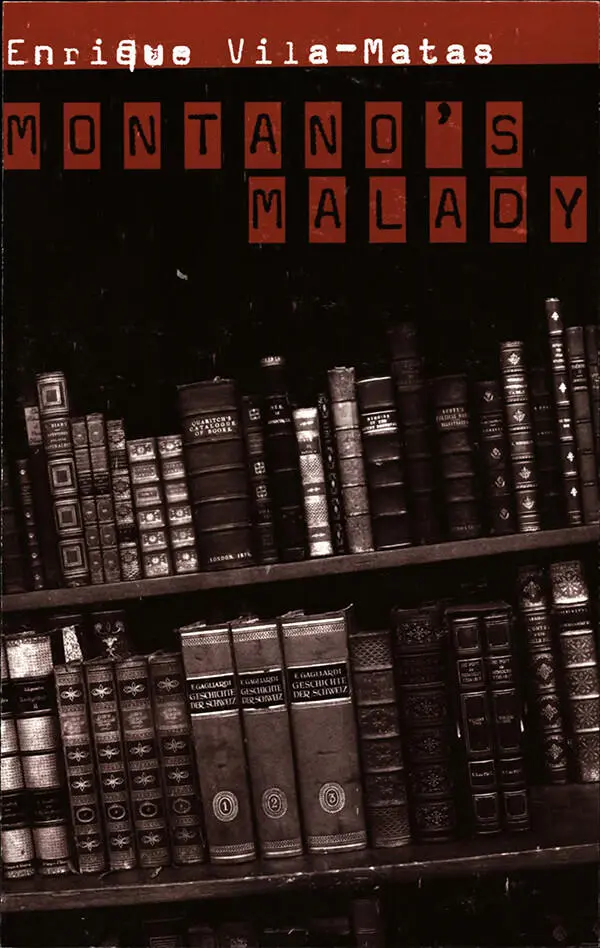
- Название:Montano's Malady
- Автор:
- Издательство:New Directions
- Жанр:
- Год:2007
- ISBN:нет данных
- Рейтинг книги:5 / 5. Голосов: 1
-
Избранное:Добавить в избранное
- Отзывы:
-
Ваша оценка:
Montano's Malady: краткое содержание, описание и аннотация
Предлагаем к чтению аннотацию, описание, краткое содержание или предисловие (зависит от того, что написал сам автор книги «Montano's Malady»). Если вы не нашли необходимую информацию о книге — напишите в комментариях, мы постараемся отыскать её.
is a writer named Jose who is so obsessed with literature that he finds it impossible to distinguish between real life and fictional reality. Part picaresque novel, part intimate diary, part memoir and philosophical musings, Enrique Vila-Matas has created a labyrinth in which writers as various as Cervantes, Sterne, Kafka, Musil, Bolano, Coetzee, and Sebald cross endlessly surprising paths. Trying to piece together his life of loss and pain, Jose leads the reader on an unsettling journey from European cities such as Nantes, Barcelona, Lisbon, Prague and Budapest to the Azores and the Chilean port of Valparaiso. Exquisitely witty and erudite, it confirms the opinion of Bernardo Axtaga that Vila-Matas is "the most important living Spanish writer."
Montano's Malady — читать онлайн бесплатно полную книгу (весь текст) целиком
Ниже представлен текст книги, разбитый по страницам. Система сохранения места последней прочитанной страницы, позволяет с удобством читать онлайн бесплатно книгу «Montano's Malady», без необходимости каждый раз заново искать на чём Вы остановились. Поставьте закладку, и сможете в любой момент перейти на страницу, на которой закончили чтение.
Интервал:
Закладка:
He shared this anti-novelism with Robert Musil, who was speaking at that time of the loathsome narrative and coming out with statements that suit this personal dictionary, constructed in part from the madness of others, extremely well: “Our whole being is just a delirium of many.” Or else: “Man’s deepest association with his peers is dissociation.” Musil, in The Man Without Qualities , ignores procreation, fills his whole novel with childless children, ignores continuity and Oedipal repetition; everything is left behind, there are no offspring and, therefore, all narrative possibilities are eliminated from his novel, since — as Magris says in this regard—“the possibility of narrative presupposes life and the meaning of life, the epic is based on the unity of the world and of the individual, on a multiplicity enlightened and ordered by a meaning and a value.”
Musil’s story dissolves into a game of symbols and variations that reflect one another without reference to a meaning. After the different variants are combined, there is no story left; after the rays of sun that tremble on the water, there is nothing left. I often think that, as Góngora wrote, everything ends “in earth, in smoke, in dust, in shade, in nothing.” I often feel close to Musil and to Ulrich, the character in The Man Without Qualities , who reveals himself to me now — on this flat afternoon in Barcelona today — to be a fanatic of Montano’s malady; you see, I have just remembered something he says at one point: “Our life should be purely and only literature.” Applause for Ulrich. I wonder how I can have been so stupid, believing for so long that I must eradicate my Montano’s malady, when it is the only worthwhile and truly comfortable possession I have. I also wonder why I should apologize for being so literary if, in the final outcome, only literature could save the spirit in an age as deplorable as ours. My life should be, once and for all, purely and only literature.
Monsieur Teste, Ulrich’s close relation, wanted to write the life of a life in the same way — he said — as that of a passion (going to bed), which has already been overwritten. Had Teste traveled to Budapest, perhaps he would have written a theory of Budapest — as my dear mother did — where we could have “finally seen with wide-open eyes to the limits of things or of sight.”
Teste’s adventure always took place within the limits of the self. The kind of horizon on which he wrote his diary about the life of his mind could only be intellectual, it could not be anything else. Teste, like Musil, was not made for novels, and much less for the kind of private journals being written in his time, which continue to proliferate today in rancid fashion, with all their painful introspection — why do they do it if they can’t hear anything there? — with all their sluggish descriptions of the behavior of others, which they wish to pass off as diaries and sometimes even as novels.
In the era of the autobiographical pact, in an age when the novel of the self has the upper hand, a man named Teste, up before dawn, in his pyjamas, his shoulders draped in a shawl, notes: “I am the unknown I carry in me.”
I return to the loathsome narrative and observe that I am incapable of taking a firm stand against the possibility of narrative, rather I sympathize with Borges when he says there is something of the story that will always last, and he does not believe that men will ever tire of hearing and telling stories. I evoke these comments by Borges and yet see that they imply a certain lack of trust in the future of the novel, perhaps because in the future a narrative art will most probably be born under other guises, though the story will continue to survive. Very new forms will flourish, immanently perhaps, with no dimension beyond reason. I still cannot imagine these forms. Fortunately, I think. The new man — i.e., Teixeira — in his empty home on the island of Pico, may be imagining them now. Fortunately, I think, I cannot imagine them and it is better like this; I trust that I shall not have to know them, that I can continue a little as before, attempting to transform the art of the novel, which is no mean feat. I realize that there are a thousand ways of doing this and I have to find mine, which, in fact, is what I’m doing.
VALÉRY, PAUL (Sète, 1871–Paris, 1945). A writer who was the youthful passion of Rosario Girondo, who aspired one day, as he says in his secret diary, to be as intelligent as him. “Stupidity is not my strong point,” Valéry tells us in the opening line of Monsieur Teste . I read the sentence a couple of times and ask myself how this afternoon, this false light, this false day, these papers, everything I perceive right now, yes, how this afternoon is different from yesterday’s.
I know perfectly well that today is not the same day, but I am only capable of knowing it. Is that to be intelligent? Was Valéry really intelligent? Has anyone ever been intelligent? Alberto Savinio said that complete, balanced, fertile intelligence has always been a special case. And he added: “The effort made by man to climb the steps of intelligence is so painful, so desperate…. The damages resulting from an incomplete intelligence are so much greater than those arising from a frank and submissive stupidity.”
We should doubt the usefulness and real value of such prized intelligence, prized perhaps because it doesn’t actually exist. The very fact that some of us — not all of us — search for intelligence simply goes to show that it isn’t natural, isn’t human, it isn’t of this world. Given this state of affairs, and given that his monstrous perseverance produced some very relative results, Valéry — like the rest of humanity — wasn’t so intelligent. “Intelligence,” says Savinio, “is the holy Grail, but stupidity, that Cinderella, poor, modest, despised, vilified stupidity, is what the true, spontaneous, lasting love of man in the end returns to.” Savinio thinks that man, even in metaphysics, divides his affection between intelligence (the lover, the holy Grail) and stupidity (the wife or consort). After all the deceptions of intelligence, it is she, good, magnanimous stupidity, who consoles us deeply.
Stupidity is loyal and constant, we have known her from time immemorial, she awaits us in the sweet home to share with us, with imposing resignation, the colossal misfortune not to be intelligent.
O Valéry!
III. Theory of Budapest
FASTING IN BUDA
Ladies and gentlemen, distinguished Hungarian public, I have been in the melancholy and beautiful city of Budapest for several days now, I arrived here with ample time to devote in situ to the preparation of my lecture as part of this International Symposium on the Private Journal as Narrative Form.
Until a few hours ago, when the organizers discovered that I was in the city and transferred me to the Kakania Grand Hotel (where, by the way, I have refused to shower and eat), I lived like a beggar, barely touching any food, in a disreputable boardinghouse in Buda. There, when I had the time — sometimes you will see me improvise as well, I am fascinated by exposing myself to danger, by risking my life in front of an audience — I began to prepare my words for this evening.
First of all, I should like to celebrate the presence among us, in this historic room in Budapest’s Literature Museum, of someone I admire, Imre Kertész. It is a great honor for me and a huge responsibility to have him in the audience. I should like also to greet Monsieur Tongoy, seated in the front row, arching his eyebrows at this moment. Monsieur Tongoy is a vagrant of Hungarian origin, a distant relation of Monsieur Teste and of the Hungarian Bela Lugosi. Some of you must already have noticed him, his miserable clothing and the vampiric features of his frightful face, he is the very image of Count Dracula, a strange cross between his relation Lugosi and Murnau’s Nosferatu. He is a vagrant, but he is also an actor, he works when he can, when producers forget that he is drawn to a miserable life. He starred as dragonfly-man in a film by Fellini. And has played Bela Lugosi on the screen. From here I send Monsieur Tongoy, my alter ego, my very best wishes. Greetings also to the mendicant beside him, Rosa, my partner in begging difficulties. I must warn you, before we begin, that I am hungry, very hungry.
Читать дальшеИнтервал:
Закладка:
Похожие книги на «Montano's Malady»
Представляем Вашему вниманию похожие книги на «Montano's Malady» списком для выбора. Мы отобрали схожую по названию и смыслу литературу в надежде предоставить читателям больше вариантов отыскать новые, интересные, ещё непрочитанные произведения.





Обсуждение, отзывы о книге «Montano's Malady» и просто собственные мнения читателей. Оставьте ваши комментарии, напишите, что Вы думаете о произведении, его смысле или главных героях. Укажите что конкретно понравилось, а что нет, и почему Вы так считаете.